How do energy based transformers enable deeper AI reasoning
TL;DR
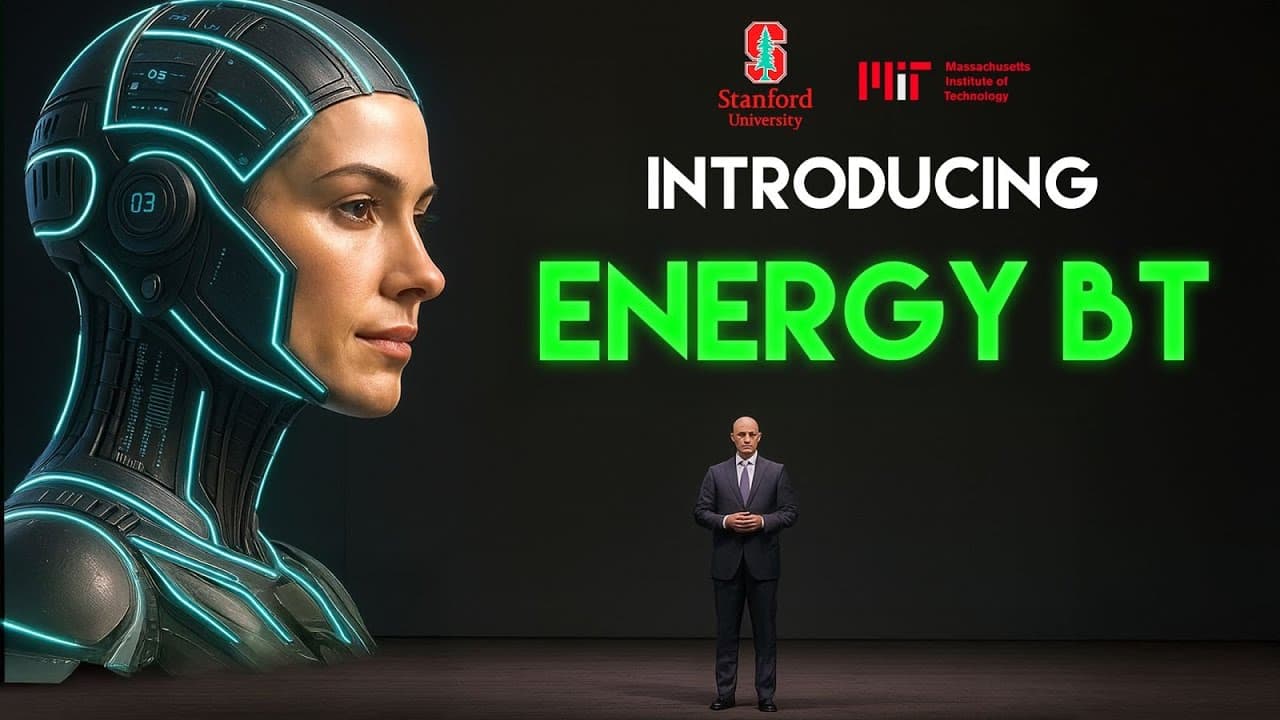
Energy Based Transformers let AI reason step by step by scoring possible answers with energy values and iteratively improving them. They adapt effort to task difficulty, scale with data types like language and vision, and can check their own work, stop when energy stops improving, or generate multiple options for selection.
Transcript
All right, so here's what's going on. AI is starting to think in new ways. We've got a brand new kind of model that can actually reason through problems step by step, like a human working through a puzzle. Then there's this wild system from Google that trains on completely broken smartwatch data. Yep, missing chunks and all. And still figures out s... Read More
Key Insights
- Energy Based Transformers introduce energy values to evaluate candidate answers, guiding iterative refinement.
- EBTs enable flexibility by increasing compute for hard tasks and speeding up for easy ones.
- Query by energy allows stopping early when improvement stalls, improving efficiency.
- EBTs provide a built in way to check work and select among multiple candidate answers.
- Training EBTS involves second order gradients and shaping the energy landscape to avoid poor solutions.
- EBTs scale more efficiently than standard transformers in language and vision tasks by up to a notable margin.
- They perform well across data types including images, video and denoising, sometimes with fewer processing steps than diffusion models.
- The method supports better uncertainty assessment, enabling models to know when they are unsure and adjust behavior accordingly.
Install to Summarize YouTube Videos and Get Transcripts
Explore YouTube Video Summarizer or Get YouTube Transcript Extractor
Questions & Answers
Q: What are energy based transformers and how do they differ from traditional transformers?
Energy based transformers are a new class of models that use energy values to score and compare possible answers rather than producing a single output in one pass. They start with a rough answer, evaluate it with an energy metric, and then iteratively refine the answer to reach the lowest energy. This approach adds flexibility, allows more compute for hard tasks, and enables internal checks of answer quality, which standard transformers lack.
Q: How do energy based transformers achieve deeper reasoning compared to fast responses like GPT models?
EBTs slow down when needed by allocating more compute to harder problems, using energy scores to guide each refinement step. This stepwise approach mirrors human reasoning, where options are tested and re-evaluated before finalizing an answer. The model can stop early if energy stops improving or generate multiple candidates and choose the best one, enabling deeper, more reliable reasoning than one shot predictions.
Q: What is the role of energy in guiding the model
0s decisions in EBTs?
Energy acts as a scoring mechanism for possible answers at each step. Lower energy means a better fit to the problem, so the model iteratively updates its guesses to minimize energy. This framework provides a continuous measure of quality during generation, allowing the model to track improvement, compare alternatives, and decide when an answer has converged to an acceptable solution.
Q: What kinds of data and tasks have EBTs shown improvement in?
EBTs have demonstrated improved scaling efficiency across language and vision tasks, and even in video processing. They show robustness to noise and incomplete data, performing well on image denoising and other multimodal tasks. The ability to adjust computation by task difficulty helps EBTs maintain performance across diverse data types, including wearable sensor data and real world noisy inputs.
Q: How do EBTs compare to standard transformers in terms of training complexity?
Training EBTS involves advanced optimization techniques such as second order gradients and shaping the energy landscape to avoid getting stuck in poor solutions. While more complex, these methods enable the model to reliably navigate many potential solutions, improving final performance and allowing the system to scale more efficiently than fixed-burst standard transformers.
Q: Can EBTs check their own work during inference and training?
Yes, one of the key advantages of EBTs is that each hypothesis carries an energy score, so the model can evaluate how good each guess is at every step. It can stop when energy stops improving and can even generate multiple answers and pick the best one based on energy. This internal self-check capability is not present in traditional transformers.
Q: What is the potential impact of EBTs on real world AI systems?
EBTs promise smarter, more adaptable AI that can reason through difficult problems, decide when to keep going or stop, and operate efficiently across diverse domains such as language, vision, and time series data. Their energy guided reasoning enables better reliability, explanation, and flexibility, which are crucial for deploying AI in real world, noisy environments.
Q: What is PI Vision and how does it relate to AI reasoning research?
PI Vision is a research project that lets AI models write Python code during tasks to solve visual reasoning challenges. The model analyzes problems, generates code to solve them, runs the code, and iterates if results are unsatisfactory. This dynamic tool crafting enables flexible, on the fly problem solving and demonstrates how robotics and AI can break away from fixed toolkits to tackle complex visual tasks.
Summary & Key Takeaways
-
Energy Based Transformers use energy scores to guide answer refinement and enable flexible, stepwise reasoning across tasks.
-
They differ from standard transformers by adjusting compute for hard problems and by having a built in mechanism to assess answer quality at each step.
-
Across language and vision, EBTs show improved scaling efficiency and robustness in incomplete or noisy data.
Read in Other Languages (beta)
Share This Summary 📚
Summarize YouTube Videos and Get Video Transcripts with 1-Click
Try YouTube Summary with ChatGPT & Claude or YouTube Transcript Generator
Explore More Summaries from AI Revolution 📚




Summarize YouTube Videos and Get Video Transcripts with 1-Click
Try YouTube Summary with ChatGPT & Claude or YouTube Transcript Generator