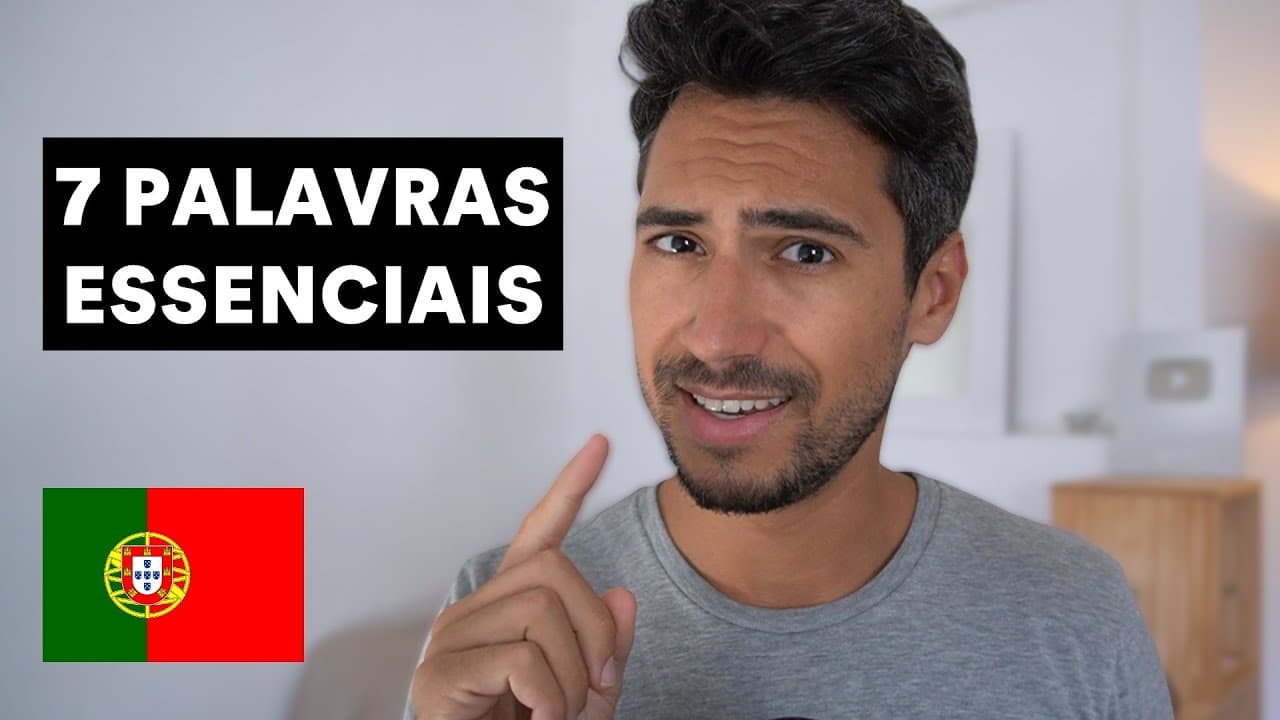
Se queres FALAR como um Português, diz isto...
TL;DR
Learn common Portuguese expressions to sound more native.
Transcript
Leo! Yes? Do you want to go to the beach? It's "ganda" sunny day! "Epá", I'd love to, but I can't, I have to work! You work all day, come "mas é" to the beach, "vá lá"! "Oxalá" I could go, but "não dá"! Yeah, these Portuguese With Leo videos won't be done by themselves, "não é"? Hello and welcome back to Portuguese With Leo and another quick Portu... Read More
Key Insights
- The video introduces Portuguese expressions like 'ganda', 'epá', 'mas é', 'vá lá', 'oxalá', 'não dá', and 'não é', which are commonly used in everyday conversations in Portugal.
- 'Ganda' is a colloquial form of 'grande', used to describe something very good or excellent, especially among younger people.
- 'Epá' or 'pá' serves as an attention-getter or an interjection, similar to 'hey' or 'um' in English.
- 'Mas é' is used in the imperative to suggest doing something instead, often the opposite of what someone is currently doing.
- 'Vá lá' is used in requests, equivalent to 'pretty please', often accompanied by a pleading gesture.
- 'Oxalá' expresses hope or wish, similar to 'hopefully', and originates from the Arabic 'inshallah'.
- 'Não dá' uses the verb 'dar' to indicate possibility; when 'it gives', something is possible, and when 'it doesn't give', it is not.
- 'Não é?' is a tag question used for confirmation, similar to 'right?' in English, and can be colloquially shortened to 'né'.
Install to Summarize YouTube Videos and Get Transcripts
Explore YouTube Video Summarizer or Get YouTube Transcript Extractor
Questions & Answers
Q: What does 'ganda' mean in Portuguese?
'Ganda' is a colloquial form of the adjective 'grande', used among younger Portuguese speakers to describe something very good, excellent, or fantastic. It is often used without the definite article and is positioned before the noun, such as in 'ganda pastel de nata', which means a great custard tart.
Q: How is 'epá' used in Portuguese conversation?
'Epá' is used as an interjection when thinking about what to say or as a way to get someone's attention. In the latter case, 'pá' is more commonly used. For instance, 'Epá, não sei!' means 'Um, I don't know!' and 'Pá, estás bem?' means 'Hey, are you alright?'.
Q: What is the function of 'mas é' in a sentence?
'Mas é' is used in the imperative to reinforce a suggestion or order, often suggesting doing something instead of what is currently being done. It is similar to saying 'Do this instead!' in English. For example, 'Larga os doces e come uma salada mas é!' means 'Drop the sweets and eat a salad instead!'
Q: In what context is 'vá lá' used?
'Vá lá' is used in the imperative for making requests, equivalent to saying 'pretty please'. It is often accompanied by a pleading gesture, like hands in a prayer position. It can also be shortened to 'lá' with the verb of the request, like 'Diz lá!' meaning 'Say it, come on!'
Q: What does 'oxalá' express in Portuguese?
'Oxalá' is used to express hope or a wish, similar to 'hopefully' in English. It originates from the Arabic 'inshallah'. It can be used alone for agreement, like 'Oxalá!' meaning 'Hopefully!', or at the beginning of a sentence followed by the subjunctive, like 'Oxalá que Benfica ganhe!' meaning 'Hopefully Benfica will win!'
Q: How is 'não dá' used to express possibility?
'Não dá' uses the verb 'dar' to indicate whether something is possible or not. If 'it gives', something is possible, and if 'it doesn't give', it is not. For example, 'Hoje não dá para ir à praia' means 'Today it is not possible to go to the beach'. It requires the preposition 'para' when followed by a verb.
Q: What is the equivalent of 'não é?' in English?
'Não é?' is a tag question used at the end of a statement to seek confirmation, similar to 'right?' in English. It is used when the speaker expects agreement or affirmation from the listener. Some speakers colloquially shorten it to 'né?', though this is considered less formal.
Q: What additional resources does the video offer?
The video offers a downloadable PDF to help consolidate the expressions learned, which includes detailed explanations, everyday phrases, and exercises. Additionally, there is an invitation to join the Portuguese With Leo community on platforms like Patreon for exclusive content, practice opportunities, and access to a podcast and monthly video calls.
Summary & Key Takeaways
-
The video teaches viewers how to use common Portuguese expressions to sound more like a native speaker. It covers expressions such as 'ganda', 'epá', 'mas é', 'vá lá', 'oxalá', 'não dá', and 'não é', explaining their meanings and usage in everyday conversation.
-
Expressions like 'ganda' and 'epá' are explained in detail, with 'ganda' being a youthful slang for 'grande' and 'epá' serving as an interjection. The video also provides a downloadable PDF for further learning and consolidation.
-
The lesson includes cultural references and practical examples to help learners integrate these expressions into their speech. It also invites viewers to join the Portuguese With Leo community for exclusive content and practice opportunities.
Read in Other Languages (beta)
Share This Summary 📚
Summarize YouTube Videos and Get Video Transcripts with 1-Click
Try YouTube Summary with ChatGPT & Claude or YouTube Transcript Generator
Explore More Summaries from Portuguese With Leo 📚



Summarize YouTube Videos and Get Video Transcripts with 1-Click
Try YouTube Summary with ChatGPT & Claude or YouTube Transcript Generator