How to Build an Evening Routine for Better Sleep
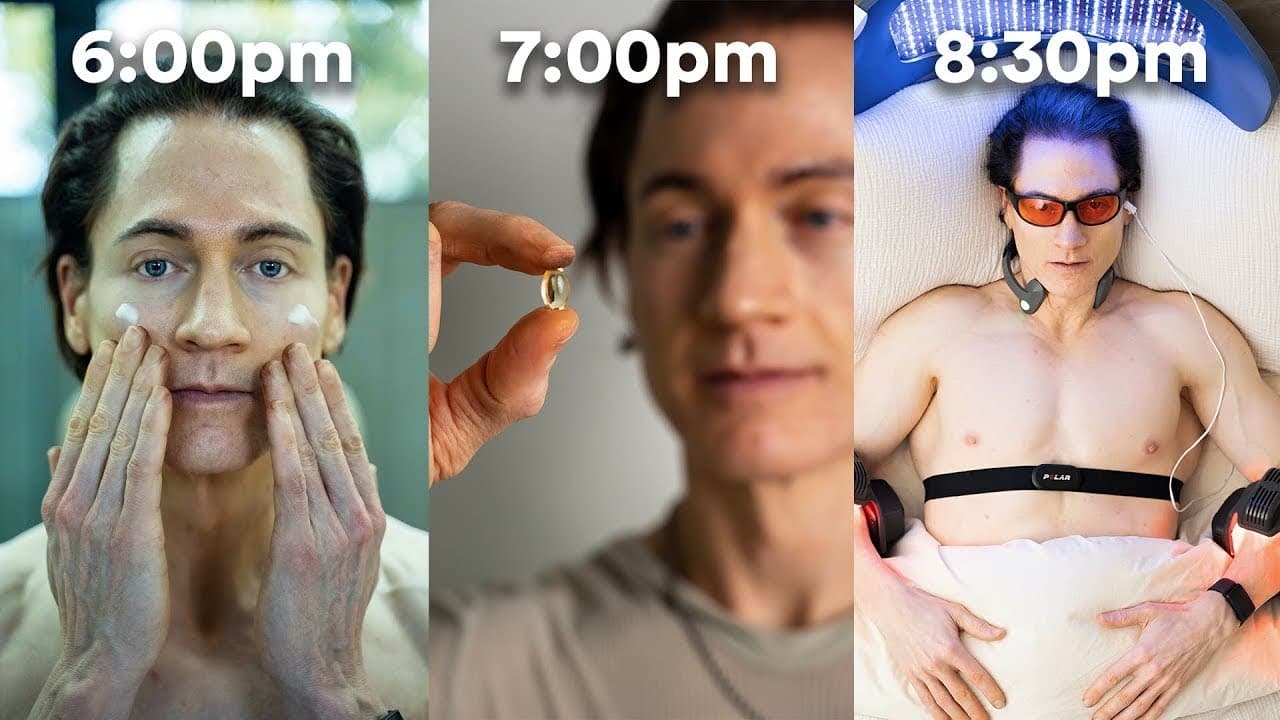
TL;DR
Finish eating roughly eight hours before bedtime, prepare for bed early, and follow a consistent wind-down routine that reduces stress and removes last-minute tasks. Bryan Johnson attributes his month of perfect WHOOP sleep scores to making sleep his top priority, tracking biomarkers, maintaining an orderly environment, and retaining only the interventions that repeatedly improve his results.
Transcript
foreign I'm just getting home I agreed to be filmed today and I just had a laser treatment on my face it looks like my face has a really bad sunburn so just so you know if my face looks all messed up that's why my body has a whole bunch of stuff too looks like skill I got fish scaled today it's all from my back too but what they did today actually ... Read More
Key Insights
- Early meal timing is a central part of Johnson’s sleep preparation. He finishes eating between 11 a.m. and noon, giving his body about eight hours to digest before sleep, and reports that this pattern helps keep his resting heart rate between 45 and 50.
- Sleep is Johnson’s highest personal priority because he finds that good sleep makes life feel manageable and enjoyable. He says even one mediocre night can substantially alter his emotions, interpretation of difficult problems, and the solutions that come to mind the following day.
- An orderly environment is part of the wind-down process. Johnson keeps outdoor and indoor shoes separate, cleans dishes promptly, labels the dishwasher, and maintains an uncluttered workspace because he finds that physical order supports a calmer, less bothered mental state.
- HRV is used as a marker of nervous-system condition and the balance between stress and relaxation. Johnson reports raising his HRV from the low 30s to the low 60s after changing his lifestyle and prioritizing recovery instead of repeatedly working himself into exhaustion.
- Vagus nerve stimulation is one experimental component of the routine. Johnson uses an ear-attached electrical device for 30 minutes in the morning and evening, while another device worn around the neck is used for 10 minutes before bed.
- The Blueprint process is based on repeated testing and retention of interventions that appear effective. Johnson says the team trials five to ten new things in a typical week, considers the available evidence, watches for stable benefits, and adds successful practices to the existing routine.
- Theta-wave audio produced a strong initial response during Johnson’s trial. He reports becoming suddenly tired when first hearing it at 5:30 p.m., followed by improved sleep quality and HRV for 10 days, while emphasizing that further observation was needed to determine whether the effect would persist.
- Completing hygiene before the final relaxation period removes friction at bedtime. Johnson washes his face, brushes his teeth, and gets fully ready before spending an hour reading, talking, or relaxing with his son, allowing both of them to go directly upstairs when tired.
Install to Summarize YouTube Videos and Get Transcripts
Explore YouTube Video Summarizer or Get YouTube Transcript Extractor
Questions & Answers
Q: How does Bryan Johnson prepare for better sleep?
Bryan Johnson prepares by finishing food between 11 a.m. and noon, cleaning and organizing his environment, taking his scheduled pills, and completing face washing and tooth brushing before his final relaxation period. He also uses several experimental therapies. The evening ends with an hour of reading, talking, or relaxing with his son so they can go directly to bed when tired.
Q: Why does Bryan Johnson stop eating around noon?
Johnson stops eating between 11 a.m. and noon to provide about eight hours for digestion before he sleeps. He reports that following this schedule is associated with a resting heart rate between 45 and 50 and makes a good night of sleep highly likely for him. The practice is presented as one of the routine’s foundational habits rather than a last-minute sleep intervention.
Q: What role does HRV play in Bryan Johnson’s routine?
HRV serves as Johnson’s indicator of how stressed or relaxed his nervous system appears to be. He describes lower HRV as connected with his former pattern of overwork and reports moving from the low 30s to the low 60s after changing his priorities. He monitors the measurement while testing therapies intended to promote a calmer internal state and better sleep.
Q: How does Bryan Johnson use vagus nerve stimulation?
Johnson uses an electrical stimulation device attached to part of his ear for 30 minutes in the morning and another 30 minutes in the evening. He says the current feels like a light electrical sensation. He also trials a neck-worn device for 10 minutes before bed, using these approaches as part of his effort to influence relaxation and HRV.
Q: Why does an organized home matter for sleep preparation?
An organized home helps Johnson maintain what he describes as a clean mind. Clutter bothers him, so he puts dishes away, keeps workspaces clear, labels the dishwasher, and separates indoor shoes from outdoor shoes. These actions require relatively little effort and help create an orderly evening environment before he begins personal care, relaxation, and sleep.
Q: How does the Blueprint team test new sleep interventions?
The Blueprint team may trial five to ten new things in a given week. Johnson says the process starts by identifying an intervention, assessing whether its supporting evidence is strong or emerging, and observing its effects. Practices that appear to work are retained and stacked with earlier successes, while newer experiments are monitored to determine whether their benefits remain stable over time.
Q: What effect did theta-wave audio have on Bryan Johnson?
Johnson reports that theta-wave audio made him intensely tired when he first played it around 5:30 p.m. He felt compelled to stop a conversation with his mother and lie down. According to his account, the experiment improved his sleep quality and HRV for 10 days, although he said the team still needed to determine whether the apparent benefit would continue or disappear.
Q: Why does Bryan Johnson complete his hygiene routine early?
Johnson washes his face, brushes his teeth, and becomes fully ready for bed before spending the final hour of the evening with his son. They use that hour to read, talk, or simply spend time together. Completing all necessary tasks beforehand means that once bedtime arrives and they feel tired, they can walk upstairs and get into bed without another burst of activity.
Summary & Key Takeaways
-
Bryan Johnson organizes his evening around sleep preparation because sleep quality strongly affects his mood, judgment, and ability to solve problems. His foundational habits include finishing food by noon, maintaining an orderly home, completing hygiene early, and reserving a relaxed hour with his son before they go directly to bed.
-
The routine includes prescribed thyroid medication, aspirin three times weekly, melatonin before bed, and several experimental devices. Johnson uses electrical stimulation intended to affect the vagus nerve, monitors HRV, treats dry eyes with a nasal stimulation device, practices hearing rehabilitation, and tracks lung function following reported damage after COVID.
-
Johnson treats Blueprint as an ongoing trial process rather than a fixed collection of interventions. His team may test five to ten new ideas in a week, examine the supporting evidence, observe measurable effects, keep practices that work, and stack successful elements into a routine designed to produce stable, repeatable sleep.
-
Key Insights
Read in Other Languages (beta)
Share This Summary 📚
Summarize YouTube Videos and Get Video Transcripts with 1-Click
Try YouTube Summary with ChatGPT & Claude or YouTube Transcript Generator
Explore More Summaries from Bryan Johnson 📚

Summarize YouTube Videos and Get Video Transcripts with 1-Click
Try YouTube Summary with ChatGPT & Claude or YouTube Transcript Generator