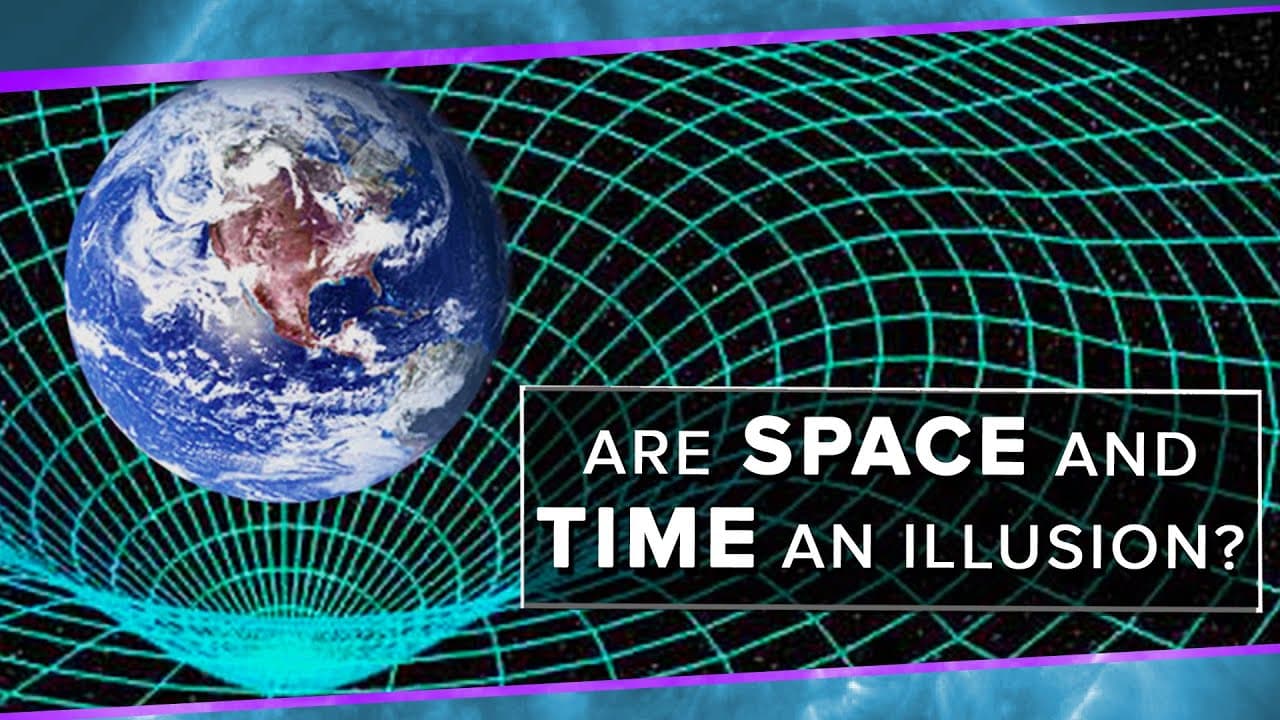
Are Space and Time An Illusion?
TL;DR
Spacetime challenges our understanding of reality and causality.
Transcript
[INTRO MUSIC] Today's episode is about space, time, and the nature of reality. My name is Gabe, and this time, it really is "Space Time." [THEME MUSIC] If you pay attention, this episode is going to blow your mind, so we're going to take it slow. What is spacetime, exactly? Before I can answer that, I need you to do something for me. Give up your... Read More
Key Insights
- Spacetime is a concept that combines space and time into a single interwoven continuum, challenging traditional notions of separate spatial and temporal dimensions.
- Observers in relative motion perceive different measurements of time and space, yet agree on the spacetime interval, a concept crucial for understanding causality.
- The spacetime interval can be positive, zero, or negative, determining whether events can influence each other, highlighting the fundamental role of causality in reality.
- Minkowski's idea that reality is a four-dimensional non-Euclidean space, rather than a three-dimensional space evolving in time, reshapes our understanding of existence.
- In spacetime, events are fixed and predetermined, with no motion through time, suggesting a tense-less reality where past, present, and future coexist.
- Our perception of reality as spatial and temporal is an imposition by our brains, lacking objective existence, unlike the geometric relations in spacetime.
- The nature of spacetime raises philosophical questions about free will and the subjective experience of the universe, challenging our conventional beliefs.
- The episode introduces flat spacetime, with future discussions on general relativity revealing diverse spacetime geometries, deepening the complexity of the concept.
Install to Summarize YouTube Videos and Get Transcripts
Explore YouTube Video Summarizer or Get YouTube Transcript Extractor
Questions & Answers
Q: Why do observers perceive time and space differently?
Observers in relative motion perceive time and space differently due to the effects of relativity. According to Einstein's theory, time and space are not absolute; they vary depending on the observer's state of motion. This leads to discrepancies in measurements of time intervals and spatial distances, yet observers agree on the spacetime interval, a consistent measure that underscores the importance of causality in understanding reality.
Q: What is the significance of the spacetime interval?
The spacetime interval is significant because it remains consistent across different observers, regardless of their relative motion. It determines whether events can influence each other, highlighting the fundamental role of causality in reality. The spacetime interval can be positive, zero, or negative, indicating whether signals or influences can travel between events, thus shaping our understanding of temporal and spatial relationships.
Q: How does Minkowski's idea of spacetime differ from traditional views?
Minkowski's idea of spacetime differs from traditional views by proposing that reality is a four-dimensional non-Euclidean space, rather than a three-dimensional space evolving in time. In this framework, events are fixed and predetermined, existing as points in a geometric space. This challenges the conventional notion of time as a flowing entity and suggests that our perception of time and space is an arbitrary construct imposed by our brains.
Q: What philosophical questions does spacetime raise?
Spacetime raises philosophical questions about the nature of free will, the subjective experience of the universe, and the reality of past, present, and future. If events are fixed in a four-dimensional space, it challenges the belief that we can change the future. It also questions the objective existence of time and space as we perceive them, suggesting that our experience of reality may be more subjective than previously thought.
Q: How does spacetime relate to causality?
Spacetime is intricately linked to causality, as the spacetime interval determines whether events can influence each other. Even though observers disagree on measurements of time and space, they agree on the spacetime interval, which signifies causal relationships. This suggests that causality is a fundamental aspect of reality, with temporal and spatial perceptions arising from these underlying causal structures.
Q: What does the episode suggest about our perception of reality?
The episode suggests that our perception of reality as spatial and temporal is an arbitrary imposition by our brains, lacking objective existence. Unlike the geometric relations in spacetime, which are objectively real, our experiences of time and space are akin to the XY grid in math class—useful but inherently meaningless. This challenges the traditional understanding of reality and highlights the subjective nature of our perceptions.
Q: What future topics are hinted at in the episode?
The episode hints at future discussions on general relativity, which will reveal diverse spacetime geometries beyond the flat spacetime introduced in this episode. These discussions promise to deepen the complexity of the spacetime concept, exploring how different geometries affect our understanding of reality and potentially leading to new insights into the nature of the universe.
Q: Why is spacetime considered a mind-blowing concept?
Spacetime is considered a mind-blowing concept because it fundamentally challenges our intuitive understanding of time and space. By merging these dimensions into a single continuum and emphasizing the role of causality, spacetime reshapes our perception of reality, suggesting that events are fixed in a four-dimensional space. This challenges conventional beliefs about free will, the flow of time, and the objective existence of spatial and temporal dimensions.
Summary & Key Takeaways
-
Spacetime is a revolutionary concept that merges space and time into a single framework, challenging our conventional understanding of these dimensions. Observers in relative motion perceive time and space differently, yet agree on the spacetime interval, emphasizing the importance of causality in reality.
-
Minkowski proposed that reality is a four-dimensional non-Euclidean space, not a three-dimensional one evolving in time. In this view, events are fixed, and our perception of reality as spatial and temporal is an arbitrary imposition by our brains, lacking objective existence.
-
The nature of spacetime raises philosophical questions about free will and the subjective experience of the universe. The episode introduces the concept of flat spacetime, with future discussions on general relativity promising to reveal diverse spacetime geometries and deepen our understanding.
Read in Other Languages (beta)
Share This Summary 📚
Summarize YouTube Videos and Get Video Transcripts with 1-Click
Try YouTube Summary with ChatGPT & Claude or YouTube Transcript Generator
Explore More Summaries from PBS Space Time 📚
Summarize YouTube Videos and Get Video Transcripts with 1-Click
Try YouTube Summary with ChatGPT & Claude or YouTube Transcript Generator