What Is Prompt Engineering and How to Write Better Prompts?
TL;DR
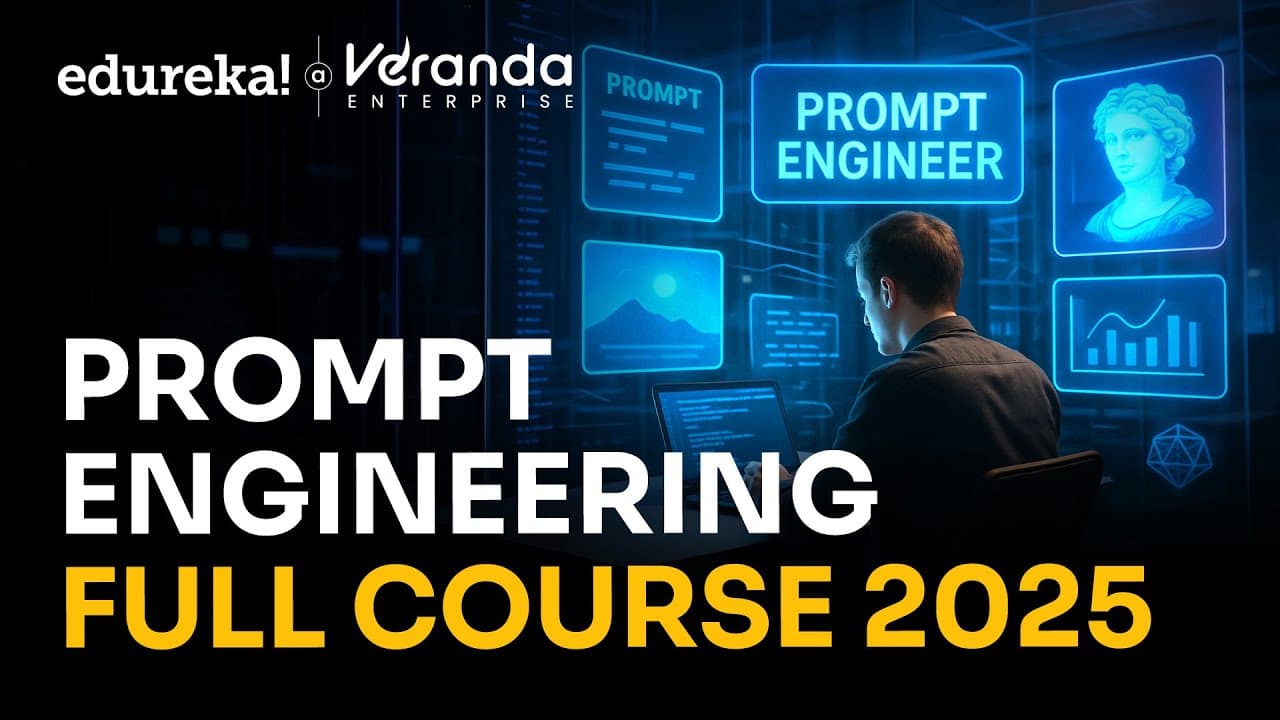
Prompt engineering is crafting clear, precise instructions that guide large language models like GPT-3 to produce the responses you want. Effective prompts follow six rules: be clear, give context, show examples, keep it short, avoid biases, and set limits. Applying these turns a vague request like 'write about cars' into a targeted, useful output.
Transcript
hello everyone and welcome to the prompt engineering full course this course starts with the fundamentals that is what prompt engineering is how large language models work and how to craft effective prompts you will learn to design refine and optimize prompts for a wide range of use cases from text generation and chatbots to code completion and con... Read More
Key Insights
- Prompt engineering combines artificial intelligence and human language understanding, with professionals creating prompts or instructions that effectively guide AI systems to produce the expected outcome across a variety of applications.
- Prompt engineering is a method in natural language processing and machine learning focused on crafting clear, precise instructions so models like GPT-3 or BERT can generate humanlike responses based on the prompts they receive.
- Effective prompt engineering requires understanding both the model's capabilities and the problem domain, allowing developers to improve the performance and usability of LLMs for text generation, question answering, and language translation.
- Prompt engineering matters for AI because it improves model performance, customization, and reliability, helping models produce accurate and relevant results, reduce biases, improve user experience, and address ethical concerns.
- Being clear is the first rule of effective prompts: 'write about cars' is unclear, while 'write a description of a red convertible sports car' gives the AI a specific, unambiguous instruction to follow.
- Giving context improves responses: instead of 'write a story,' a prompt like 'write a story about a girl who discovers a magic book in her attic' provides enough information for the AI to produce a relevant result.
- Showing examples and setting limits guide output: adding details like palm trees and crashing waves clarifies intent, while constraints such as a maximum word count of 500 words keep the response within specific needs.
- Text generation prompts provide context and direction that influence the generated text's tone, style, and context, and can take the form of story prompts, questions, or incomplete sentences.
Install to Summarize YouTube Videos and Get Transcripts
Explore YouTube Video Summarizer or Get YouTube Transcript Extractor
Questions & Answers
Q: What is prompt engineering?
Prompt engineering is a method used in natural language processing and machine learning that combines artificial intelligence and human language understanding. It is all about crafting clear and precise instructions to interact with large language models like GPT-3 or BERT so these models can generate humanlike responses based on the prompts they receive. Professionals work to create prompts that effectively guide AI systems to produce the expected outcome across a variety of applications.
Q: Why does prompt engineering matter for AI?
Prompt engineering matters because it improves model performance, customization, and reliability. By creating clear and tailored prompts, developers can help AI models produce more accurate and relevant results, reduce biases, improve user experience, and address ethical concerns. In simple terms, prompt engineering ensures that AI systems produce useful and reliable results that meet the needs of users while adhering to ethical principles across different applications.
Q: How do you write an effective prompt?
According to the course, effective prompts follow six simple rules: make it clear by explaining exactly what you want, give enough context so the AI understands the task, show examples of the type of response you want, keep it short so the AI stays focused, avoid biases and unfair assumptions, and set limits or restrictions the AI needs to follow. Together these rules guide the model toward accurate, relevant responses.
Q: What is an example of a clear versus unclear prompt?
An unclear prompt is something like 'write about cars,' where no type of car or detail is mentioned, which might confuse the AI and lead to wrong answers. A clear prompt is 'write a description of a red convertible sports car,' which clearly explains what you want the AI to do. Clear prompts make sure the AI understands the task and produces the expected outcome rather than a vague or off-target response.
Q: How does prompt engineering improve product descriptions?
Without prompt engineering, a generic prompt like 'generate a product description for a smartphone' lacks specificity and produces bland output. With prompt engineering, a prompt such as 'create a product description for a budget-friendly smartphone perfect for young professionals, highlighting its affordable, sleek design and top-notch camera features' tailors the generated description to the target audience or brand style, producing engaging, informative content that highlights specific features based on the instructions provided.
Q: What types of tasks can text generation prompts handle?
Text generation prompts provide context and direction to the model, allowing it to generate humanlike text and influence the tone, style, and context of the output. They can be story prompts, questions, or incomplete sentences. Examples include writing a short story about a character discovering hidden treasure, answering questions such as describing COVID-19 symptoms and precautions, translating English sentences into Spanish, and performing code autocompletion using tools like OpenAI Codex.
Q: How can prompts be used for language translation?
For language translation, you specify the source and target language in the prompt along with the input sentence. For example, a prompt might say 'translate the given English sentence, the quick brown fox jumps over the lazy dog, into Spanish while maintaining its original meaning.' By specifying both languages and the sentence, the model is instructed to perform a precise translation task, ensuring accurate language conversion while preserving the original meaning of the text.
Q: What does this prompt engineering full course cover?
The course starts with fundamentals such as what prompt engineering is, how large language models work, and how to craft effective prompts. Learners design, refine, and optimize prompts for use cases from text generation and chatbots to code completion and content creation. As it progresses, it explores tools like LangChain, RAG, and LLMOps, with hands-on real-world applications including prompt engineering for code, building AI chatbots, and using tools like GitHub Copilot.
Summary & Key Takeaways
-
Prompt engineering is a field combining AI and human language understanding where professionals craft prompts that guide AI systems to produce expected outcomes. A travel-planning virtual assistant example shows how an enhanced, detailed prompt generates a more engaging and helpful response than a generic query like 'what should I do in Paris.'
-
Prompt engineering is defined as an NLP and machine learning method for crafting clear, concise instructions that guide models like GPT-3 or BERT to produce desired responses. It matters because it improves model performance, customization, and reliability while reducing biases and addressing ethical concerns for users.
-
Six rules generate effective prompts: make it clear, give context, show examples, keep it short, avoid biases, and set limits. Prompts can be used for text generation, question answering such as COVID-19 symptoms, language translation into Spanish, and code autocompletion using tools like OpenAI Codex.
-
(Content reviewed on 2026-08-27.)
Read in Other Languages (beta)
Share This Summary 📚
Summarize YouTube Videos and Get Video Transcripts with 1-Click
Try YouTube Summary with ChatGPT & Claude or YouTube Transcript Generator
Explore More Summaries from edureka! 📚

Summarize YouTube Videos and Get Video Transcripts with 1-Click
Try YouTube Summary with ChatGPT & Claude or YouTube Transcript Generator