What Is the Lever Principle and How Does It Work?
TL;DR
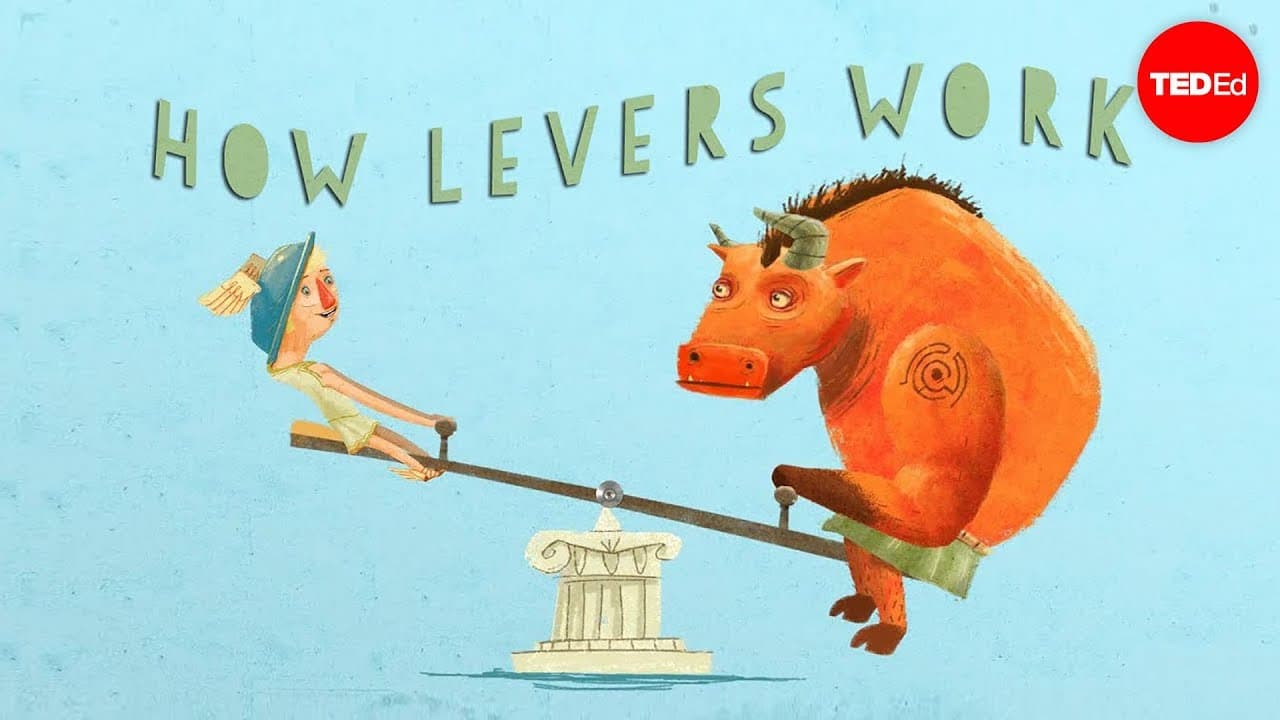
The lever principle allows you to lift heavy objects by redistributing weight and using less force. It consists of three main parts: the effort arm, resistance arm, and fulcrum. By adjusting the distances from the fulcrum, you can lift weights more efficiently, as demonstrated in everyday tools and even in massive constructions like the Pyramids.
Transcript
A famous Ancient Greek once said, "Give me a place to stand, and I shall move the Earth." But this wasn't some wizard claiming to perform impossible feats. It was the mathematician Archimedes describing the fundamental principle behind the lever. The idea of a person moving such a huge mass on their own might sound like magic, but chances are you'v... Read More
Key Insights
- 🦾 Levers are simple machines that reduce the amount of energy required for tasks by distributing weight across arms.
- 😄 Balancing forces and distances on a lever is crucial for lifting heavy objects with ease.
- 😒 Applying the lever principle allows for the efficient and effective use of the basic laws of physics in daily activities.
- 😨 Levers can have significant implications in lifting heavy objects, such as cars or stone blocks, by adjusting the lever's length.
Install to Summarize YouTube Videos and Get Transcripts
Explore YouTube Video Summarizer or Get YouTube Transcript Extractor
Questions & Answers
Q: How does a lever reduce the amount of energy required for a task?
A lever reduces energy needed by distributing weight across the effort and resistance arms, allowing you to lift heavy objects with less force by increasing the distance.
Q: What are the three main components of a lever?
The three main components of a lever are the effort arm (effort force), the resistance arm (resistance force), and the fulcrum, which balance the forces to lift objects.
Q: How does the relationship between force and distance work in a lever?
The relationship states that the product of the effort force and its distance is equal to the product of the resistance force and its distance, in accordance with the basic laws of physics.
Q: What are some examples of everyday items that utilize levers?
Some everyday items that use levers include scissors, wheelbarrows, and even the human body's musculoskeletal system, all applying the principles to make tasks easier.
Summary & Key Takeaways
-
Archimedes' lever principle explains how levers reduce energy needed for tasks.
-
Levers consist of effort arms, resistance arms, and a fulcrum to balance forces.
-
By adjusting distances on a lever, you can lift heavy objects with less force.
Read in Other Languages (beta)
Share This Summary 📚
Summarize YouTube Videos and Get Video Transcripts with 1-Click
Try YouTube Summary with ChatGPT & Claude or YouTube Transcript Generator
Explore More Summaries from TED-Ed 📚





Summarize YouTube Videos and Get Video Transcripts with 1-Click
Try YouTube Summary with ChatGPT & Claude or YouTube Transcript Generator