How to Simplify the Loss Function for Logistic Regression
TL;DR
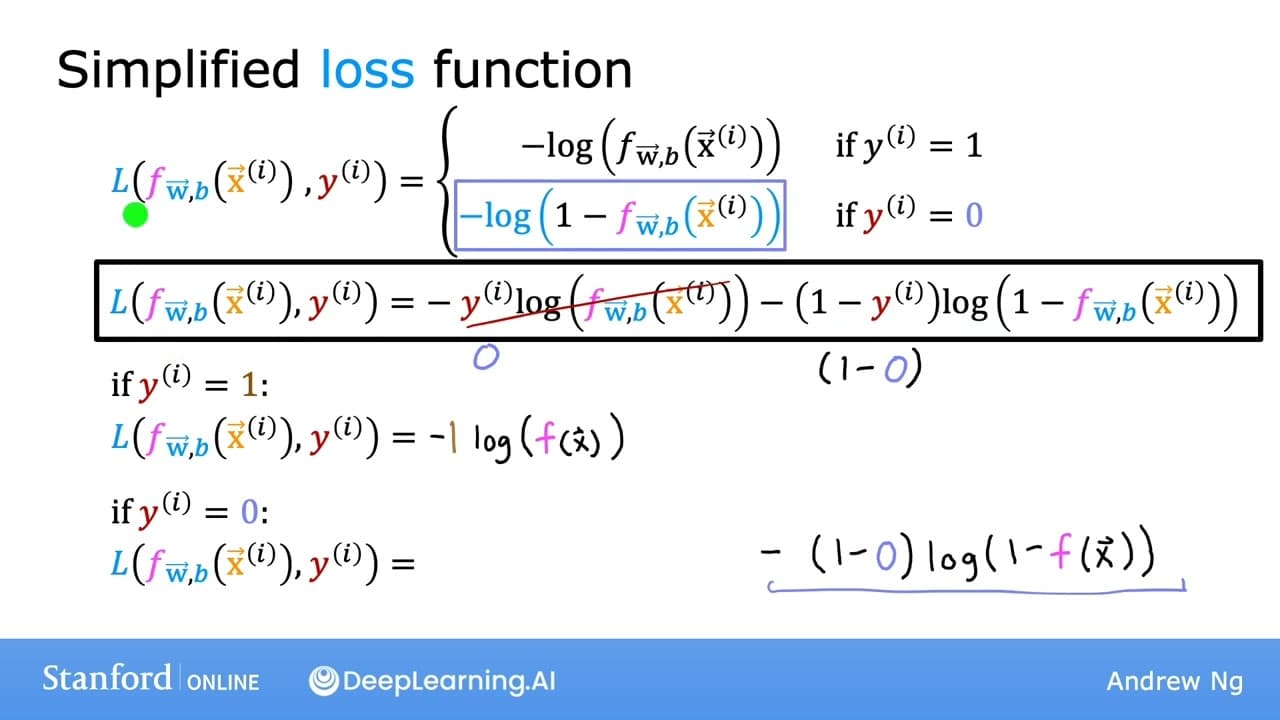
To simplify the loss function for logistic regression, use the equation: loss = -y * log(f) - (1 - y) * log(1 - f), which is equivalent to the more complex formula. This streamlined approach aids in implementing gradient descent efficiently and ensures a clear understanding of cost calculations derived from maximum likelihood estimation.
Transcript
in the last video you saw the loss function and the cost function for logistic regression in this video you see a slightly simpler way to write out the loss and cost functions so that the implementation can be a bit simpler when we get to gradient descent for fitting the parameters of a logistic regression model let's take a look as a reminder here... Read More
Key Insights
- 🌸 Logistic regression loss function can be simplified by considering the binary classification problem and the target label.
- 🌸 The simplified loss function provides a concise way to calculate the loss for logistic regression models.
- 🌸 The cost function for logistic regression is derived from the simplified loss function and is used to train the models.
- ⚾ The chosen cost function is based on statistical principles and has the property of convexity.
- 💄 The simplified cost function makes it easier to implement gradient descent for logistic regression models.
- 🤙 The cost function is derived using a statistical principle called maximum likelihood estimation.
- 🥺 Different choices of parameters in logistic regression lead to different cost calculations.
Install to Summarize YouTube Videos and Get Transcripts
Explore YouTube Video Summarizer or Get YouTube Transcript Extractor
Questions & Answers
Q: How is the simplified loss function for logistic regression derived?
The simplified loss function takes into account the binary classification problem and the target label. It is derived by considering two cases: when the target label (Y) is equal to 1 and when it is equal to 0. By substituting these values into the equation, the simplified loss function is obtained.
Q: Why is the simplified loss function beneficial?
The simplified loss function provides a concise way to calculate the loss for logistic regression. It eliminates the need to separate out the two cases (Y=1 and Y=0) as done in the previous more complex formula. This simplification makes the implementation of logistic regression models using gradient descent easier.
Q: What is the role of the cost function in logistic regression?
The cost function is used to train logistic regression models. It is computed by taking the average loss across the entire training set of M examples. The simplified loss function is plugged into the cost function, which is then minimized using gradient descent to find the optimal parameters for the logistic regression model.
Q: Why is the chosen cost function for logistic regression important?
The chosen cost function is derived from statistics using maximum likelihood estimation. It has the desirable property of being convex, which ensures that the optimization process using gradient descent will converge to a global minimum. The specific rationale and justification behind this cost function are based on statistical principles.
Summary & Key Takeaways
-
The video introduces a simpler way to write the loss function for logistic regression, which is equivalent to the previous more complex formula.
-
The simplified loss function takes into account the binary classification problem and the target label, resulting in a single equation.
-
The cost function is derived from the simplified loss function and is used to train logistic regression models.
Read in Other Languages (beta)
Share This Summary 📚
Summarize YouTube Videos and Get Video Transcripts with 1-Click
Try YouTube Summary with ChatGPT & Claude or YouTube Transcript Generator
Explore More Summaries from DeepLearningAI 📚





Summarize YouTube Videos and Get Video Transcripts with 1-Click
Try YouTube Summary with ChatGPT & Claude or YouTube Transcript Generator