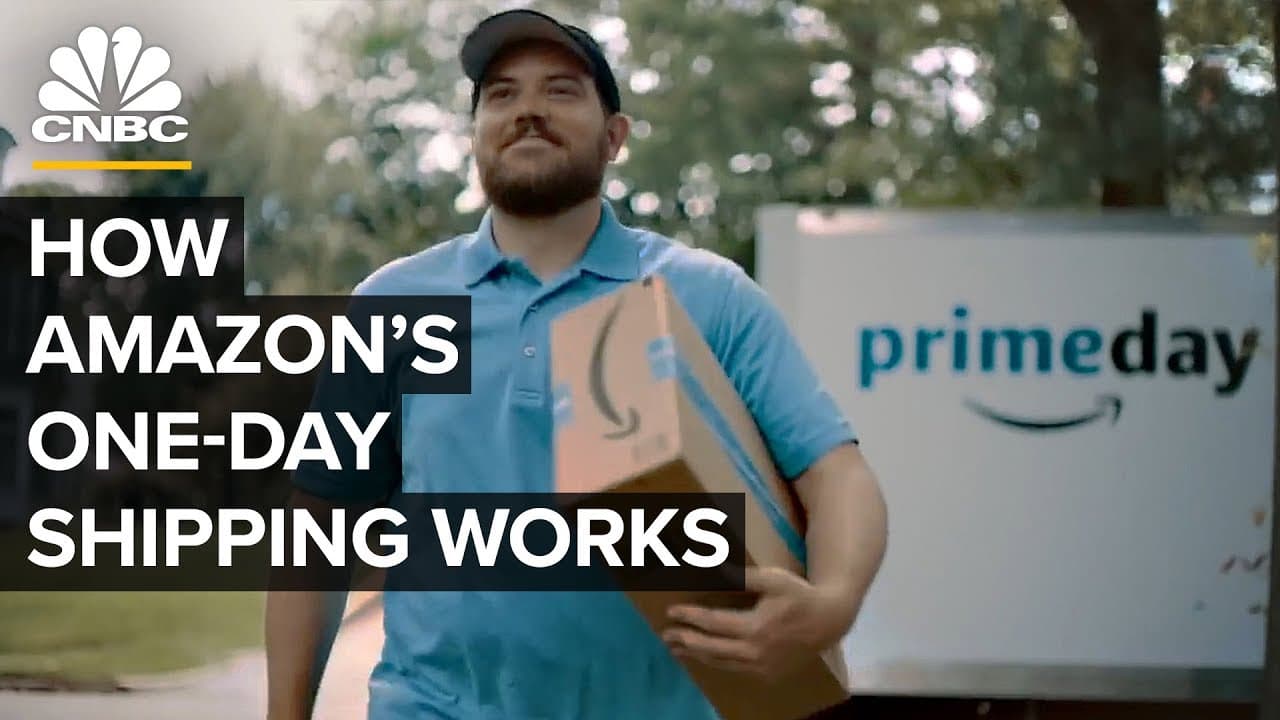
How Does Amazon Deliver Packages in One Day?
TL;DR
Amazon delivers packages in one day by storing products near customers, processing orders with workers and robots, and moving parcels through its own and partner transportation networks. The operation spans 175 fulfillment centers, at least 50 airplanes, 300 semi-trucks, and 20,000 delivery vans. Read on to see how inventory placement, warehouse automation, and logistics investments support Prime one-day shipping.
Transcript
Before Prime launched in 2005 one-day shipping was an exorbitant luxury. Now it's the standard shipping speed for Amazon's 100 million Prime members. Earlier this year Amazon doubled the speed of Prime shipping from two days to one. And the faster speed is now available on more than 10 million products. Prime one-day is basically going to A) keep u... Read More
Key Insights
- One-day Prime delivery is supported by large infrastructure investments, including $800 million set aside in the second quarter of 2019 to accelerate the transition from two-day shipping and make the faster service normal for millions of customers.
- Amazon's logistics strategy is designed to control more of the delivery process because picking, packing, and shipping costs recur with every order. Its network handled 26% of online orders while still relying on carriers such as UPS and USPS.
- Inventory placement begins before a customer orders because Amazon and many third-party sellers store products inside fulfillment centers. Third-party sales grew from 3% of total merchandise sales in 1999 to 58% in 2018, increasing their importance to the marketplace.
- Fulfillment centers combine human labor with automation to reduce unnecessary movement while maintaining quality control. About 250,000 warehouse workers often receive assistance from 100,000 robots that move inventory, lift boxes and pallets, or package products in custom-sized boxes.
- Amazon's middle-mile network moves packages from fulfillment centers toward customers through partner networks and company-controlled transportation. The company had at least 50 airplanes, 300 semi-trucks, 20,000 delivery vans, and ocean freight services between the United States and China.
- Last-mile delivery is the most expensive stage because bulk transportation ends near the destination and every package must reach a separate address. Amazon seeks more in-house capacity after USPS increased last-mile shipping rates by 9% to 12% in January, depending on package size.
- Amazon Flex expands local delivery through independent drivers who select blocks lasting three to six hours. Amazon advertised earnings of $18 to $25 per hour, although drivers remain responsible for expenses such as fuel, tolls, vehicle maintenance, and insurance.
- Emerging delivery technology is intended to streamline the last mile. Amazon announced an electric drone designed to fly up to 15 miles and deliver packages under five pounds within 30 minutes, while also testing a sidewalk delivery robot called Scout.
Install to Summarize YouTube Videos and Get Transcripts
Explore YouTube Video Summarizer or Get YouTube Transcript Extractor
Questions & Answers
Q: How does Amazon deliver packages in one day?
Amazon stores many products in fulfillment centers before customers order them, then workers and robots pick, scan, pack, and route each order. Packages move through Amazon's logistics network or partner networks toward warehouses near customers, followed by delivery to individual addresses.
Q: How many products qualify for Prime one-day shipping?
Prime one-day shipping is available on more than 10 million products. Amazon doubled Prime's standard shipping speed from two days to one for its 100 million Prime members.
Q: Why does Amazon invest so much in one-day shipping?
Amazon uses faster delivery to enhance Prime and keep up with brick-and-mortar retailers. It set aside $800 million in the second quarter of 2019 for infrastructure and transportation costs associated with making one-day shipping the norm.
Q: What happens inside an Amazon fulfillment center after an order is placed?
A worker picks the ordered product and sends it to the packing department. The item is scanned, placed in the specified box, sealed with tape, and dropped onto a line where conveyor systems move it toward shipment.
Q: How do robots help Amazon fulfill orders?
Amazon's 100,000 fulfillment-center robots help move inventory, lift boxes and pallets, and package items in custom-sized boxes. Amazon says this automation makes fulfillment more efficient while workers continue to handle picking, scanning, packing, and quality control.
Q: Where are Amazon products stored before customers order them?
Items sold directly by Amazon and most third-party items fulfilled by Amazon are already stored in Amazon warehouses. Other third-party items ship directly from sellers or are sent to an Amazon warehouse after the customer places an order.
Q: How large is Amazon's fulfillment and transportation network?
Amazon operates 175 fulfillment centers around the globe and employs 250,000 warehouse workers, often assisted by 100,000 robots. Its transportation network includes at least 50 airplanes, 300 semi-trucks, and 20,000 delivery vans, along with ocean freight services between the U.S. and China.
Q: Why is Amazon reducing its reliance on UPS and the U.S. Postal Service?
Picking, packing, and shipping costs recur every time Amazon sends a unit, so the company wants greater control over the process and its cost. It is investing in its own logistics network while still relying on partners when needed, and it handles shipping for 26% of online orders.
Summary & Key Takeaways
-
Definition: Prime one-day shipping moves eligible Amazon orders from stored inventory through fulfillment, transportation, and local delivery within one day.
-
Number: Prime one-day shipping serves 100 million Prime members and is available on more than 10 million products.
-
Number: Amazon's shipping costs rose 23% to a record $9 billion in the last quarter of 2018.
-
Number: Amazon set aside $800 million in the second quarter of 2019 to help make one-day shipping the norm.
-
Step 1: Amazon stores direct-sale inventory and most third-party items fulfilled by Amazon in warehouses before customers order them.
-
Step 2: Workers and robots pick, scan, box, and route orders at 175 fulfillment centers around the globe.
-
Step 3: At least 50 airplanes, 300 semi-trucks, and 20,000 delivery vans move packages through Amazon's logistics network.
-
Who: Amazon's fulfillment operation uses 250,000 warehouse workers, often assisted by 100,000 robots.
-
Compare: Amazon doubled Prime shipping speed from two days to one, while Walmart offered next-day shipping on orders of 35 dollars or more.
-
Tool: Driving robots move inventory, robotic arms lift boxes and pallets, and another robot packages items in custom-sized boxes.
Read in Other Languages (beta)
Share This Summary 📚
Summarize YouTube Videos and Get Video Transcripts with 1-Click
Try YouTube Summary with ChatGPT & Claude or YouTube Transcript Generator
Explore More Summaries from CNBC 📚






Summarize YouTube Videos and Get Video Transcripts with 1-Click
Try YouTube Summary with ChatGPT & Claude or YouTube Transcript Generator