How to Estimate Missing Data in Air Pollution Sensors?
TL;DR
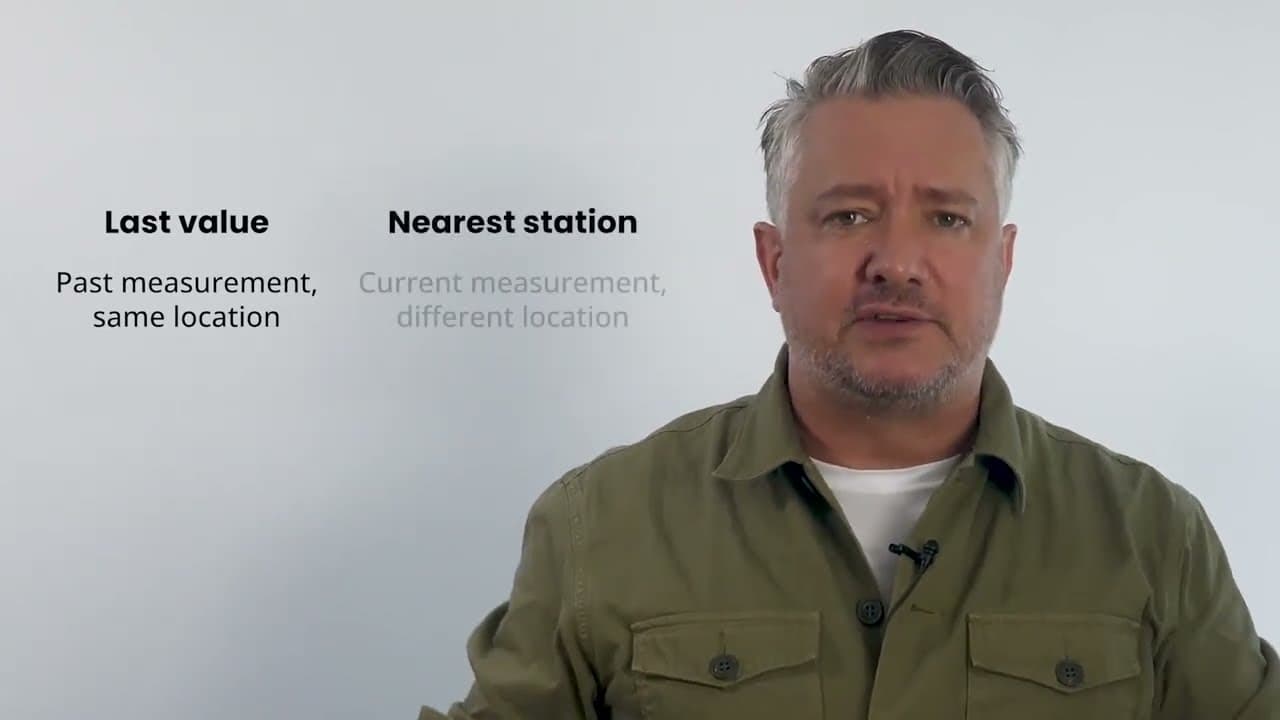
To estimate missing data in air pollution sensor networks, use the most recent actual measurement from the same sensor or adopt the value from the nearest operational sensor. Both methods serve as viable baselines for evaluating more advanced machine learning approaches, considering factors like time and location for accurate predictions.
Transcript
welcome to week three here you will be designing and implementing uh your air quality mapping product in this first lesson you'll be working through the design phase and the steps you'll focus on will be prototyping your data and modeling strategies addressing any data privacy and security issues and designing the end user experience for your proje... Read More
Key Insights
- 👱 Missing data is a significant issue in air pollution sensor networks, affecting the accuracy of analysis and mapping.
- ❓ Simple approaches, such as using the most recent measurement or the nearest sensor's value, can be used to estimate missing values as baselines.
- 🥳 Considering time of day, day of the week, and location can help in predicting missing values accurately.
- ❓ Experimenting with simpler solutions before implementing complex AI models can establish baselines for performance evaluation.
- 👱 Addressing data privacy and security issues is an essential step in the design phase of an air quality mapping product.
- 🎟️ Correlations exist between different pollutant levels, suggesting the possibility of using AI to make accurate estimates of missing values.
- 😥 Real-time estimation of missing values requires different approaches than interpolation based on surrounding data points.
Install to Summarize YouTube Videos and Get Transcripts
Explore YouTube Video Summarizer or Get YouTube Transcript Extractor
Questions & Answers
Q: What are some significant challenges in air pollution sensor networks?
One of the major challenges is dealing with missing data. Sensors may drop out for one hour, resulting in missing values. This creates a need to estimate these missing values for accurate analysis.
Q: What is the simplest approach to estimate a missing value?
The simplest approach is to use the most recent actual measurement for that sensor as the estimate. This provides a straightforward way to fill in missing data without complicated calculations.
Q: Is it necessary to consider the location of nearby sensor stations when estimating missing values?
Yes, an alternative approach is to look for the nearest sensor that has an actual measurement and replace the missing value with that recorded value. This takes into account spatial proximity in estimating missing data.
Q: What are the advantages and disadvantages of using the most recent measurement versus the nearest sensor's value?
Using the most recent measurement at the same location ensures consistency, while using the nearest sensor's value considers spatial similarities. Both approaches have their pros and cons and can provide suitable baselines for comparing machine learning approaches.
Summary & Key Takeaways
-
The video focuses on the design phase of an air quality mapping product, specifically addressing data and model strategies.
-
Missing data is a significant issue in air pollution sensor networks in Bogota, and the video explores two simple approaches to estimate missing values.
-
The approaches include using the most recent actual measurement or finding the nearest sensor with a recorded value to replace the missing data.
Read in Other Languages (beta)
Share This Summary 📚
Summarize YouTube Videos and Get Video Transcripts with 1-Click
Try YouTube Summary with ChatGPT & Claude or YouTube Transcript Generator
Explore More Summaries from DeepLearningAI 📚





Summarize YouTube Videos and Get Video Transcripts with 1-Click
Try YouTube Summary with ChatGPT & Claude or YouTube Transcript Generator