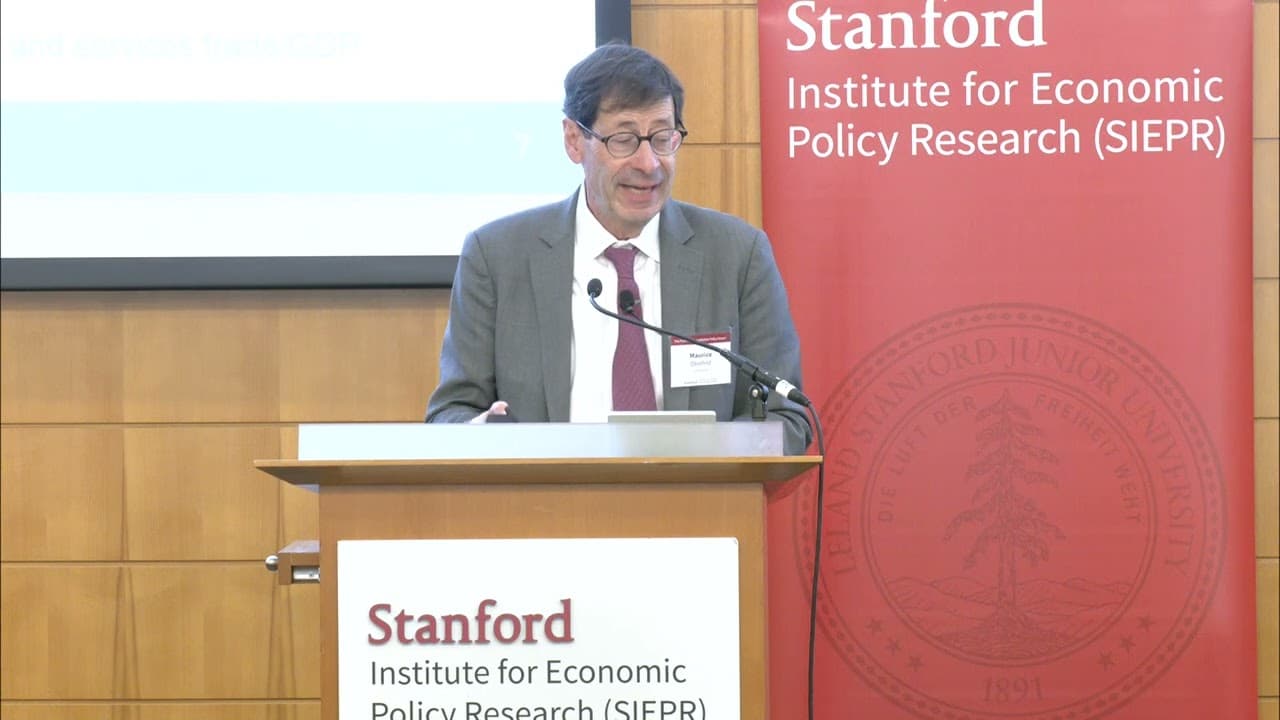
What Is the Future of Globalization? Policy Forum Lunch Keynote with Maurice Obstfeld
TL;DR
The future of globalization depends on preserving and building upon the postwar multilateral system rather than assuming international integration will endure automatically. Maurice Obstfeld traces this system from the July 1944 Bretton Woods agreement through the collapse of fixed exchange rates in 1973 and the subsequent era of hyper-globalization. He connects today’s fragmentation and political backlash with geopolitical, climate, and health challenges. Read on to understand how history can guide renewed global cooperation.
Transcript
I'm delighted to introduce our uh third session today which is going to be our keynote session uh and the speaker is going to be my obfelden uh obfelden bergston senior fellow at the Peterson Institute for international economics and the class of 1958 professor of Economics ameritus at University of California at Berkeley from 2015 through 2018 he ... Read More
Key Insights
- 😥 The collapse of the fixed exchange rate system at Bretton Woods in 1973 marked a turning point in the global economic system.
- 🥺 The growth of trade and finance during the era of hyper globalization brought significant benefits, but also led to distributional effects, cultural animosity, and political backlash.
- 🌐 The world now faces new challenges such as globalization backlash, geopolitical tensions, climate change, and health crises that require increased global cooperation.
Install to Summarize YouTube Videos and Get Transcripts
Explore YouTube Video Summarizer or Get YouTube Transcript Extractor
Questions & Answers
Q: What is the future of globalization according to Maurice Obstfeld?
Globalization is not guaranteed to continue because, as Obstfeld emphasizes, international integration does not remain in place automatically once built. Its future depends on using the legacies of the postwar multilateral system to address fragmentation, geopolitical tensions, climate change, and health crises through greater cooperation.
Q: What was the purpose of the Bretton Woods system?
The Bretton Woods system sought to promote postwar recovery through international trade, relatively open markets, and economic growth. It also aimed to support prosperity and peace after the devastation of World War II while balancing global rules with governments’ ability to conduct stabilization policies.
Q: When was the Bretton Woods agreement established?
The Bretton Woods agreement was reached in July 1944. It created the foundation for a postwar international economic system intended to prevent the kind of fragmentation experienced during the 1930s.
Q: Why is 1973 important in the history of globalization?
The fixed exchange-rate system established at Bretton Woods collapsed in 1973. Obstfeld uses its 50th anniversary as an opportunity to examine what the postwar institutions achieved, why the system failed, and how similar forces relate to current concerns about fragmentation and de-globalization.
Q: How well did the postwar economic system perform?
Obstfeld argues that the system performed fairly well. Merchandise trade relative to world GDP rose substantially from the trough associated with the Great Depression and World War II, reaching levels comparable to the first great age of globalization by about 1980 before rising more rapidly.
Q: How did global economic growth change after 1950?
Global growth was high during the first two decades after 1950, partly because economies were catching up after the war. Growth then declined globally during the 1970s and fell further during the 1980s, with results differing across countries and regions.
Q: What drove the era of hyper-globalization?
Major drivers included China’s entry into the global economy, the collapse of the Soviet bloc, and the expansion of finance. Together, these developments contributed to substantial growth in global trade and financial integration.
Q: What challenges now threaten the global economy?
The challenges include fragmentation, trade-policy uncertainty, trade restrictions, geopolitical tensions, industrial-policy disputes, climate change, health crises, and supply-chain vulnerabilities. Globalization also produced distributional effects and structural changes that contributed to cultural animosity and political backlash.
Summary & Key Takeaways
-
The collapse of the fixed exchange rate system at Bretton Woods in 1973 marked the beginning of the end of the post-war global economic system.
-
The growth of trade and finance during the era of hyper globalization brought benefits to advanced and developing economies, but also led to distributional effects and other stresses.
-
The world now faces new challenges such as globalization backlash, geopolitical tensions, climate change, and health crises that require increased global cooperation.
Read in Other Languages (beta)
Share This Summary 📚
Summarize YouTube Videos and Get Video Transcripts with 1-Click
Try YouTube Summary with ChatGPT & Claude or YouTube Transcript Generator
Explore More Summaries from Stanford Institute for Economic Policy Research (SIEPR) 📚






Summarize YouTube Videos and Get Video Transcripts with 1-Click
Try YouTube Summary with ChatGPT & Claude or YouTube Transcript Generator