Is Ernest Rutherford’s Surprise Signature Genuine? - Periodic Table of Videos
TL;DR
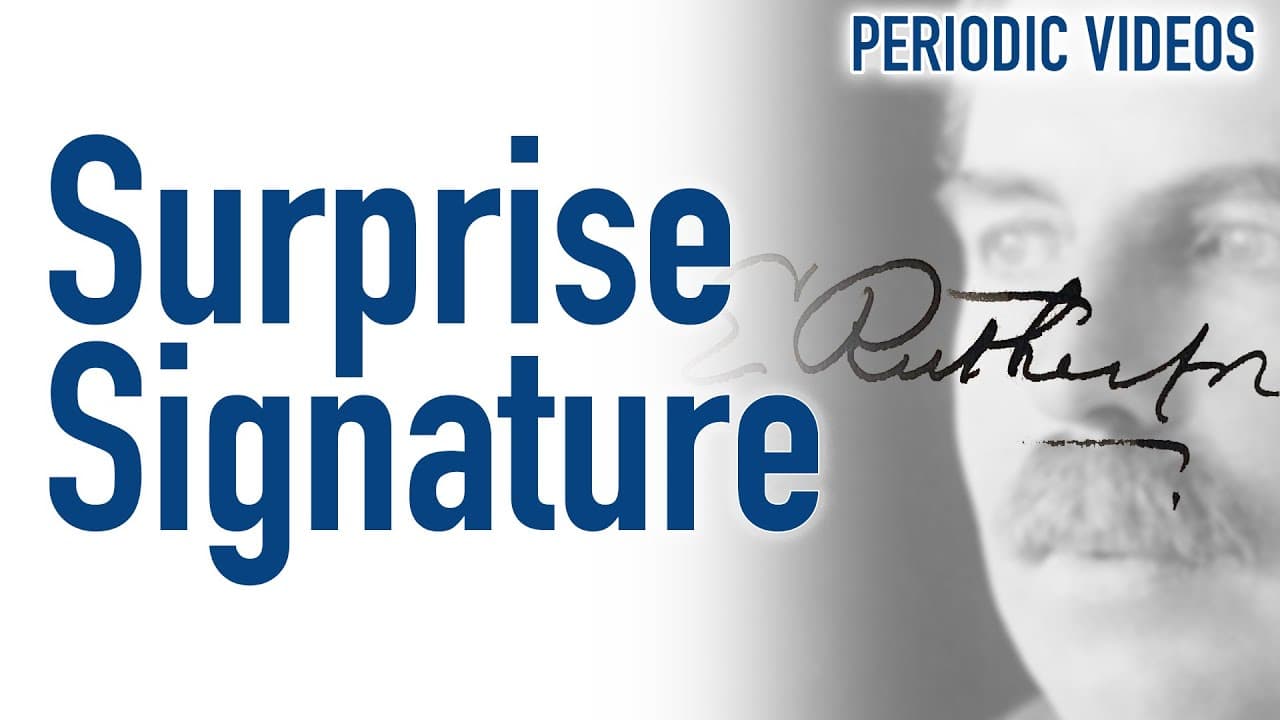
Ernest Rutherford’s signatures in Introduction to Chemical Philosophy appear genuine, according to expert Keith Moore, but the book’s monetary value remains uncertain. Published in 1886, it also contains an old periodic table filled with question marks for possible elements and no noble gases because they had not yet been discovered. Read on for the professor’s theories about the book’s origins, its two signatures, and its unusual chemical symbols.
Transcript
as you can see I'm locked down in a room that's full of books and I know what most of them are but a few weeks ago I discovered the book I didn't realize I had and there was something really quite exciting about it I found this book which is called introduction to chemical philosophy found it quite late at night and then I looked inside and much to... Read More
Key Insights
- 🥺 Discovery of a signed book by Ernest Rutherford in the professor's collection leads to speculation about its origins and value.
- 😉 Rutherford, a celebrated physicist, won the Nobel Prize and made significant contributions to atomic theory.
- 📑 The book's old periodic table contains curious annotations and marks for potential new elements.
- 📙 The professor's theories on the book's origins range from inheritance to related to his wife's grandfather.
- 📔 The potential archival value of the book prompts interest from experts like Keith Moore.
- 📔 The presence of Rutherford's signatures inside the book adds to its authenticity and historical significance.
- 🙂 Comparisons to other autographs and historical documents shed light on the perceived value of the book.
Install to Summarize YouTube Videos and Get Transcripts
Explore YouTube Video Summarizer or Get YouTube Transcript Extractor
Questions & Answers
Q: Is the Ernest Rutherford signature in the book genuine?
Keith Moore, described as an expert on such items, examined a photograph and said he thought the signature was genuine. The professor initially suspected a forgery or joke, but he also found a second, faint Rutherford signature inside the cover.
Q: How did the professor discover the Rutherford-signed book?
He found Introduction to Chemical Philosophy among his books after 11 o’clock one night while preparing to go to bed. When he opened it, he was amazed to see a signature that appeared to be Ernest Rutherford’s.
Q: Where might the signed book have come from?
The professor offers two theories. He may have inherited it from his friend David Jones’s library, or it may have come through his wife’s family because her grandfather studied with Rutherford.
Q: Why are there two Rutherford signatures in the book?
The signatures appear to mark ownership rather than dedicate the book to someone. The professor speculates that Rutherford first signed inside the cover, then signed the next page because the first inscription was difficult to see.
Q: When was the book published, and how old was Rutherford then?
The book was published in 1886, when Rutherford was 15. The professor theorizes that Rutherford may later have bought it secondhand after coming from New Zealand to England as a student.
Q: Why is Ernest Rutherford historically significant?
Rutherford formulated the first plausible structure of the atom and discovered that alpha particles were the nuclei of helium atoms. He won the Nobel Prize for Chemistry in 1908, and eleven of his students also won Nobel Prizes.
Q: What is unusual about the book’s periodic table?
The old periodic table contains question marks where new elements might exist and omits noble gases because they had not yet been discovered. It also shows beryllium as “Gl,” boron as “Bo,” and rhodium as “Ro,” which the professor suspects may reflect hurried preparation and mistakes.
Q: How much might the Rutherford-signed book be worth?
The professor says he has no idea whether it is worth much and doubts that it is very valuable because the signature merely labels ownership. During the discussion, an autographed Rutherford letter from 1920 was found listed for two and a half thousand dollars, but the professor considered a signed letter more special than a name written in a book.
Summary & Key Takeaways
-
Professor finds a book signed by Ernest Rutherford, theorizing it may have come from a friend or wife's family.
-
Rutherford, a renowned physicist, won the Nobel Prize for Chemistry in 1908 and his autograph is deemed genuine.
-
The book contains an old periodic table with interesting notations and question marks for yet-to-be-discovered elements.
Read in Other Languages (beta)
Share This Summary 📚
Summarize YouTube Videos and Get Video Transcripts with 1-Click
Try YouTube Summary with ChatGPT & Claude or YouTube Transcript Generator
Explore More Summaries from Periodic Videos 📚




Summarize YouTube Videos and Get Video Transcripts with 1-Click
Try YouTube Summary with ChatGPT & Claude or YouTube Transcript Generator