How AI and Household Debt Threaten the Economy
TL;DR
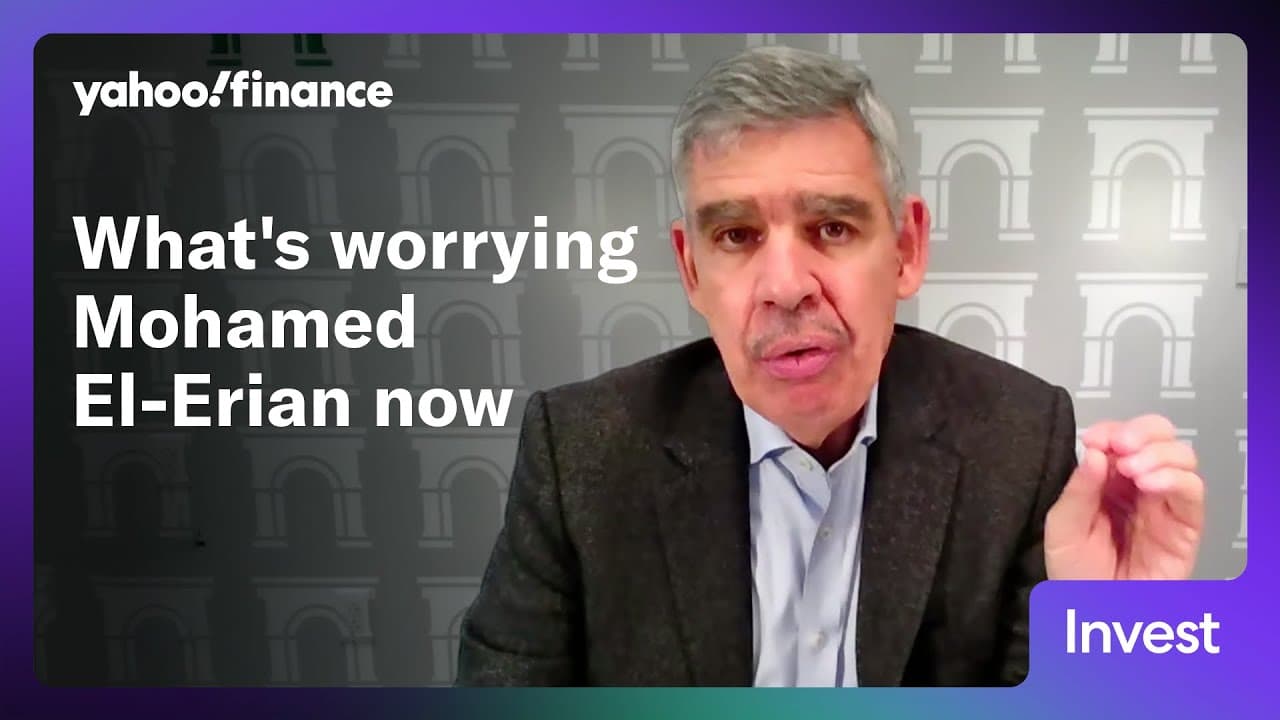
Lower-income households and debt refinancing at higher interest rates are the clearest economic pressure points, but Mohamed El-Erian does not expect a systemic shock. He argues that AI could raise productivity and permit looser monetary policy, yet a corporate focus on cutting costs could prioritize worker displacement over AI’s labor-enhancing opportunities.
Transcript
Welcome to Yahoo Finance Invest. The global economy is rapidly evolving from shifting monetary policy to inflation pressures and structural changes thanks to technology. In the backdrop, record setting markets that are sparking fears of a correction or even worse. Joining me now is Muhammad Alan, Alian's chief economic adviser. Muhammad, a real tre... Read More
Key Insights
- Economic accidents are likely, but El-Erian does not expect a systemic shock. Investors stretched for additional returns during a strong economy and loose financial conditions, sometimes moving beyond their comfort zones and due diligence capabilities, which makes isolated credit problems unsurprising.
- Lower-income households are near recession because affordability pressures remain severe. The earlier inflation shock was partly offset by income transfers, but households now face inflation stuck at 3%, insecurity about future income, surging layoffs, high debt, and credit cards that have been maxed out.
- Weak spending by lower-income households can affect the entire economy. El-Erian argues that these consumers may stop spending because they lack the ability, not the desire, and that reduced demand could spread upward even though middle-income and upper-income households remain stronger.
- The affordability divide will take years to repair. Government actions involving gasoline prices, pharmaceuticals, proposed payments, legislation, and AI-related investment address parts of the problem, but El-Erian describes the divide as deep-rooted and complicated by differences between real and perceived conditions and relative and absolute outcomes.
- The next Federal Reserve chair will inherit an institution divided over its dual mandate. Some officials emphasize employment while others emphasize inflation, and both indicators are flashing yellow. Officials also disagree about relying on backward-looking data versus developing a forward-looking, strategic view of the economy.
- Federal Reserve independence should be preserved alongside stronger accountability and internal reform. El-Erian says the institution has made decisions too late, suffered from groupthink, and faced accusations of irregularities involving five officials, making operational and cultural reform important for maintaining policy autonomy.
- A better inflation target would be a range of 2.5% to 3%, according to El-Erian. He argues that a single 2% point target implies unrealistic precision and notes that stable inflation at 3% has not unanchored inflation expectations.
- AI offers both labor displacement risks and major labor-enhancing opportunities. El-Erian’s main concern is the corporate mindset, because most companies currently view AI primarily as a way to minimize costs, potentially producing painful job consequences instead of emphasizing worker augmentation and broader productivity gains.
Install to Summarize YouTube Videos and Get Transcripts
Explore YouTube Video Summarizer or Get YouTube Transcript Extractor
Questions & Answers
Q: What economic risks concern Mohamed El-Erian most?
Mohamed El-Erian is most concerned about pressure on households at the lower end of the income distribution and the volume of debt that must be refinanced at higher interest rates. He says these vulnerabilities could become worse if policymakers make a mistake. Trade conflict concerns him less than before because higher United States tariffs have not triggered much retaliation.
Q: Why does El-Erian expect economic accidents but not a systemic crisis?
El-Erian says investors were encouraged by a strong economy and very loose financial conditions to stretch for additional returns. Some moved beyond their comfort zones and their ability to conduct adequate due diligence. That behavior can produce credit and economic accidents, but he does not believe those incidents will damage the foundations or integrity of the broader financial system.
Q: Are lower-income households already in a recession?
El-Erian says lower-income households are near recession rather than definitively in one. They are dealing with an affordability problem shaped by inflation stuck at 3%, uncertain future income, surging layoffs, high debt, and credit cards that have been maxed out. These pressures occupy the weaker side of what he calls a K-shaped economy.
Q: How could lower-income consumer weakness affect the broader economy?
Lower-income households may reduce spending because they are no longer able to maintain it, even if they still want to purchase goods and services. El-Erian warns that this decline would not remain isolated. It could contaminate the economy upward by weakening demand, eventually affecting higher-income consumers and other groups that currently have stronger income and wealth positions.
Q: How can the affordability gap between households be reduced?
El-Erian says closing the gap requires action on both incomes and prices over several years because the problem is deep-rooted. He notes steps involving gasoline and pharmaceutical prices, alongside proposed payments, legislation, job creation, and AI data-center construction. However, the challenge is complicated by differences between real and perceived conditions and between relative and absolute improvements.
Q: What should the next Federal Reserve chair prioritize?
The next chair should provide a unifying, forward-looking narrative for a divided Federal Reserve. El-Erian says the institution must move beyond excessive reliance on backward-looking data and develop the confidence to assess the economy strategically and act proactively. The chair must also reconcile competing concerns about employment and inflation, both of which are currently flashing yellow.
Q: Should the Federal Reserve replace its 2% inflation target?
El-Erian does not want the inflation target eliminated, but he believes it should be changed from a precise point to a range. He favors a range of 2.5% to 3% because a single number suggests a level of precision that policymakers cannot reliably achieve. He also observes that stable 3% inflation has not unanchored inflation expectations.
Q: How could AI affect productivity, monetary policy, and jobs?
El-Erian believes successful AI diffusion could produce a significant productivity increase and allow monetary policy to be looser than it otherwise would be. However, AI presents both labor displacement risks and substantial opportunities to enhance workers. His concern is that most of corporate America currently treats AI mainly as a tool for minimizing costs, which could lead to painful employment consequences.
Summary & Key Takeaways
-
El-Erian expects isolated credit and economic accidents after investors stretched for returns under strong growth and loose financial conditions. He distinguishes these problems from threats that undermine the system’s foundations. His central concern is not a systemic shock, but pressure on lower-income households and borrowers refinancing debt at higher interest rates.
-
Lower-income households face persistent inflation, uncertain future income, rising layoffs, high debt, and heavily used credit cards. El-Erian says this group is near recession and warns that constrained spending could eventually weaken the broader economy. Closing the affordability gap will require years of work on both prices and incomes.
-
The next Federal Reserve chair will inherit divisions over employment, inflation, and whether policy should remain backward-looking or become more strategic. El-Erian supports Federal Reserve independence alongside accountability and reform. He favors a 2.5% to 3% inflation target range and sees AI diffusion as a potential source of productivity growth.
Read in Other Languages (beta)
Share This Summary 📚
Summarize YouTube Videos and Get Video Transcripts with 1-Click
Try YouTube Summary with ChatGPT & Claude or YouTube Transcript Generator
Explore More Summaries from Yahoo Finance 📚



Summarize YouTube Videos and Get Video Transcripts with 1-Click
Try YouTube Summary with ChatGPT & Claude or YouTube Transcript Generator