How Fast Can You Heal a Sprained Ankle Fracture?
TL;DR
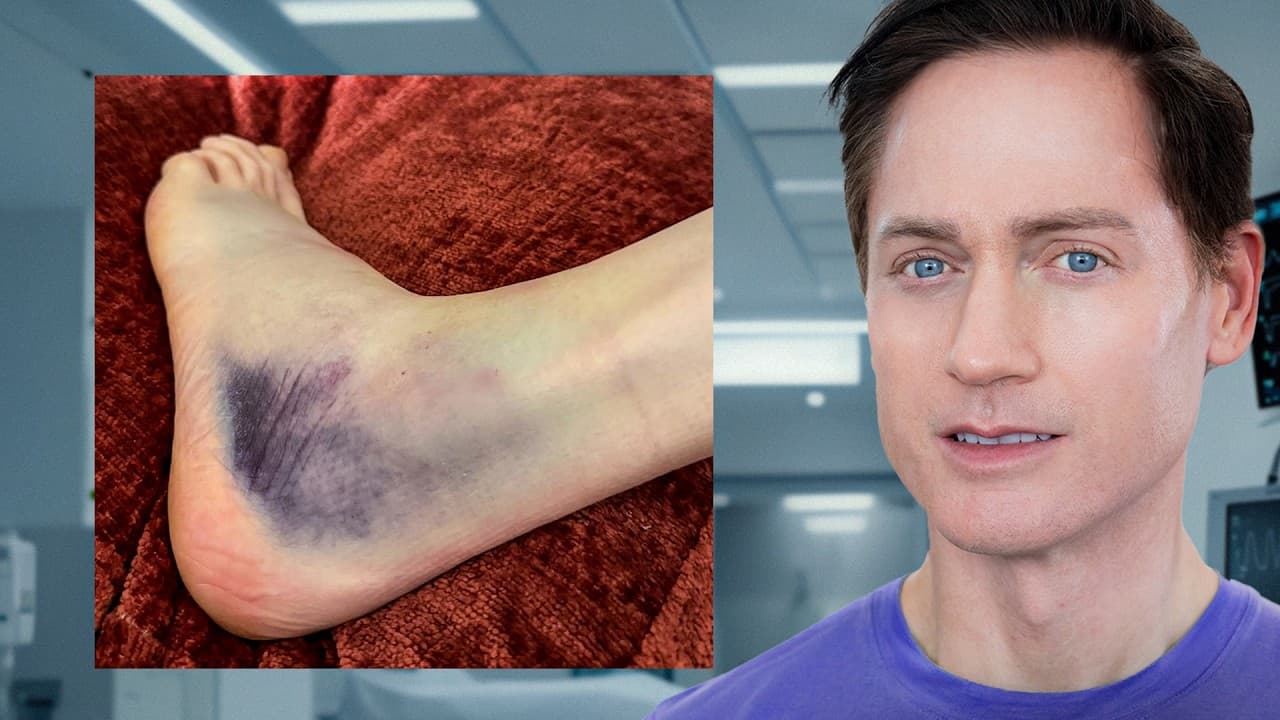
Seven therapies were stacked at once on a mildly displaced avulsion fracture of the calcaneus: peptides, focused shockwave, EMT magnetic pulses, laser, soft tissue work, PRP and physical therapy. The injury did not cross the threshold for surgery. Crutches were needed in week one, week four brought a strength turning point, and by week five the boot came off, bruising was gone, and stairs were possible without crutches.
Transcript
I'm Brian Johnson that crazy Tech guy who's asking if we could be the first generation to not die I'm following a rigorous day-to-day protocol to slow and reverse my aging damage but sometimes things don't go to plan be careful that's your trip hey guys what happened oh dancing I was at a music festival and I danc and I spray my ankle it was a grea... Read More
Key Insights
- A mildly displaced avulsion fracture of the calcaneus happens when a ligament tears with enough force to pull a fragment of bone off its attachment point. Dr Steve Sampson noted it usually requires greater injury force than a standard sprain, though it is not rare.
- Stacking multiple therapies simultaneously trades scientific clarity for speed. Johnson explicitly acknowledged that the normal approach isolates one therapy to test whether it achieves the result, but he chose to run all seven at once because the goal was healing, not measurement.
- The seven therapies used were peptides, focused shockwave therapy, EMT, laser, soft tissue work, PRP and physical therapy. Each was selected on the basis that there is evidence showing the ankle can be improved with these treatments.
- Swelling is part of the healing process rather than a problem to eliminate. Sampson described the body mobilizing cells to the injury site like mobile paramedics, producing redness, soreness and eventually bruising, with the initial course usually running 48 to 72 hours.
- PRP quality is visually assessable. Sampson said Johnson's plasma looked clean and luminescent, placing it in the top 1% he had seen, and explained that a poor diet or poor health produces plasma that does not look as good.
- Focused shockwave therapy uses acoustic waves to promote healing properties in a wounded area. Johnson noted he had also used the same technology on his penis when trying to increase nighttime erections as part of his rejuvenation protocols.
- EMT works through high energy magnetic pulses that stimulate healing but produce no sensation through the device. Johnson demonstrated the field by placing a circle of paper clips below the device and turning it on, which made sparks fly.
- Detraining effects appear within days, not weeks. Johnson reported putting on weight, feeling lethargic and noticing his whole body change in a matter of days once he could no longer do his usual daily hour in the gym, which he called his happiest moment of the day.
- Week four is a specific risk window in ankle recovery because improving symptoms tempt more activity while reinjury risk stays high. Johnson kept a heavy schedule that week including travel to San Francisco, hosted dinners and a tech roast show, on top of therapies.
- Trey Villareal, who trains professional athletes and celebrities, invented the Achilles device after his own repeated ankle and foot injuries as an all state quarterback. He said Johnson was recovering faster than athletes he had seen, crediting clean eating and low inflammation.
Install to Summarize YouTube Videos and Get Transcripts
Explore YouTube Video Summarizer or Get YouTube Transcript Extractor
Questions & Answers
Q: How did Bryan Johnson break his ankle?
He sprained his ankle while dancing at a music festival, immediately after telling everyone around him to be careful and while wearing his don't die hat. His foot dropped into a hole and rolled. Imaging with both an MRI and a CT scan revealed a minor fracture that did not cross the threshold requiring surgery, so he was placed on a repair path rather than an operative one and ended up on crutches.
Q: What is a mildly displaced avulsion fracture of the calcaneus?
Dr Steve Sampson explained it as what happens when a ligament is sprained with enough force that, as it tears, it pulls the bony attachment away with it, leaving a small bony fragment. In Johnson's case the fracture was anterolateral, meaning front outside. The chipped piece of bone was visible on his CT scan. Sampson said the injury is less common because it usually requires a greater force, but it is not an injury clinicians rarely see.
Q: What seven therapies were used to speed up ankle healing?
The protocol combined peptides, focused shockwave therapy, EMT, laser therapy, soft tissue work, PRP and physical therapy. Johnson said each was chosen because there is evidence showing the ankle can be improved with these therapies. He noted the trade off directly: normally you would isolate a single therapy and test whether it achieves the result you care about, but because the objective was healing his ankle as fast as possible, he accepted the risk of doing everything at once.
Q: Why does stacking multiple treatments make results hard to interpret?
When seven therapies run simultaneously, there is no way to attribute the outcome to any one of them. Johnson stated that the normal method takes one therapy, isolates it, and asks whether that therapy achieves the result. He deliberately set that method aside here, describing it as taking a risk, because his priority was the fastest possible recovery rather than knowing which specific intervention contributed what.
Q: What does PRP appearance say about a person's health?
Dr Steve Sampson said the visual appearance of platelet rich plasma is a significant indicator. Johnson's plasma was described as really clean and luminescent in color, which Sampson placed in the top 1% of what he had seen, though not a record. Sampson explained the contrast: if someone has a poor diet or is in poor health, the plasma is not going to look that good. He joked he could not publicize it because other patients would get jealous.
Q: How does focused shockwave therapy work for injury recovery?
Focused shockwave therapy uses acoustic waves to promote healing properties in the wounded area. It was the second therapy Johnson applied to his ankle. He also noted he had used the same technology outside of injury recovery, specifically for rejuvenating his penis when he was working on increasing nighttime erections, which is how he became familiar with the device before the ankle injury.
Q: What happens to the body when you stop exercising after an injury?
Johnson reported that the effects arrived remarkably fast. Within just a few days of being unable to work out, he started putting on weight and felt lethargic, saying his whole body changed in a matter of days and that the speed of the change was stunning. He described daily exercise as his happiest moment of the day, an hour in the gym he looked forward to when going to bed at night, so losing it was emotionally difficult too.
Q: Why is week four risky during ankle rehabilitation?
Johnson identified week four as a danger zone because you think you might be okay to start doing a bit more activity, but you are actually still at real risk of reinjuring yourself, so caution is required. Despite the warning, that week was active for him: a movie outing, a trip to San Francisco to be roasted at a tech roast show, several hosted dinners and a dentist appointment, all on top of therapies and a full work schedule.
Q: How does EMT therapy stimulate healing?
EMT uses high energy magnetic pulses to stimulate healing in the injured area. A distinctive feature is that once the device is placed on the foot, you cannot actually feel it working, which makes it hard to tell whether anything is happening. To make the effect visible, Johnson placed a circle of paper clips right below the device and turned it on, and sparks flew, demonstrating the strength of the magnetic field being applied.
Q: What was the goal of PRP treatment for the torn ligament?
Dr Steve Sampson stated the goal was to help strengthen and repair the ligament while providing more resiliency with less scar tissue than would result from simply leaving the body to heal on its own. He noted the swelling Johnson had was secondary swelling, and that the other therapies Johnson was already using, laser, EMT and shockwave, speed the body's natural course of inflammation and recovery, which usually occupies the first 48 to 72 hours.
Q: Who is Trey Villareal and what is the Achilles device?
Trey Villareal specializes in training professional athletes and celebrities and invented a machine called Achilles that rehabilitates and exercises the entire lower leg extremity. He was an all state quarterback who suffered many ankle and foot injuries and kept reinjuring himself despite deep tissue massages and other standard protocols. The idea came to him while meditating one day, he built it with his father, and roughly seven or eight years later it is in use.
Q: What did recovery look like by week five?
By week five things began to normalize. Johnson was back in a shoe with the boot off, wearing a small brace, doing his triple therapy twice a week, and otherwise back to his normal routine. The bruising had completely disappeared, which he called a good sign. He described being back on two feet, going up and down stairs without crutches, and moving around freely just three weeks after arriving at therapy on crutches.
Summary & Key Takeaways
-
Bryan Johnson sprained his ankle dancing at a music festival, moments after telling everyone around him to be careful. His foot dropped into a hole and rolled. An MRI and CT scan showed a minor fracture that did not cross the threshold for surgery, so he moved onto a repair path rather than an operation, aiming for what he described as a world record for fastest healing.
-
Rather than isolating a single treatment to test its effect, he ran seven therapies at once: peptides, focused shockwave therapy, EMT, laser, soft tissue work, PRP and physical therapy. He acknowledged that this abandons the usual method of isolating one therapy to see whether it produces the result, but chose speed of healing over clean measurement.
-
The formal diagnosis from Dr Steve Sampson was a mildly displaced avulsion fracture of the calcaneus, anterolaterally. A ligament tore with enough force that it pulled a bony fragment off its attachment, visible on the CT scan. Sampson noted this requires greater force than a standard sprain, and Johnson had already sprained each ankle roughly three times.
-
Week one was the hardest: basic daily tasks took ten times longer, workouts stopped, weight went on, and lethargy set in within days. Week four was flagged as a danger zone for reinjury while feeling better. By week five the boot was replaced by a brace, bruising had disappeared, and normal routines including stairs returned without crutches.
Read in Other Languages (beta)
Share This Summary 📚
Summarize YouTube Videos and Get Video Transcripts with 1-Click
Try YouTube Summary with ChatGPT & Claude or YouTube Transcript Generator
Explore More Summaries from Bryan Johnson 📚

Summarize YouTube Videos and Get Video Transcripts with 1-Click
Try YouTube Summary with ChatGPT & Claude or YouTube Transcript Generator