How Can India Lower Taxes and Widen the Tax Base?
TL;DR
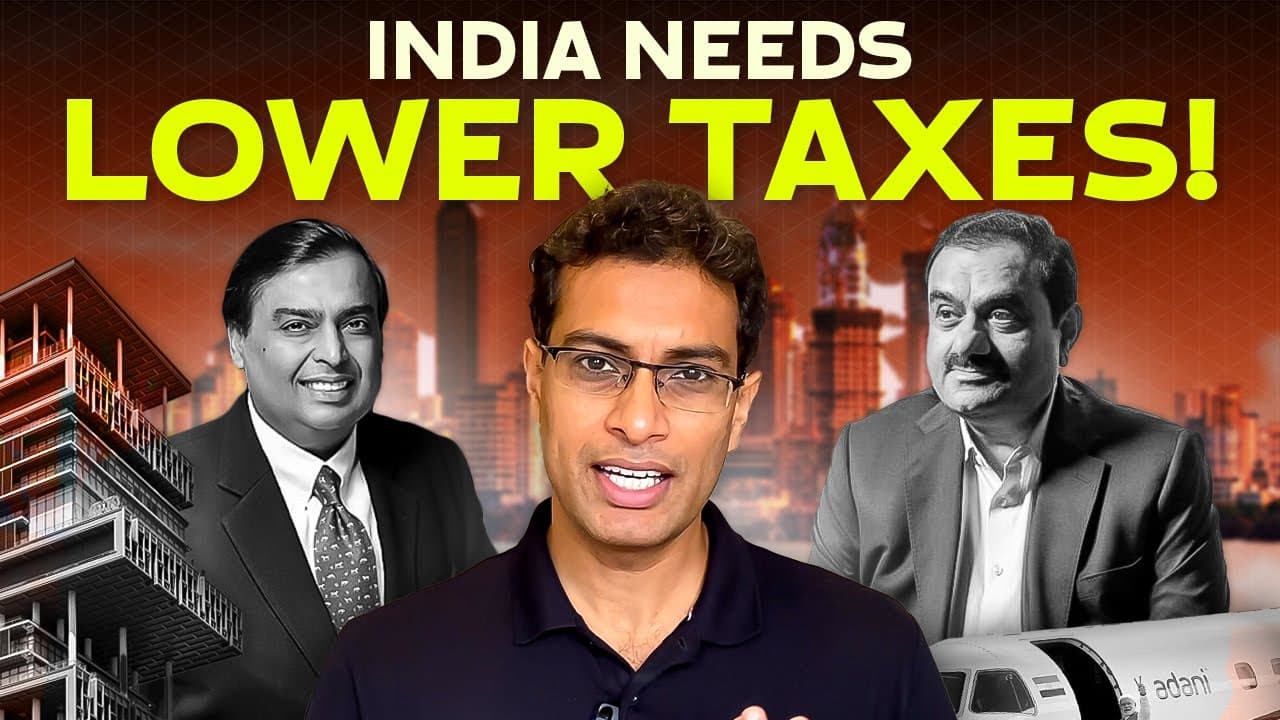
India could lower taxes by widening the direct-tax base, restricting tax exemptions for wealthy agricultural earners, and making real-estate transactions transparent enough to curb black-money flows. The proposed first step is to publish transaction data through a blockchain-based system modeled on Dubai, which could reduce inflated land prices and lower costs for renting, manufacturing, and operating businesses.
Transcript
hi everyone welcome to today's video so many of you ask me that hey AET you talk about like Indian taxation system and criticize it so much do you have better Solutions if he make you the Finance Minister of India what is it that you will do okay so I will tell you the exact thing that I'm going to do and this is literally step one that I should be... Read More
Key Insights
- India’s taxation system has four broad components: personal income tax, corporate income tax, indirect tax, and capital-gains tax. Salaries can face personal tax, companies pay corporate tax, purchases attract GST, and profits from assets such as stocks or real estate can create capital-gains liabilities.
- Real-estate transparency is presented as a way to address black money. The proposed system would publish transaction information such as locality, sale price, apartment type, built-up area, and unit number while excluding the identities of buyers and sellers.
- Black-money flows are described as a cause of inflated Indian property prices. The speaker connects political donations from large businesses with money entering real estate and argues that this helps explain why Mumbai’s average apartment price per square meter is higher than Dubai’s.
- Lower land prices could reduce costs throughout the economy. The speaker argues that cheaper property would lower shop rents, business operating expenses, and manufacturing costs because factories and other production facilities must be built on land.
- India’s highest effective personal income-tax rate is described as close to 39%, down from approximately 43%. The comparison offered is the UAE, where salary income is described as tax-free because the personal income-tax rate is 0%.
- India’s corporate tax is described as roughly 25%, compared with approximately 9% in Dubai and Hungary and roughly 20% in Singapore. These comparisons support the speaker’s broader argument that businesses can face lower corporate rates in several other jurisdictions.
- High GST can reduce customer demand by increasing the final selling price. Using a course priced at 14,999 as an example, the speaker explains that raising GST from 18% to 25% would increase what buyers pay and cause some prospective customers to abandon the purchase.
- India’s tax base is described as unusually narrow because only 2% of the population pays direct income tax. The speaker argues that widening this base should include reconsidering exemptions that allow wealthy agricultural earners making crores to pay 0% tax.
Install to Summarize YouTube Videos and Get Transcripts
Explore YouTube Video Summarizer or Get YouTube Transcript Extractor
Questions & Answers
Q: How could India lower taxes while maintaining revenue?
India could combine lower tax burdens with a wider direct-tax base and stronger action against black money. The speaker states that only 2% of the population pays direct income tax, leaving a narrow group to carry much of the burden. Bringing wealthy exempt earners into the tax system and making real-estate transactions transparent could broaden collections without relying as heavily on high rates for existing taxpayers.
Q: How could blockchain improve India’s real-estate market?
A blockchain-based property system could publish transaction details such as the locality, selling price, apartment type, built-up area, and unit number while withholding buyer and seller identities. The speaker proposes borrowing this approach from Dubai. Greater transaction visibility would make it harder for black money to flow into property, potentially reducing artificial price inflation and improving trust in market data.
Q: Why does the speaker connect black money with high property prices?
The speaker describes a chain in which large businesses make political donations and money subsequently flows into real estate. This flow is said to inflate property values beyond levels justified by development or normal demand. As supporting context, the speaker states that Mumbai’s average apartment price per square meter is higher than Dubai’s and attributes this disparity to India’s black-money problem.
Q: How would lower land prices reduce business costs in India?
Lower land prices would reduce the cost of renting shops, acquiring commercial property, and constructing manufacturing facilities. The speaker emphasizes that production units must be built on land, so expensive real estate becomes part of the cost of making goods. If property inflation caused by black-money flows were reduced, manufacturing and general business operating costs could also decline.
Q: What are the four main types of taxes discussed for India?
The four categories are personal income tax, corporate income tax, indirect tax, and capital-gains tax. Personal tax applies to earnings such as salaries, while corporate tax applies to registered companies. GST is the principal indirect tax discussed. Capital-gains tax applies when assets such as stocks or real estate are sold for a profit, subject to the relevant rules and exemptions.
Q: Why can a high GST rate hurt businesses and consumers?
A high GST rate raises the amount customers must pay on top of a product’s base price, which can reduce demand. The speaker illustrates this with a course priced at 14,999. If GST rose from 18% to 25%, the final selling price would increase even though the seller collects the tax for the government, causing some customers to abandon the purchase.
Q: How are capital gains and fixed-deposit returns taxed in the examples?
The speaker states that long-term capital gains on equities are taxed at 10%, while long-term gains on real estate are taxed at 20%, with the applicable treatment depending on factors such as holding duration and exemptions. Fixed-deposit returns create a different concern because the interest is added to the investor’s income and taxed according to that person’s income-tax slab.
Q: Why does the speaker want India to widen its tax base?
The speaker states that only 2% of India’s population pays direct income tax, which makes the existing base very narrow. Widening it is presented as the first of three central tax-policy goals. One suggested measure is to reconsider the 0% treatment available to wealthy agricultural earners making crores, while preserving the broader point that reform is not an argument against farmers.
Summary & Key Takeaways
-
India imposes personal income tax, corporate income tax, indirect tax through GST, and capital-gains tax. The speaker argues that all four categories are high, citing a highest effective personal rate near 39%, corporate tax around 25%, GST commonly around 18%, and long-term real-estate gains tax at 20%.
-
The proposed first reform is to make real-estate transactions transparent by publishing property details through a blockchain-based system modeled on Dubai. The speaker argues that greater transparency would obstruct black-money flows into property, reduce inflated land values, and consequently lower the costs of commercial rent, manufacturing facilities, and business operations.
-
Tax reform should pursue three central goals, beginning with widening the tax base. The speaker states that only 2% of India’s population pays direct income tax and questions why wealthy agricultural earners can remain untaxed. Lower rates would therefore need to accompany broader, more consistent participation in the tax system.
Read in Other Languages (beta)
Share This Summary 📚
Summarize YouTube Videos and Get Video Transcripts with 1-Click
Try YouTube Summary with ChatGPT & Claude or YouTube Transcript Generator
Explore More Summaries from Akshat Shrivastava 📚




Summarize YouTube Videos and Get Video Transcripts with 1-Click
Try YouTube Summary with ChatGPT & Claude or YouTube Transcript Generator