How to Make Silica Aerogel at Home Step by Step
TL;DR
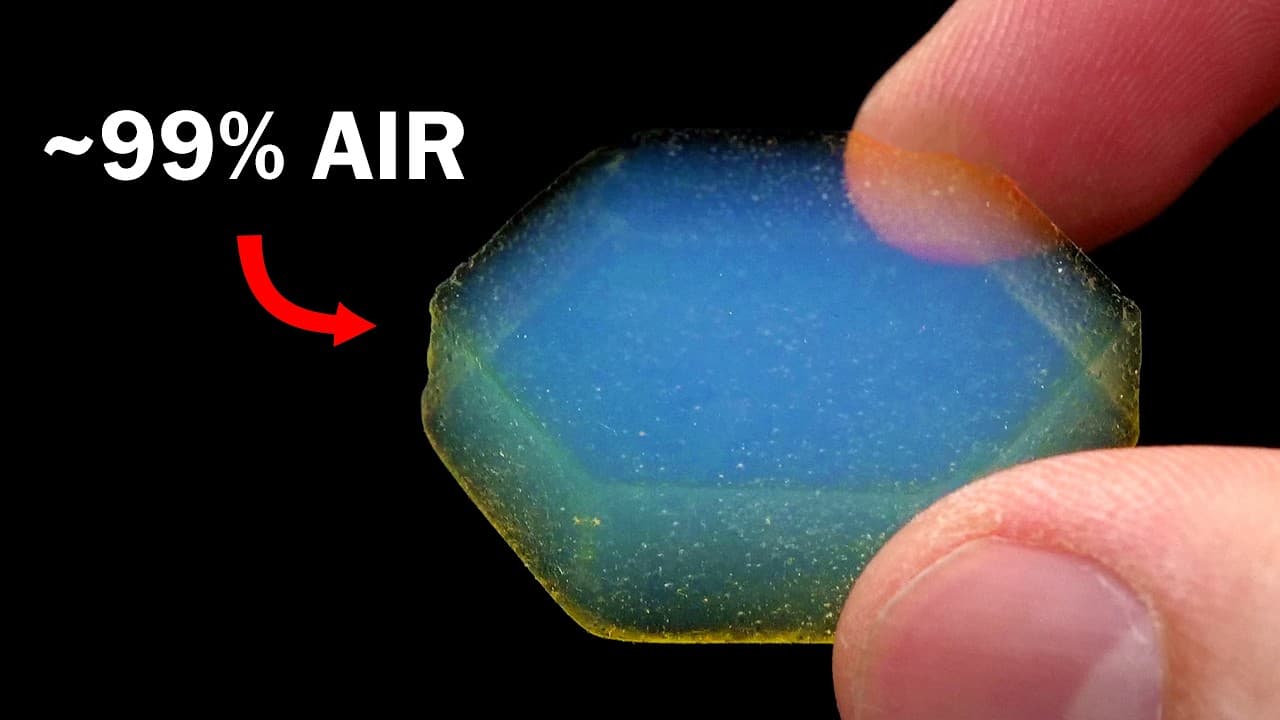
To make silica aerogel at home, create an alcohol-based gel using TMOS, then dry it using a specialized supercritical drying chamber. Precise control of temperature and pressure is crucial to prevent cracking. The process is labor-intensive and time-consuming, but can yield successful and crack-free aerogel with proper techniques.
Transcript
This video has been sponsored by Raycon. Last year, I started getting really interested in aerogel, which is one of the lightest-known materials. There are many different types of aerogel, but the most common one is from silica, and that's what I have here. By volume though, it's actually less than 1% silica, and over 99% of it is just air. This ma... Read More
Key Insights
- 👱 Silica aerogel is a lightweight material composed of air trapped in a silica network and is primarily used as a thermal insulator.
- 😇 The process of making aerogel involves creating a gel from an alcohol-based solution, drying it in a specialized chamber, and removing the solvent through supercritical drying.
- 🏛️ Building a homemade supercritical drying chamber requires specialized materials and proper safety precautions.
- 🥶 Precise control over temperature, pressure, and timing is crucial to achieve crack-free and well-dried aerogel.
- 🔬 The process of making aerogel is time-consuming, labor-intensive, and requires a thorough understanding of chemistry and materials science.
- 🥶 The modification of the drying process using a Sous Vide cooker showed promising results in achieving crack-free aerogel.
- 🌱 The author plans to explore further improvements and scaling up the aerogel production process in the future.
Install to Summarize YouTube Videos and Get Transcripts
Explore YouTube Video Summarizer or Get YouTube Transcript Extractor
Questions & Answers
Q: What are the main uses of silica aerogel?
Silica aerogel is primarily used as a thermal insulator due to its low density and excellent insulating properties. It can be used in applications such as building insulation, aerospace equipment, and cryogenic applications.
Q: Why is making aerogel a difficult process?
Making aerogel requires handling dangerous chemicals and following strict safety precautions. Additionally, the gel formation and drying process are complex and delicate, requiring precise control over temperature, pressure, and timing.
Q: How does a supercritical drying chamber work?
A supercritical drying chamber utilizes liquid carbon dioxide (CO2) to replace the liquid solvent in the gel. The chamber is pressurized with liquid CO2, which is then heated to the supercritical point. The liquid CO2 turns into a supercritical fluid, which can be easily removed without causing damage to the gel structure.
Q: What are the advantages of aerogel compared to other insulating materials?
Aerogel has an extremely low density, making it one of the lightest solid materials. It also has exceptional thermal insulation properties, low thermal conductivity, and high durability. Additionally, aerogel is highly transparent to infrared radiation, allowing for efficient solar heat insulation.
Summary & Key Takeaways
-
The content explores the process of making silica aerogel, a lightweight material that is mostly composed of air and used as a thermal insulator.
-
The creator faces numerous challenges, including sourcing dangerous chemicals, finding the right gel recipe, and creating molds for gel formation.
-
The author builds a specialized supercritical drying chamber and modifies the method using a Sous Vide cooker to achieve crack-free and well-dried aerogel.
Read in Other Languages (beta)
Share This Summary 📚
Summarize YouTube Videos and Get Video Transcripts with 1-Click
Try YouTube Summary with ChatGPT & Claude or YouTube Transcript Generator
Explore More Summaries from NileRed 📚
Summarize YouTube Videos and Get Video Transcripts with 1-Click
Try YouTube Summary with ChatGPT & Claude or YouTube Transcript Generator