How to Schedule Efficiently with Margin for Errors
TL;DR
Over schedule creates stress and reduces deep work, so plan with ample time and accept losses you must sacrifice. Focus on learning during lectures rather than retrofitting material after the fact. By estimating tasks conservatively and identifying what you will drop, you gain control over your schedule and energy for unforeseen events.
Transcript
if you can't follow your schedule there's a good chance you've misunderstood a crucial perspective on time management in fact what most people don't realize is that creating schedules in the wrong way can actually make your time management worse you can have the perfect app everything time blocked pomodora every waking moment of your day and still ... Read More
Key Insights
- Scheduling should include a wide margin of error so there is wiggle room for unexpected events.
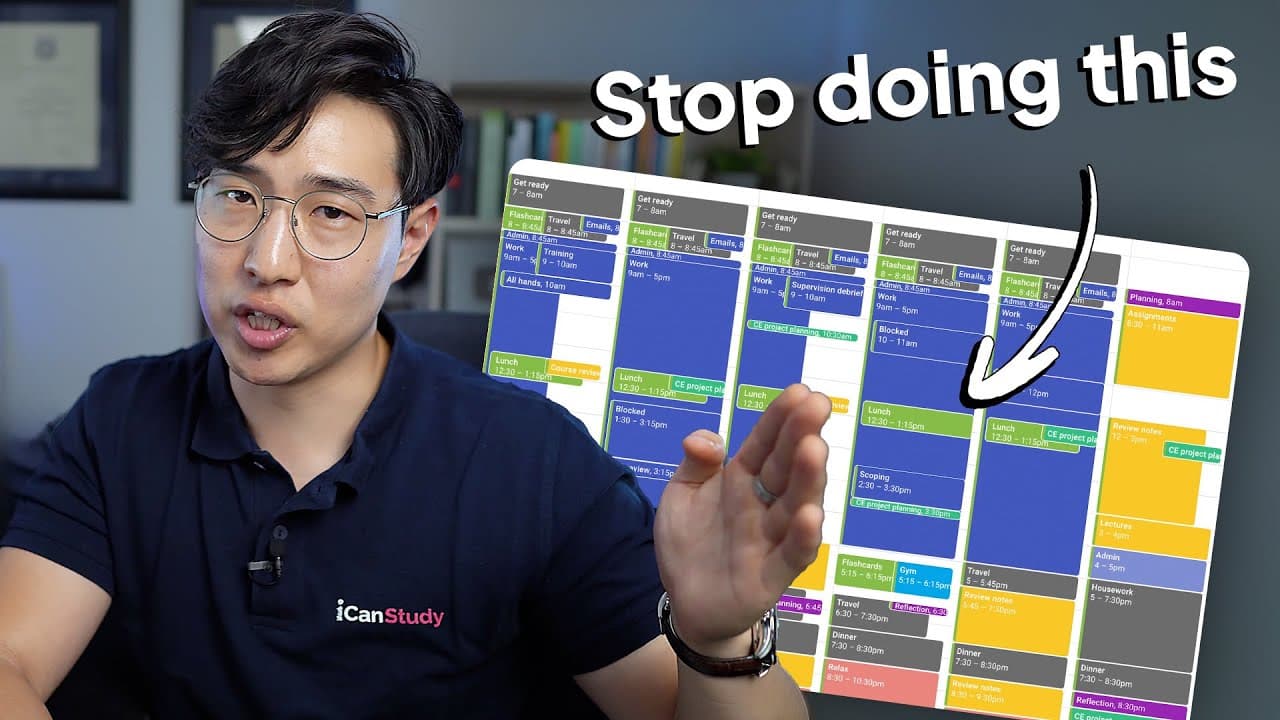
- Over scheduling creates a fantasy world where you expect to finish everything, but reality often requires adjustments and re planning.
- The main mistakes are over scheduling and not actively deciding what to lose, which leads to chronic falling behind.
- Plan your losses in advance to stay in control, rather than reacting to every disruption.
- Focus on planning up front to stay in deep flow and avoid constant task switching.
- Learning efficiency improves when you learn during lectures rather than after them, reducing review time.
- A real weekly schedule should accommodate note consolidation and review without squeezing everything into narrow blocks.
- Replacing some study time with better learning strategies yields long term time savings and confidence.
Install to Summarize YouTube Videos and Get Transcripts
Explore YouTube Video Summarizer or Get YouTube Transcript Extractor
Questions & Answers
Q: A real search query question about the video (e.g. 'How to...', 'What is...', 'Why does...', 'When should...'). Question 1
How can I avoid over scheduling and still get productive results? Over scheduling happens when you pack too many tasks into a single day with little margin for error. To avoid it, estimate tasks to take twice as long as you expect, create buffer periods for unexpected events, and be willing to drop or reschedule non essential tasks. This approach prevents constant catching up and preserves deep work time.
Q: Question 2
What is the core change the student Phillip implemented to become more confident in time management? Phillip shifted away from rigid, tightly packed blocks to allow for note review and learning during lectures. He sacrificed about three hours of studying per week to learn more effectively during lectures, which reduced future study time and increased long term efficiency.
Q: Question 3
Why is over scheduling considered a problem for deep work and focus? Over scheduling leaves no margin for error, so when interruptions occur you must constantly reorganize. This reduces the ability to stay in deep flow, as you switch between tasks and waste time evaluating what to do next instead of executing.
Q: Question 4
What does it mean to pick your losses in scheduling and why is it necessary? Picking losses means actively deciding what you will sacrifice when plans don’t fit reality. It is necessary because attempting to do everything can lead to chronic underperformance; choosing what to drop helps you stay in control and finish what truly matters.
Q: Question 5
How does learning during lectures differ from after lectures, and why does this matter? Learning during lectures reduces the need for extensive later review. When you understand material in real time, you consolidate knowledge and save study time overall, improving efficiency and confidence in long term learning.
Q: Question 6
What role does margin of error play in effective scheduling for beginners? Margin of error provides flexibility to absorb unexpected events without derailing the day. Beginners should estimate tasks with extra time so plans remain realistic, allowing for adjustments without creating a cascade of rescheduled tasks.
Q: Question 7
What was the initial problem with Phillip’s schedule despite it being organized and color coded? The schedule was over scheduled and lacked wiggle room, making it nearly impossible to complete everything. Even though it appeared meticulous, it caused recurring delays, and required frequent rescheduling to cope with late lectures and other disruptions.
Q: Question 8
What long term benefit did Phillip gain from reallocating study time to learn during lectures? The long term benefit was improved efficiency and reduced need for future study time, as learning during lectures allowed better retention. This shift made him feel more in control and helped him catch up and stay ahead over time.
Summary & Key Takeaways
-
A practical approach to scheduling emphasizes margin and realistic pacing to prevent constant catching up, so you can maintain focus and energy throughout the day.
-
The video uses a real case study of Phillip the accountant to illustrate how over scheduling and not planning losses lead to chronic underperformance.
-
Long-term gains come from reallocating a small amount of study time to learn more effectively during lectures, improving efficiency and confidence over time.
Read in Other Languages (beta)
Share This Summary 📚
Summarize YouTube Videos and Get Video Transcripts with 1-Click
Try YouTube Summary with ChatGPT & Claude or YouTube Transcript Generator
Explore More Summaries from Justin Sung 📚


Summarize YouTube Videos and Get Video Transcripts with 1-Click
Try YouTube Summary with ChatGPT & Claude or YouTube Transcript Generator