Sergey Brin on Google's AI Strategy and AGI
TL;DR
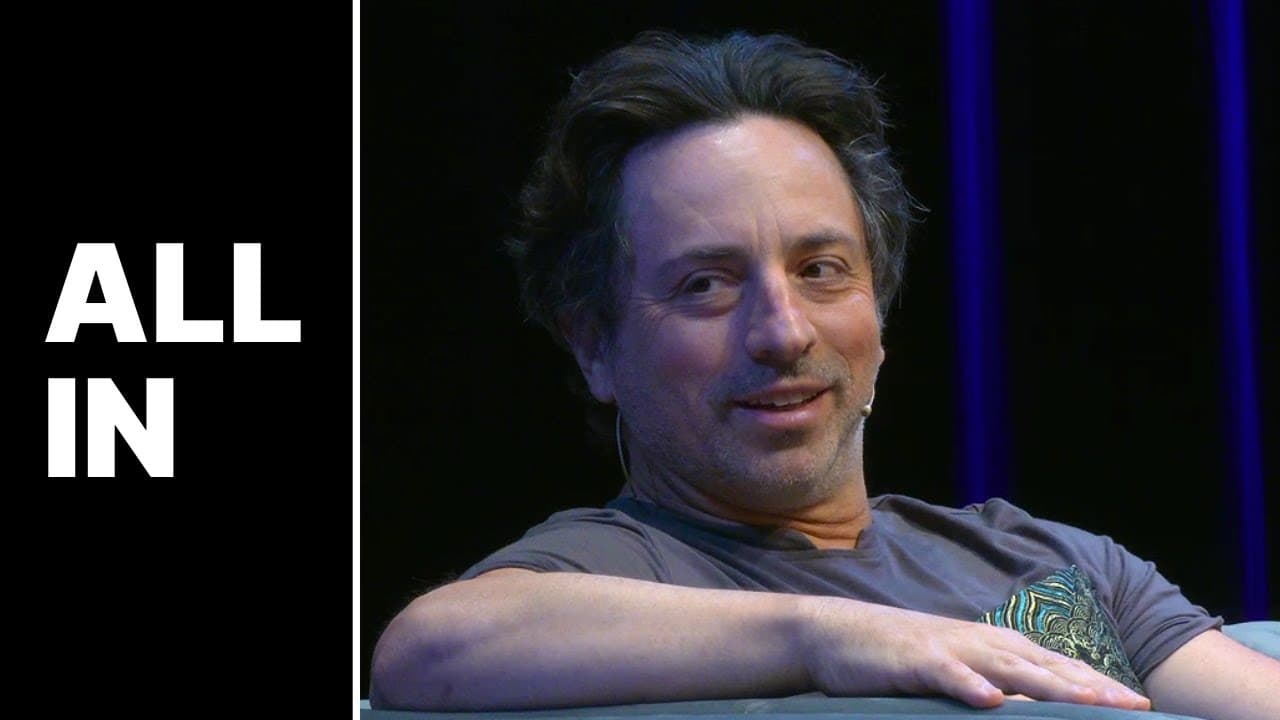
Google is expanding AI computing capacity as quickly as possible because customer demand for TPUs, GPUs, model training, and inference exceeds available supply. Sergey Brin expects AI systems to become more unified, but he cautions against blindly projecting today’s computing trends because algorithmic improvements may outpace increases in hardware.
Transcript
they wondered if there was a better way to find information on the web on September 15th 1997 they registered Google as a website one of the greatest entrepreneurs of our times someone who really wanted to think outside the box if that sounds like it's impossible let's try it he took a backseat in recent years to other Google leaders Brin is now ba... Read More
Key Insights
- Sergey Brin is working at Google nearly every day because he considers recent AI advances unusually exciting from a computer science perspective. He returned to technical work because new model capabilities appear frequently, and he does not want to miss this period of development.
- Neural networks were once treated as a largely discarded AI approach, but greater computing capacity, more data, and several clever algorithms produced sustained progress. Brin describes the resulting advances over roughly the last decade as remarkable compared with AI’s limited role in his graduate curriculum.
- AI affects far more than information retrieval because it can change programming and many other daily activities. Brin says writing code from scratch now feels difficult compared with asking an AI system to generate it, although he still writes some code personally for enjoyment.
- AI-generated code can accelerate experimental evaluation by building the testing infrastructure around a model. Brin asked an AI to create software that generated Sudoku puzzles, submitted those puzzles to the model, and scored its performance, with the requested implementation finished about half an hour later.
- Unified AI models are becoming more likely even though specialized systems historically handled different tasks. Brin expects increasing use of shared architectures and models, while stopping short of endorsing the idea that one so-called God Model will necessarily dominate every application.
- Google’s math competition system used three distinct AI components: a formal theorem prover, a geometry-specific system, and a general-purpose language model. The combined system earned a silver medal and finished one point short of gold, with the formal theorem prover producing the strongest results.
- Algorithmic improvements may be advancing faster than increases in computing resources, so present hardware trends should not be projected blindly by several orders of magnitude. Brin supports rapid infrastructure expansion but questions simple forecasts that assume model development will depend only on continually multiplying power and compute.
- Robotics is impressive but not yet sufficiently robust for most everyday uses, according to Brin’s assessment. General language models and limited fine-tuning can produce surprising demonstrations, yet reliability remains a practical constraint. He believes earlier Google robotics efforts may simply have arrived before the timing was right.
Install to Summarize YouTube Videos and Get Transcripts
Explore YouTube Video Summarizer or Get YouTube Transcript Extractor
Questions & Answers
Q: Why did Sergey Brin return to technical work at Google?
Sergey Brin returned to technical work because he considers the recent pace of AI progress exceptionally exciting from the perspective of a computer scientist. He says he works at Google nearly every day and sees new capabilities emerging frequently. His motivation is not limited to protecting search. He views AI as affecting programming, information access, and many other aspects of daily life.
Q: How is AI changing the way programmers write code?
AI is shifting programming from manually writing every component toward describing a desired result and asking a model to implement it. Brin says coding from scratch can feel difficult compared with requesting generated code. In his Sudoku experiment, the model created code to generate puzzles, send them to itself, and score the results, completing the requested system in roughly half an hour.
Q: Will one general AI model replace specialized models?
The trend described by Brin points toward more unified models with shared architectures, but specialized systems still play an important role. Historically, chess, image generation, weather forecasting, geometry, and theorem proving used different techniques. Brin expects knowledge from specialized systems to be incorporated into general language models, although he does not fully endorse the stronger claim that one God Model will rule every task.
Q: How did Google combine AI models for mathematics?
Google’s mathematics system combined three different components: a formal theorem-proving model, an AI designed specifically for geometry problems, and a general-purpose language model. The system achieved a silver medal and finished one point away from gold. Brin says the formal prover performed particularly well, and Google subsequently began trying to transfer its knowledge and abilities into more general language models.
Q: Why is Google rapidly expanding its AI computing capacity?
Google is expanding computing capacity because demand is already greater than the available supply. Brin says cloud customers want large quantities of TPUs, GPUs, and related resources. Google also needs computing power internally to train and serve its own models. The company sometimes must turn customers away because it lacks sufficient capacity, which provides a practical reason for continued infrastructure investment.
Q: Does AI progress require endlessly increasing computing power?
AI development requires substantial computing power, but Brin cautions against assuming that present growth can be projected blindly several orders of magnitude into the future. He notes that algorithmic improvements over recent years may be advancing even faster than increased computing投入. His position supports current capacity expansion while recognizing that better methods could change how much hardware future systems actually require.
Q: What is a successful scientific application of AI discussed by Sergey Brin?
Brin identifies biology as an area where AI has produced an established practical tool. He points to AlphaFold and its more recent variants, saying that the biologists he speaks with use them. He characterizes it as a somewhat different kind of AI, while also arguing that distinct AI approaches are tending to converge through shared techniques, architectures, and increasingly general models.
Q: Why are AI-powered robots not yet widely useful in daily life?
AI-powered robotics can produce impressive demonstrations using general-purpose language models or limited fine-tuning, but Brin says the systems generally have not reached the robustness required for dependable everyday use. He nevertheless sees a path toward practical applications. Looking back at Google’s several robotics businesses, including Boston Dynamics, he suggests those efforts may have been technically impressive but launched before the timing was right.
Summary & Key Takeaways
-
Sergey Brin has returned to technical work at Google nearly every day because recent AI progress is exceptionally compelling to him as a computer scientist. He contrasts today’s rapidly expanding capabilities with the limited role AI played during his graduate studies, when neural networks were widely treated as a discarded approach.
-
AI is changing programming by allowing people to request working code instead of writing everything from scratch. Brin tested this by asking a model to create software that generated Sudoku puzzles, submitted them back to the model, and scored the answers. The requested system was completed within roughly half an hour.
-
AI development is trending from specialized systems toward shared architectures and more unified models. However, specialized components remain valuable, as demonstrated by Google’s math competition system combining formal theorem proving, geometry-specific AI, and a general language model. Computing demand is strong, while robotics still lacks dependable everyday robustness.
Read in Other Languages (beta)
Share This Summary 📚
Summarize YouTube Videos and Get Video Transcripts with 1-Click
Try YouTube Summary with ChatGPT & Claude or YouTube Transcript Generator
Explore More Summaries from All-In Podcast 📚





Summarize YouTube Videos and Get Video Transcripts with 1-Click
Try YouTube Summary with ChatGPT & Claude or YouTube Transcript Generator