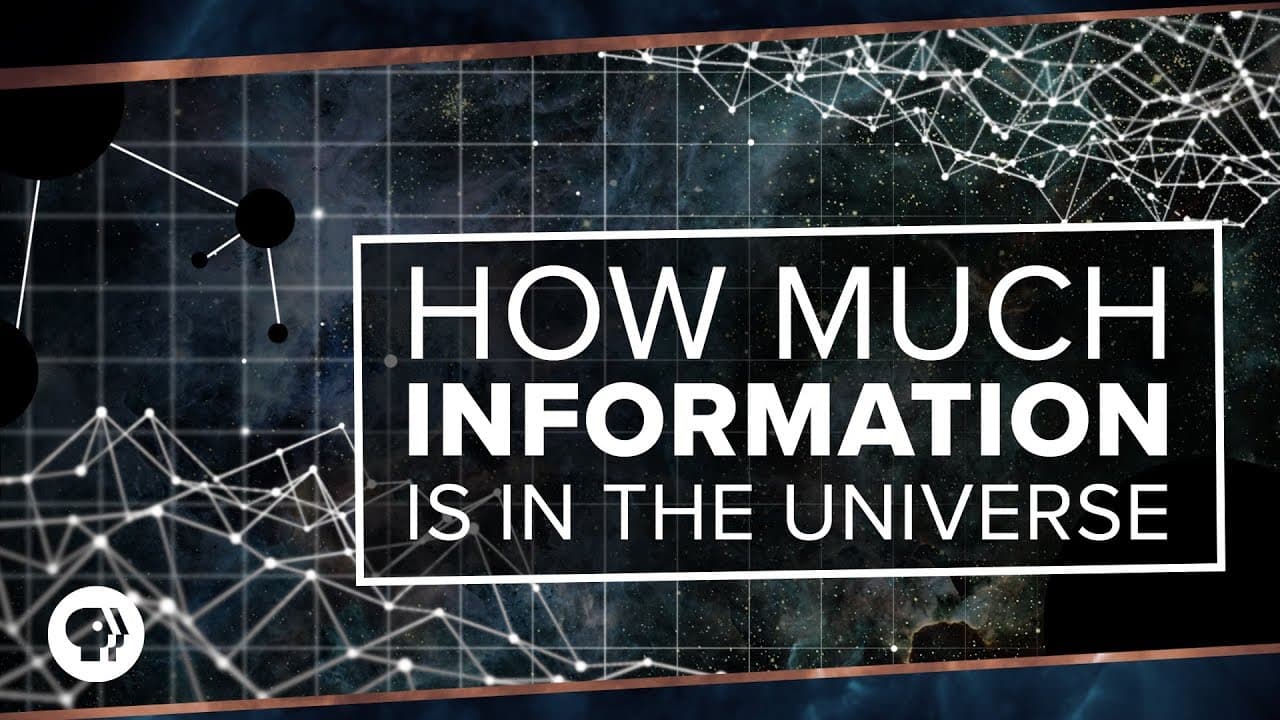
How Much Information is in the Universe?
TL;DR
The universe's information is bound by surface area, not volume.
Transcript
Can you fit all of the information in the universe into a region smaller than the universe let's find out There's quite a bit of stuff in the universe to put it mildly Hundreds of billions of galaxies each with hundreds of billions of stars each with rather a lot of particles in them and Then there's all the stuff that isn't stars: the dark matter,... Read More
Key Insights
- The universe is composed of vast amounts of information, not just matter, with its evolution seen as a computation.
- The holographic principle suggests the universe's information content is proportional to the surface area, not its volume.
- The Bekenstein bound limits the information in a space region to the number of Planck areas on its surface.
- Despite the universe's massive scale, its information content is far below the Bekenstein bound.
- Black holes contain most of the universe's entropy, requiring significant information to describe.
- If the universe exceeded its information capacity, it would collapse into a black hole.
- The hypothetical proton decay time illustrates the vast timescales involved in cosmic processes.
- Advanced civilizations could theoretically compute on a black hole's event horizon, testing the universe's informational limits.
Install to Summarize YouTube Videos and Get Transcripts
Explore YouTube Video Summarizer or Get YouTube Transcript Extractor
Questions & Answers
Q: What is the Bekenstein bound?
The Bekenstein bound is a theoretical limit on the amount of information that can be stored within a given volume of space. It is determined by the surface area of the region, measured in Planck areas, rather than its volume. This concept arises from the study of black hole entropy, where the entropy, or hidden information, is proportional to the event horizon's surface area.
Q: How does the holographic principle relate to the universe's information?
The holographic principle posits that the information content of the universe is encoded on a two-dimensional boundary, rather than throughout its three-dimensional volume. This implies that the maximum information capacity of a region of space is proportional to its surface area. This principle challenges traditional notions of space and has profound implications for understanding the universe's structure and information limits.
Q: Why is the universe's information capacity surprising?
The universe's information capacity is surprising because it defies the intuitive expectation that information content should depend on volume. Instead, it is proportional to the surface area, as dictated by the holographic principle and the Bekenstein bound. This revelation suggests that the universe's informational structure is more akin to a hologram, where the two-dimensional surface encodes all necessary data.
Q: What role do black holes play in the universe's information structure?
Black holes are central to the universe's information structure, containing the majority of its entropy. The entropy of a black hole is proportional to the surface area of its event horizon, which aligns with the Bekenstein bound. This means black holes require significant information to describe, and understanding their entropy provides insights into the universe's overall information limits.
Q: What happens if the universe exceeds its information capacity?
If the universe exceeds its information capacity, as defined by the Bekenstein bound, it would theoretically collapse into a black hole. This is because the bound sets a limit on the amount of information that can be contained within a region of space before it becomes gravitationally unstable. Such a scenario would mark the end of space-time as we know it.
Q: How does proton decay illustrate cosmic timescales?
Proton decay, with a hypothetical half-life of 10^40 years, exemplifies the vast timescales involved in cosmic processes. This half-life means that over such a period, each proton has a 50% chance of decaying. Understanding these timescales helps frame the longevity and evolution of the universe, highlighting the immense duration over which cosmic events unfold.
Q: Could advanced civilizations compute at the Bekenstein limit?
In theory, advanced civilizations could compute at the Bekenstein limit by utilizing a black hole's event horizon as a computational surface. This concept explores the maximum information storage and processing capabilities within a given volume, pushing the boundaries of how we understand and potentially harness the universe's informational properties for computation.
Q: What is the significance of the cosmic microwave background in the universe's information content?
The cosmic microwave background (CMB) is significant because it contains a vast amount of the universe's information, primarily in the form of photons. These photons, remnants from the Big Bang, are abundant and contribute substantially to the universe's entropy. The CMB provides a snapshot of the early universe, offering insights into its informational and thermal history.
Summary & Key Takeaways
-
The universe's information is fundamentally tied to its surface area, a concept central to the holographic principle. This challenges the common intuition that volume dictates information capacity, suggesting a novel way to understand cosmic information limits.
-
Black holes play a crucial role in the universe's informational structure, containing most of its entropy. Despite their complexity, the universe's total information remains well within the Bekenstein bound, avoiding collapse into a black hole.
-
Theoretical scenarios, such as advanced civilizations computing at the Bekenstein limit, provide insights into the universe's computational capacity. These ideas push the boundaries of how we perceive information storage and processing on a cosmic scale.
Read in Other Languages (beta)
Share This Summary 📚
Summarize YouTube Videos and Get Video Transcripts with 1-Click
Try YouTube Summary with ChatGPT & Claude or YouTube Transcript Generator
Explore More Summaries from PBS Space Time 📚
Summarize YouTube Videos and Get Video Transcripts with 1-Click
Try YouTube Summary with ChatGPT & Claude or YouTube Transcript Generator