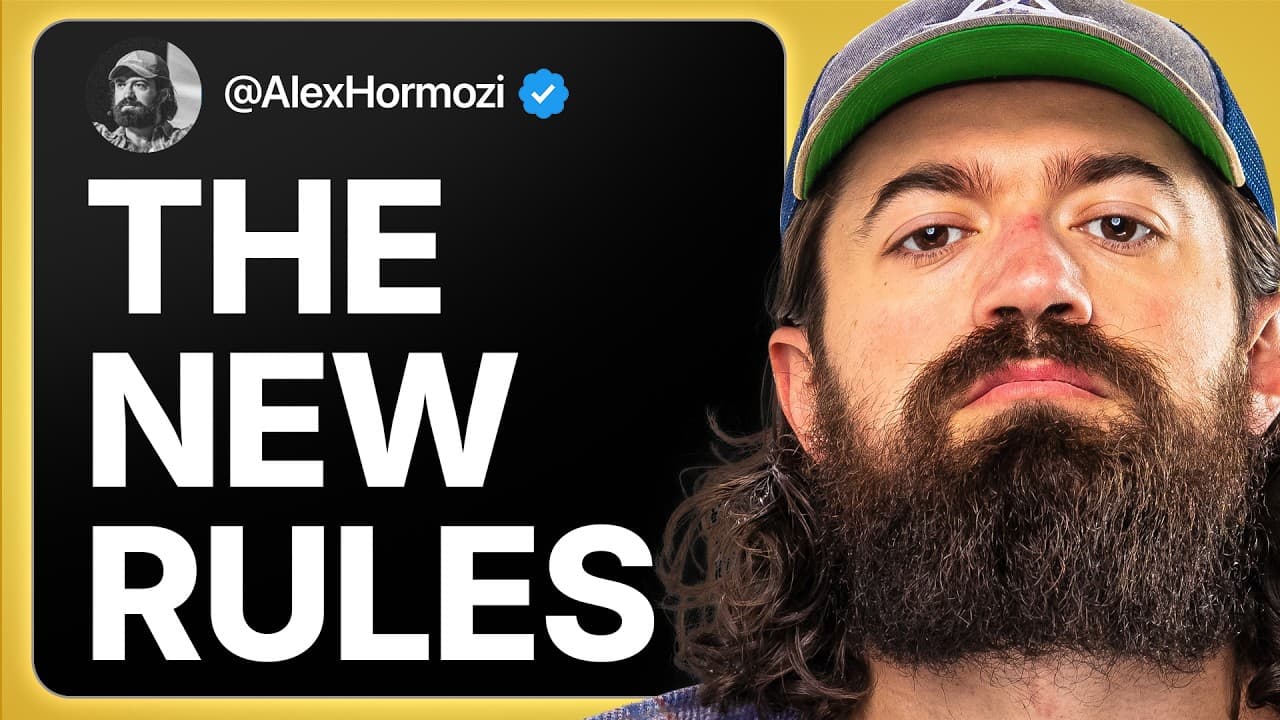
How to Build a Personal Brand Amid AI Disruption
TL;DR
Build a personal brand amid AI disruption by showing visible, real-world proof that makes people want to listen to you. The speaker maps creators along a risk continuum: entertainment asks only for viewing time, B2C education aims to change behavior, and money advice carries higher stakes and requires stronger credibility. With 21,393,122 followers across the ACQ brands cited as context, read on to understand how risk determines the proof your content needs.
Transcript
21,393,122 followers across all platforms for Leila, Chiron, and me in the ACQ brands. And I want to break down how to build a personal brand in 2026, both leveraging AI, but more importantly in spite of AI and how you can actually prove yourself as somebody that people will want to listen to. And so I think the big thing that has to be understood ... Read More
Key Insights
- AI will not equally disrupt all creators; risk levels vary across content types.
- Entertainment content is low-risk, focusing on consumption and immediate value delivery.
- B2C educational content has moderate risk, with lower stakes for consumer decisions.
- B2B content requires higher proof and credibility due to increased stakes and risks.
- Proof and real-time demonstration are essential for building trust in a brand.
- AI can replicate content, but not the authenticity of real-world experience and interaction.
- Creators should integrate proof into their business operations to showcase expertise.
- To compete with AI, focus on documenting real interactions and providing tangible proof.
Install to Summarize YouTube Videos and Get Transcripts
Explore YouTube Video Summarizer or Get YouTube Transcript Extractor
Questions & Answers
Q: How do you build a personal brand amid AI disruption?
Prove why people should listen to you by demonstrating relevant experience and credibility. The higher the risk involved in following your content, the more visible proof your audience will expect.
Q: Will AI disrupt all content creators equally?
No. Creators sit on a continuum from low risk to high risk, based on what their content asks consumers to do. AI is best suited to disrupt content on the lower-risk side, where audiences may act on tips as long as they seem sensible.
Q: What determines whether a creator is low risk or high risk?
The determining factor is what is being asked of the consumer. Watching a comedy clip risks only the viewer’s time, while acting on savings or investing advice puts money at stake and therefore requires more proof.
Q: Why is entertainment considered low-risk content?
Entertainment delivers its value within the content itself. If someone watches a stand-up clip and laughs, the value cycle is complete, with nothing further required from the viewer.
Q: What is the purpose of educational content?
The purpose of education is to change behavior. The transcript illustrates this with schooling, where children are expected to begin reading, writing, speaking, or doing math rather than continue acting the same.
Q: Why is B2C educational content lower risk than financial content?
B2C tutorials about hair, makeup, fitness, diet, or relationships generally carry lower stakes. If a diet or lash-extension technique does not work well, the consequence is presented as less serious than making a poor decision about savings or investing.
Q: How can a B2C creator demonstrate credibility?
A creator can use the product or method live and let viewers see the result. Huda Beauty is cited as an example because the product could be demonstrated with a before-and-after result in real time.
Q: Why do financial creators need more visible proof?
Savings and investing decisions involve more risk than hair, lashes, or diet tips, so audiences are less likely to trust someone without demonstrable third-party proof. The transcript points to credentials and experience, such as being an attorney, coming from finance, or having long-term business success, as reasons people listen to particular money creators.
Summary & Key Takeaways
-
Building a personal brand in the age of AI requires focusing on proof and real-world demonstration. AI will disrupt low-risk content more easily, so creators must show credibility and expertise, especially in higher-risk areas. Engage audiences through live demonstrations and authentic interactions to stand out.
-
Content creators face varying levels of risk from AI disruption, with entertainment being low-risk and B2B content requiring higher proof. To build a resilient brand, creators must integrate proof into their operations and showcase their expertise through real-time demonstrations and interactions.
-
AI's ability to replicate content challenges creators to differentiate through authenticity and proof. By documenting real interactions and providing tangible evidence of expertise, creators can build trust and credibility, essential for thriving in an AI-driven content landscape.
Read in Other Languages (beta)
Share This Summary 📚
Summarize YouTube Videos and Get Video Transcripts with 1-Click
Try YouTube Summary with ChatGPT & Claude or YouTube Transcript Generator
Explore More Summaries from Alex Hormozi 📚

Summarize YouTube Videos and Get Video Transcripts with 1-Click
Try YouTube Summary with ChatGPT & Claude or YouTube Transcript Generator