How Does Stanford's Octopus 2 Outperform GPT-4?
TL;DR
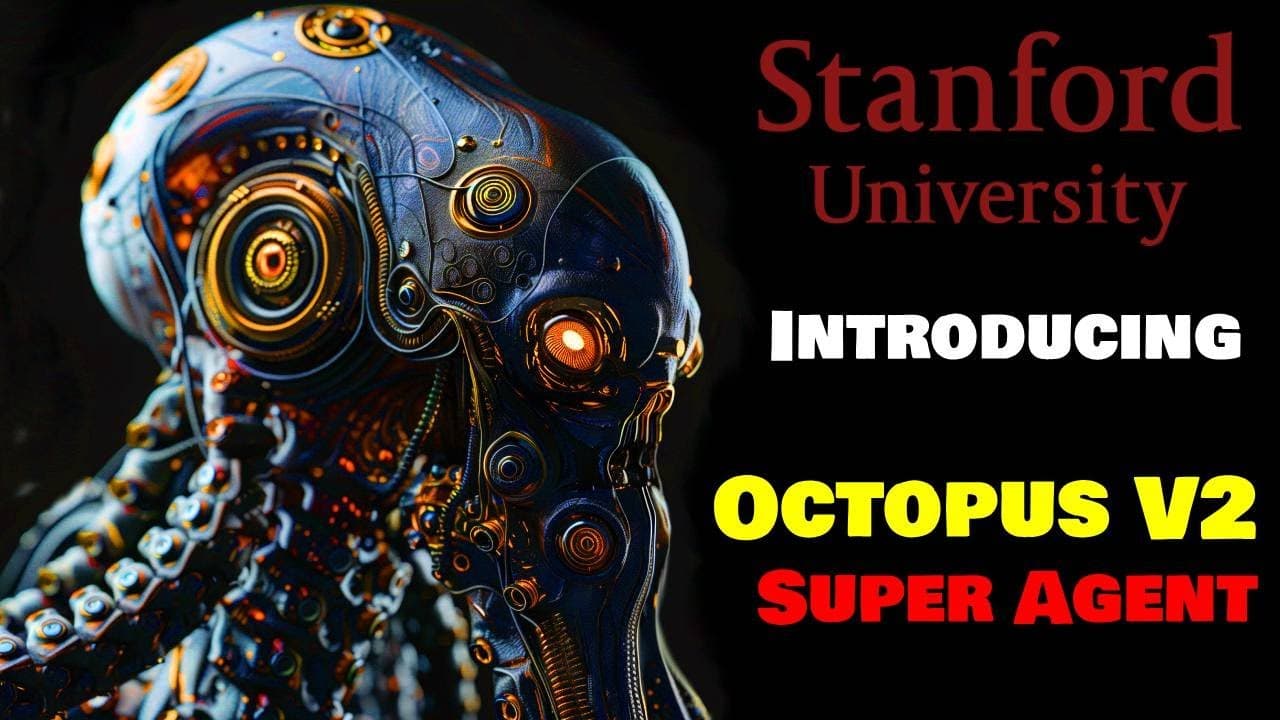
Stanford's Octopus 2 is an on-device language model that surpasses GPT-4 in accuracy and latency, enabling rapid function calling essential for AI agents. This smaller model demonstrates that compact AI can outperform larger counterparts in specific tasks, offering enhanced privacy and cost-efficiency.
Transcript
the autonomous AI agent space is heating up Stanford University drops this gem octopus B2 on device language model for super agent a small model that surpasses the performance of GPT 4 in both accuracy and latency how fast it is and what it is it's an on device language model for super agent so on device meaning it can run on your computer on your ... Read More
Key Insights
- 😶🌫️ On-device language models like Octopus 2 offer increased privacy and cost efficiency over cloud-based models.
- 🤙 Function calling is crucial for AI agents, with tiny models like Octopus 2 showcasing superior performance in specific tasks.
- 👍 Tiny AI models are proving to be as effective, if not more, than larger models like GPT 4, challenging the notion of scaling for AI advancement.
- 💋 The rapid growth of AI agents and tools is driven by advancements in on-device models like Octopus 2, marking a shift in AI architecture development.
- 🛩️ Comparison tests against GPT 4 and other models show that smaller, more efficient models can outperform larger counterparts in accuracy and latency.
- 👶 Lowering the context length by 95%, tiny models like Octopus 2 demonstrate a new approach to AI model development.
- 🛩️ Apple's on-device models and Stanford's Octopus 2 highlight the potential for highly effective, small-scale AI models to revolutionize specific tasks in various devices.
Install to Summarize YouTube Videos and Get Transcripts
Explore YouTube Video Summarizer or Get YouTube Transcript Extractor
Questions & Answers
Q: How does Octopus 2 compare to GPT 4 in terms of performance?
Octopus 2, a small on-device language model, surpasses GPT 4 in both accuracy and latency, providing superior results in specific tasks like function calling and screen reading.
Q: What are the advantages of on-device language models like Octopus 2?
On-device models like Octopus 2 offer increased privacy, reduced costs, and faster performance compared to cloud-based models like GPT 4, making them more accessible and efficient for users.
Q: What role does function calling play in AI agent creation?
Function calling is essential for defining the capabilities of AI agents, allowing them to perform specific tasks like taking photos, getting trending news, or sending emails with specified parameters and instructions.
Q: How do tiny AI models challenge the notion of larger models for AI advancement?
The success of tiny models like Octopus 2 and Apple's on-device models shows that smaller, more efficient models can be as effective, if not more, than larger models like GPT 4, challenging the idea of continuous scaling for AI improvement.
Summary & Key Takeaways
-
Octopus 2 is an on-device language model for super agents, smaller and faster than GPT 4.
-
It focuses on function calling, essential for creating AI agents, with improved accuracy and latency over large-scale models like GPT 4.
-
The research highlights the potential of tiny on-device AI models like Octopus 2 to outperform larger counterparts in specific tasks.
Read in Other Languages (beta)
Share This Summary 📚
Summarize YouTube Videos and Get Video Transcripts with 1-Click
Try YouTube Summary with ChatGPT & Claude or YouTube Transcript Generator
Explore More Summaries from AI Unleashed - The Coming Artificial Intelligence Revolution and Race to AGI 📚


Summarize YouTube Videos and Get Video Transcripts with 1-Click
Try YouTube Summary with ChatGPT & Claude or YouTube Transcript Generator