How to Complete the 30-Day Success Challenge
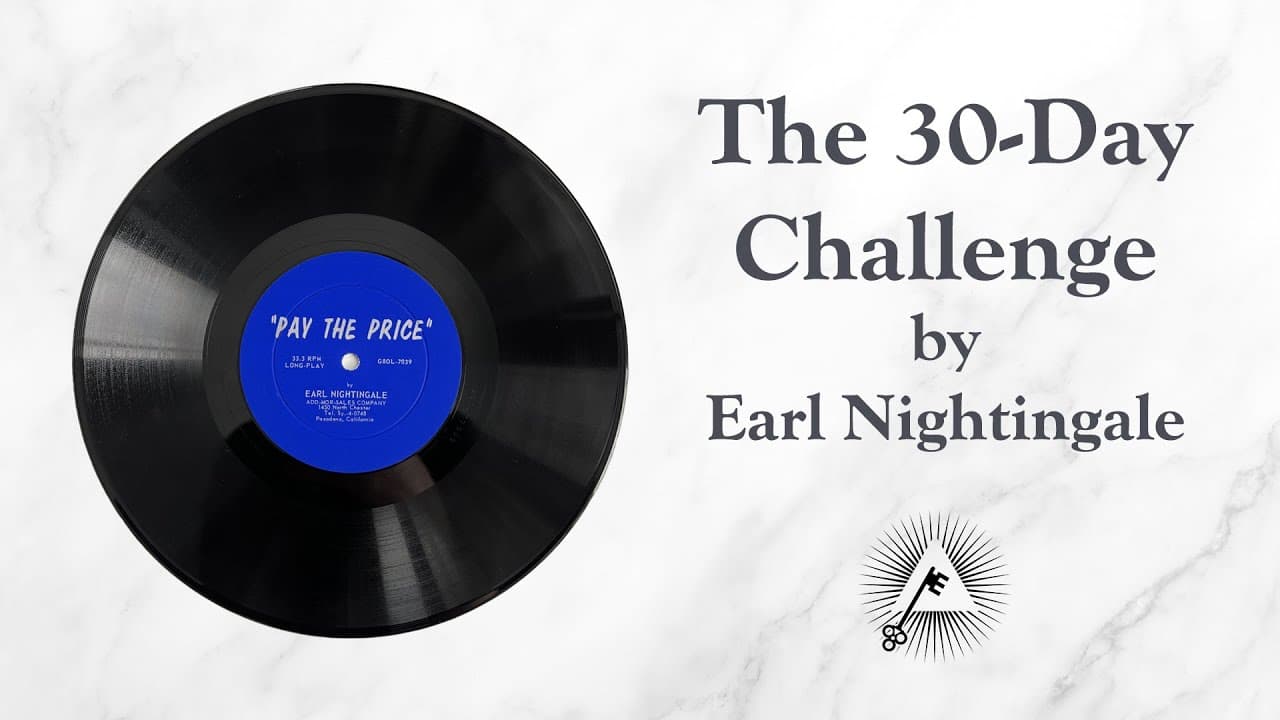
TL;DR
Choose one clearly defined goal, write it on a card, and focus on it with a calm, cheerful, positive attitude for 30 full days. Replace fearful thoughts with a mental picture of that goal, provide more useful service than required, act promptly on worthwhile ideas, save at least 10% of your earnings, and restart the challenge if persistent negativity breaks the practice.
Transcript
I want you to make a test that will last 30 days now it isn't going to be easy if you'll give it a good try it will completely change your life for the better back in the 17th century Sir Isaac nton the English mathematician and natural philosopher gave us some natural laws of physics which apply as much to human beings as they do to the movement o... Read More
Key Insights
- A clearly defined goal is the starting point of the 30-day test. The participant writes one specific desire on a card, carries it throughout the day, and reviews it each morning, whenever possible during the day, and immediately before going to bed.
- Thought control is presented as necessary for controlling one’s life. Nightingale says people become what they think about, so the challenge requires replacing each fearful or negative thought with a positive mental picture of the single worthwhile goal written on the card.
- Imagination is a tool for discovering possible solutions. The mind should examine the goal from every available angle, speculate freely about different approaches, reject self-imposed limitations, and remain alert for answers rather than assuming that present circumstances are strong enough to defeat the purpose.
- Courage is required to concentrate positively and act decisively. Once a course becomes clear, the participant should move promptly because ideas have no practical value without action. The challenge combines sustained attention with concrete effort instead of treating positive thinking as a substitute for work.
- The 30-day commitment requires doing more than the minimum. Participants are instructed to approach their jobs with calm assurance, give more of themselves than before, and understand that their returns will be directly proportional to what they contribute through useful work, products, or services.
- Saving at least 10% of earnings is part of the stated price of achievement. Nightingale includes this practice alongside goal concentration, imagination, courage, service, and action, making financial discipline one component of the broader program rather than its only measure of success.
- Persistence is described as another word for faith. The test should begin only after a firm decision to complete it, and if negative thinking overwhelms the participant, the instruction is to restart from that point and continue for another full 30 days.
- Financial return is presented as the result of successful service, not the definition of success. Nightingale argues that people must first provide products or services that others need and find useful, just as fuel must be placed in a stove before heat can be expected.
Install to Summarize YouTube Videos and Get Transcripts
Explore YouTube Video Summarizer or Get YouTube Transcript Extractor
Questions & Answers
Q: How do you complete Earl Nightingale’s 30-day challenge?
Choose one specific, clearly defined goal and write it on one side of a card. Carry the card and review the goal upon waking, repeatedly during the day, and before sleeping. For 30 full days, think about it positively, replace fearful thoughts with its mental image, remain calm and cheerful, work better than before, give additional service, and act when a useful course becomes clear.
Q: What should you write on the goal card?
Write the single thing you want more than anything else, expressed as a specific and clearly defined goal. The transcript gives examples such as doubling income, earning a particular amount, obtaining a beautiful home, succeeding at work, reaching a desired position, or developing a more harmonious family. On the other side, write the quoted instruction to ask, seek, and knock.
Q: How should you respond to negative thoughts during the challenge?
Each time a fearful or negative thought enters consciousness, replace it with a mental picture of the positive and worthwhile goal. Do not allow worry or minor annoyances to redirect attention. The practice should be calm and cheerful rather than hectic. If negative thoughts overwhelm the effort, restart from that point and complete another uninterrupted period of 30 full days.
Q: Why does the challenge require one clearly defined goal?
One clearly defined goal gives the participant a purpose, a reason to rise each morning, and a consistent subject for thought. Nightingale says that deciding on a goal places a person among those who know where they are going. Repeatedly reviewing one goal also gives imagination a stable problem to examine from many angles while possible answers and courses of action emerge.
Q: What does paying the price for success mean?
Paying the price means accepting that desired results require corresponding effort. The stated price includes controlling thought, removing self-imposed limitations, using imagination, showing courage, concentrating daily on a definite goal, acting promptly when the course is clear, saving at least 10% of earnings, doing more than required, and providing useful products or services before expecting financial returns.
Q: How are service, success, and money connected?
Nightingale presents financial return as directly proportional to useful service. People earn money by exchanging products or services that others need and value. In this view, making money follows successful service rather than creating success by itself. The stove comparison captures the order: fuel must be supplied before heat appears, just as value must be provided before payment can reasonably be expected.
Q: What should you do each day during the 30-day test?
Review the written goal several times, maintain a cheerful and positive outlook, replace fear with the goal’s mental image, and perform your responsibilities better than before. Give more of yourself without focusing constantly on immediate returns. Remain attentive to possible solutions, use imagination freely, act decisively when the direction becomes clear, and prevent worry or petty irritation from pulling you off course.
Q: What happens if you fail to maintain the challenge for 30 days?
If you become overwhelmed by negative thoughts during the first attempt, begin again from that point and continue for another full 30 days. The instruction treats persistence as evidence of faith and emphasizes that a new mental habit is difficult to form. Repeated practice should continue until positive goal-directed thinking becomes established and follows the participant beyond the original test period.
Summary & Key Takeaways
-
Nightingale argues that achievement requires paying a proportional price in effort, service, disciplined thought, imagination, courage, saving, and action. His central principle is that people become what they think about. Accordingly, controlling attention and repeatedly concentrating on a specific worthwhile goal can redirect behavior and create a more purposeful way of living.
-
The 30-day test begins by writing one clearly defined goal on a card and reviewing it each morning, throughout the day, and before sleep. Participants replace fearful or negative thoughts with a mental picture of the goal, remain calm and cheerful, perform their work exceptionally well, and give more service without immediately demanding returns.
-
Persistence demonstrates faith within the challenge, so anyone overwhelmed by negative thinking should begin another full 30-day period from that point. Nightingale also advises maintaining inspiration through constructive books and repeated listening. He presents financial returns as proportional to useful service, arguing that people must provide value before expecting money or prosperity.
Read in Other Languages (beta)
Share This Summary 📚
Summarize YouTube Videos and Get Video Transcripts with 1-Click
Try YouTube Summary with ChatGPT & Claude or YouTube Transcript Generator
Explore More Summaries from Master Key Society 📚
Summarize YouTube Videos and Get Video Transcripts with 1-Click
Try YouTube Summary with ChatGPT & Claude or YouTube Transcript Generator