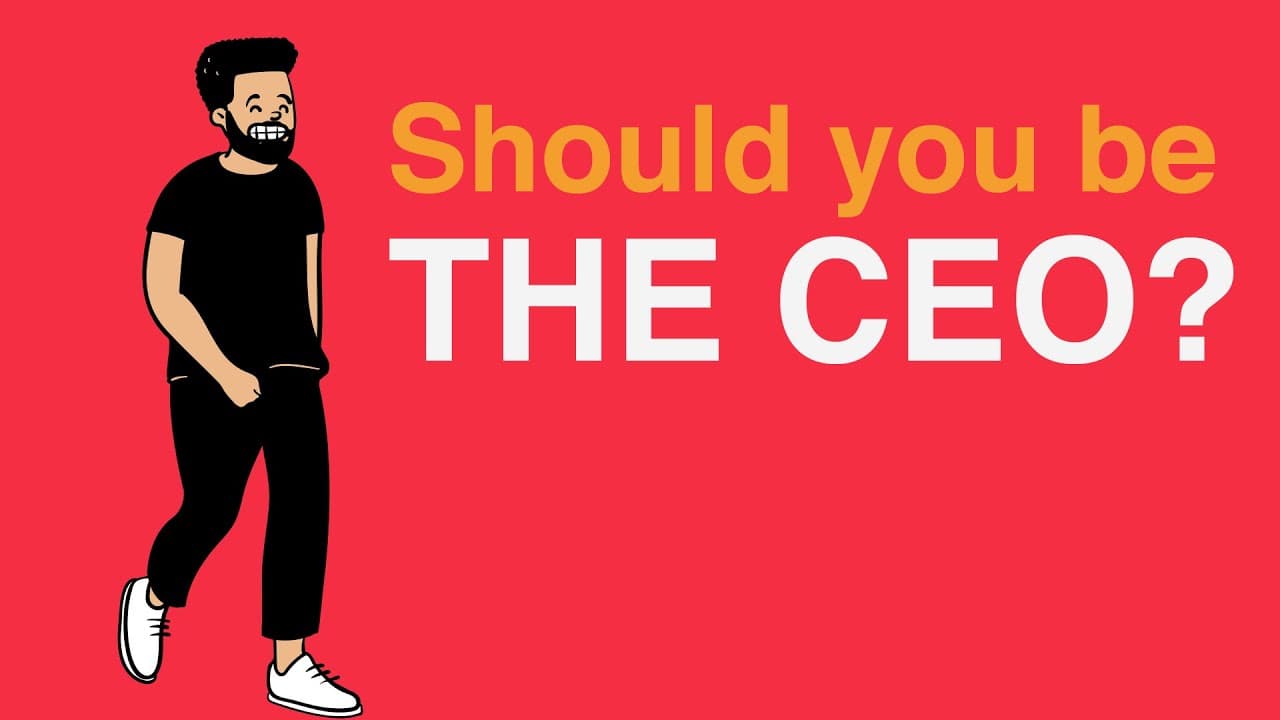
Should you be the CEO?
TL;DR
You should become CEO if you need the authority to fix what is broken and are willing to make the role your primary responsibility. The job requires leading the company’s vision, hiring and managing people, raising funds, handling investors, and persuading others to follow, while shared CEO arrangements can create frustration, delay, and organizational chaos.
Transcript
- Picture this, it's 2010, and me and my co-founder are pitching on Sand Hill Road. We're sitting in the offices of Andreessen Horowitz, pitching Marc Andreessen, and Ben Horowitz. We thought it was going fun, just like the others. Ben turns to us and asks, "Who's the CEO?" I looked at my co-founder Sachin, he looked at me, we said both. (loud blas... Read More
Key Insights
- Shared CEO leadership is structurally slow because major decisions may have to wait until both leaders agree. What appears collaborative to founders and board members can feel like frustration, chaos, and delay to the people responsible for executing the company’s work.
- A startup CEO is a singular point of authority and accountability. The role becomes especially important after product market fit, when company leadership requires dedicated attention beyond the early stage effort of getting a product or service off the ground.
- The desire for agency is a legitimate reason to pursue the CEO role. If a founder becomes intensely frustrated when problems remain broken because someone else controls the solution, that founder may need the authority that comes with being CEO.
- Self-advocacy is necessary when founders divide authority or ownership. Co-founders may be aligned on many company matters, but decisions about leadership and how to divide the pie create moments when personal needs differ and must be expressed clearly.
- CEO work requires a specific collection of leadership abilities. The CEO must persuade people to follow, hire and manage employees, raise funds, manage investors, drive company vision, and combine these responsibilities to help build a strong product or service.
- Enjoying product work does not automatically make avoiding the CEO role the right decision. Coding, designing, and shipping can feel immediately rewarding, but a founder must decide whether those activities matter more than gaining authority to steer the entire company.
- CEO responsibility requires dropping other work when necessary. A founder should not accept the title unless willing to prioritize the limited set of tasks only the CEO can perform and commit to doing those tasks to the best of their ability.
- The right leadership role depends on honest personal judgment. Some founders never want to become CEO, others need the role to steer the company, and some know from the moment they leave their jobs that they want the necessary authority.
Install to Summarize YouTube Videos and Get Transcripts
Explore YouTube Video Summarizer or Get YouTube Transcript Extractor
Questions & Answers
Q: How do you decide whether you should become a startup CEO?
You should consider becoming CEO if you need the authority to fix company problems and would feel deeply frustrated leaving those problems under someone else’s control. You must also be willing to stop prioritizing enjoyable individual work and focus on leadership duties, including vision, hiring, management, fundraising, investor relations, and persuading people to follow you.
Q: Why do shared CEO arrangements often fail in startups?
Shared CEO arrangements often fail because consequential decisions require agreement between two leaders. That additional dependency makes decisions take longer and can create frustration, chaos, and delay for employees doing the work. Although shared command may look attractive to founders and board members, the resulting loss of speed can become a serious threat to a startup’s survival.
Q: What responsibilities can only the startup CEO handle?
After product market fit, the CEO has several distinctive responsibilities that require focused ownership. These include convincing people to follow, hiring and managing employees, fundraising, managing investors, driving the company’s vision, and bringing those functions together to build a strong product or service. The role requires treating these responsibilities as priorities rather than secondary tasks.
Q: Can a founder keep coding while serving as CEO?
A founder may enjoy coding, designing, and shipping products, but becoming CEO requires a willingness to drop other activities when the company’s leadership needs demand attention. The decision is not simply about which work feels best. It is about whether the founder will prioritize vision, recruiting, management, fundraising, investors, and overall company coordination above individual product contributions.
Q: Is wanting authority a bad reason to become CEO?
Wanting authority does not have to be an expression of ego. A founder may legitimately need agency because being unable to repair a broken situation under someone else’s control would cause intense frustration. The important question is whether authority is needed to serve the company and whether the founder is prepared to accept the demanding responsibilities attached to that authority.
Q: When does the CEO role become especially important in a startup?
The CEO role becomes especially important after product market fit. Early in a startup, everyone may focus on getting the product or service off the ground. Later, a limited set of responsibilities requires dedicated CEO attention, including setting vision, recruiting and managing people, raising money, working with investors, and coordinating these elements into effective company leadership.
Q: How should co-founders choose who becomes CEO?
Co-founders should avoid treating CEO selection as an issue that can remain unresolved. They need to examine who requires decision-making authority, who is willing to prioritize the CEO’s specific duties, and who can lead employees, investors, fundraising, hiring, management, and vision. Each founder should advocate honestly for personal needs because leadership decisions can expose misaligned interests.
Q: What should a founder do after deciding to become CEO?
After deciding to become CEO, a founder must acquire and practice the role’s specific skills. That means learning to persuade people to follow, hire and manage effectively, raise funds, manage investor relationships, establish company vision, and coordinate these responsibilities. Desire for authority alone is insufficient without a commitment to perform the CEO’s work to the best of one’s ability.
Summary
In this video, the speaker recounts a mistake they made when pitching their startup to venture capitalists. They were asked who the CEO was, and they responded with "both," assuming that a co-CEO arrangement could work for them like it did for Google's Larry Page and Sergey Brin. However, the speaker later realizes that having two co-CEOs creates frustration, chaos, and delays, and can ultimately slow down the progress of a startup. The speaker reflects on their own experience and advises viewers to consider the importance of authority and self-advocacy when deciding who should be CEO. They also highlight the specific skills and responsibilities required of a CEO and emphasize the need for self-awareness in making this decision.
Questions & Answers
Q: Why did the speaker think a co-CEO arrangement would work for their startup?
The speaker believed that if the co-CEO arrangement was successful for Google's founders, it could also work for their startup.
Q: Why did the speaker regret not becoming the CEO themselves?
The speaker realized that authority and the ability to fix problems were important aspects of being a founder, and they didn't truly understand this until later in their career.
Q: What did the speaker consider when deciding whether to be CEO or continue coding?
The speaker enjoyed coding and shipping products, so they had to weigh the satisfaction they derived from those tasks against the unique responsibilities and skillset required of a CEO.
Q: What are some specific tasks that only the CEO can do?
After achieving product-market fit, the CEO becomes instrumental in driving the vision of the company, managing investors, hiring and managing employees, and being the cohesive force that brings everything together to build a great product or service.
Q: What advice does the speaker have for viewers?
The speaker urges viewers not to delude themselves about whether or not they should be CEO. If they truly feel the need for authority and have the drive to acquire the necessary skills, then they should pursue becoming a CEO.
Q: Is being a CEO right for everyone?
No, being a CEO is not for everyone. It requires a specific skillset and willingness to take on the unique responsibilities of the role. Each individual should assess their own desires and capabilities before deciding if they should be a CEO.
Q: What does the speaker emphasize about the decision to become a CEO?
The speaker highlights the importance of self-awareness and self-advocacy in the decision-making process. Each individual must understand their own needs and goals and be proactive in pursuing the role of CEO if it aligns with those aspirations.
Q: What does the speaker want viewers to take away from this video?
The speaker wants viewers to learn from their mistake and not underestimate the significance of being a CEO. They encourage viewers to make informed decisions about their role in a startup, acquire the necessary skills, and manifest their aspirations.
Takeaways
In this video, the speaker emphasizes the importance of understanding one's own needs and goals when deciding to become a CEO. While a co-CEO arrangement may work for some companies, it can often lead to frustration, chaos, and delays. The role of a CEO requires a specific skillset and the ability to take on unique responsibilities, such as driving the company's vision, managing investors, and hiring and managing employees. It is crucial for individuals to have self-awareness and self-advocacy in order to make informed decisions about their role in a startup. Ultimately, the decision to become a CEO should align with one's aspirations and the desire for authority and agency.
Summary & Key Takeaways
-
The founder recalls pitching Andreessen Horowitz in 2010 with his Posterous co-founder. When Marc Andreessen and Ben Horowitz asked who was CEO, both founders claimed the role. That answer exposed their unresolved leadership structure and effectively undermined the meeting, despite their promising growth, software, and confidence in the company at that time.
-
Shared CEO arrangements appear attractive because they promise two capable leaders and balanced authority. For employees, however, shared command can produce frustration, chaos, and delay. Important choices must wait until both leaders agree, slowing the organization when speed matters. A startup therefore needs one clearly accountable CEO who can make consequential decisions promptly.
-
Choosing to become CEO requires honest self-knowledge. A founder who needs authority to repair problems may become deeply frustrated under someone else’s leadership. After product market fit, the CEO must prioritize vision, recruiting, management, fundraising, investors, and organizational coordination. Anyone unwilling to focus on those responsibilities should pursue another important company role instead.
Read in Other Languages (beta)
Share This Summary 📚
Summarize YouTube Videos and Get Video Transcripts with 1-Click
Try YouTube Summary with ChatGPT & Claude or YouTube Transcript Generator
Explore More Summaries from Garry Tan 📚

Summarize YouTube Videos and Get Video Transcripts with 1-Click
Try YouTube Summary with ChatGPT & Claude or YouTube Transcript Generator