How Does OpenAI's Image Generation Outperform Others?
TL;DR
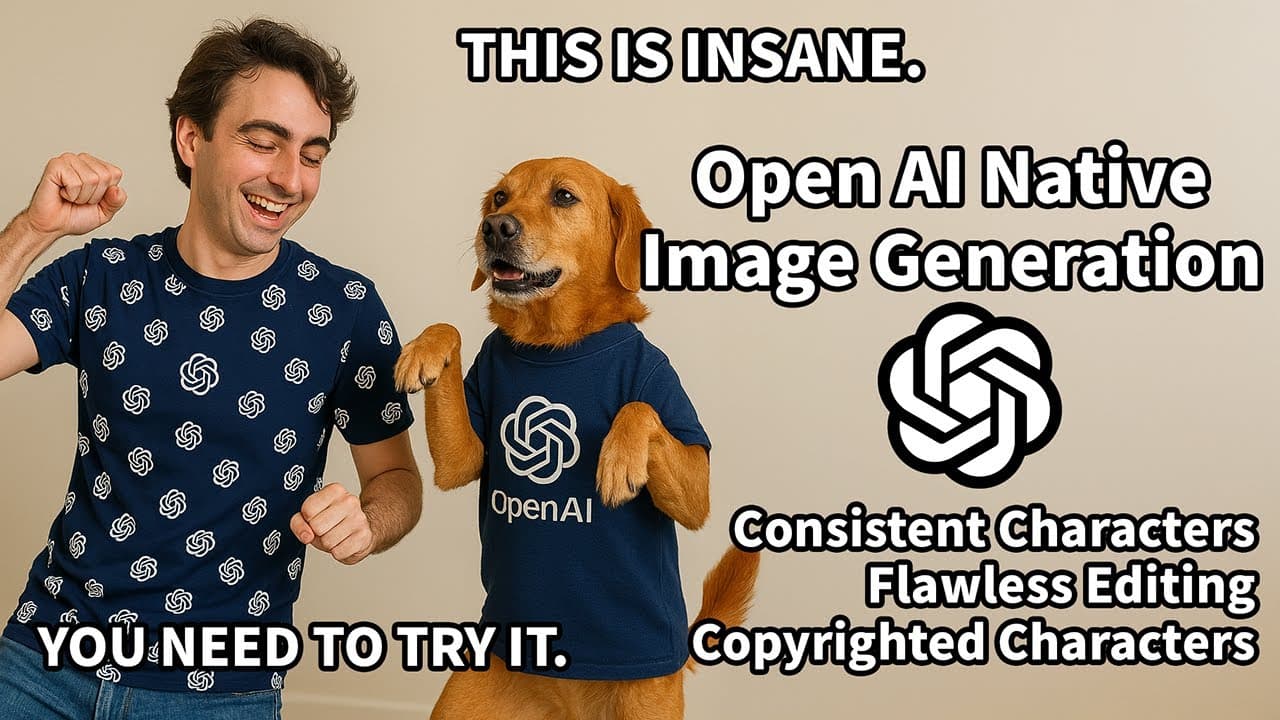
OpenAI’s native image generation outperforms traditional diffusion tools by understanding conversational language, reference images, character consistency, iterative edits, and text-heavy compositions within one multimodal model. Available in ChatGPT and Sora across all platforms and all three ChatGPT tiers, it can one-shot photorealistic identity transformations, multi-panel manga, and labeled infographics. Read on for specific examples and an explanation of how the model works.
Transcript
Yesterday, OpenAI dropped a little bit of a surprise on us. They finally released their very own native image generation. Now, this brand new native image generation is available in both ChatGpt and Sora, and it's on all platforms and all three tiers of chat GPT. And the things that this brand new native image generation can do have seriously aston... Read More
Key Insights
- OpenAI's native image generation is integrated into ChatGPT and available across all platforms and tiers.
- The technology surpasses traditional diffusion models by incorporating text, image, and sound data.
- It allows for natural language understanding and image manipulation, creating realistic images.
- Native image generation supports consistent character design and complex visual storytelling.
- The model can produce detailed infographics and manga panels with high accuracy.
- Community experiments showcase the model's ability to generate creative and varied images.
- The technology marks a significant advancement in AI image generation, offering better prompt coherence.
- OpenAI's model allows for style transfer and editing, enhancing its versatility and application.
Install to Summarize YouTube Videos and Get Transcripts
Explore YouTube Video Summarizer or Get YouTube Transcript Extractor
Questions & Answers
Q: How does OpenAI's native image generation outperform traditional diffusion models?
OpenAI’s system is described as a large autoregressive transformer trained with text, image pairs, and sound, so it can understand conversational instructions as well as images. The transcript says this makes reference handling, character consistency, subtle changes, and repeated editing more natural than with traditional diffusion models.
Q: What does native image generation mean?
Native image generation means the same multimodal model can take in images, understand what it sees, and output images. According to the transcript, the model also retains the language abilities needed to interpret natural conversational requests.
Q: Where is OpenAI's native image generation available?
The transcript says the feature is available in both ChatGPT and Sora. It is also described as being offered on all platforms and all three ChatGPT tiers.
Q: Can OpenAI's image generator preserve a person's identity from a reference photo?
The video shows Igor Pagani submitting a photo of his face and generating an image of himself as a firefighter. The narrator says the model completed this in one shot, whereas a comparable traditional diffusion workflow could require training that might take about 30 minutes.
Q: How well does the model maintain characters and backgrounds across images?
In Greg Brockman’s example, a woman turns around while retaining her OpenAI-logo shirt. The text and background also remain the same, demonstrating the consistency that the narrator highlights.
Q: Can OpenAI's image generation create readable text and manga panels?
The transcript describes a complex multi-panel manga generated from scratch with few, if any, text errors. It also maintained a consistent character across the panels while producing the requested manga style.
Q: Can the model generate a complete infographic in one shot?
One example is a full diagram explaining why San Francisco is foggy. It labels the fog, coastal mountains, marine layer, cold ocean, rising air, and airflow, while also including full descriptive sentences.
Q: Does OpenAI's image generation make accurate step-by-step visual instructions?
The model generated a graphical guide for drawing an owl, beginning with two overlapping circles, guidelines, and the basic head and body shapes. The narrator notes that steps three and four appear somewhat incorrect, but considers the remaining guide close to a complete graphical instruction.
Summary & Key Takeaways
-
OpenAI's new native image generation marks a significant advancement in AI technology, integrating text, image, and sound data for superior image creation. It offers capabilities that surpass traditional diffusion models, enabling realistic images, consistent character design, and complex visual storytelling. This technology sets a new standard in AI image generation, allowing for better prompt coherence and versatility.
-
The model's ability to understand natural language and manipulate images is a game-changer, offering seamless integration with ChatGPT across all platforms and tiers. Its potential for creating detailed infographics, manga panels, and realistic images demonstrates its groundbreaking capabilities.
-
Community experiments highlight the model's creative potential, showcasing its ability to generate varied and imaginative images. This technology represents a leap forward in AI image generation, offering unparalleled capabilities for creativity and visual storytelling.
Read in Other Languages (beta)
Share This Summary 📚
Summarize YouTube Videos and Get Video Transcripts with 1-Click
Try YouTube Summary with ChatGPT & Claude or YouTube Transcript Generator
Explore More Summaries from MattVidPro 📚
Summarize YouTube Videos and Get Video Transcripts with 1-Click
Try YouTube Summary with ChatGPT & Claude or YouTube Transcript Generator