Will AI Make Retirement Savings Unnecessary?
TL;DR
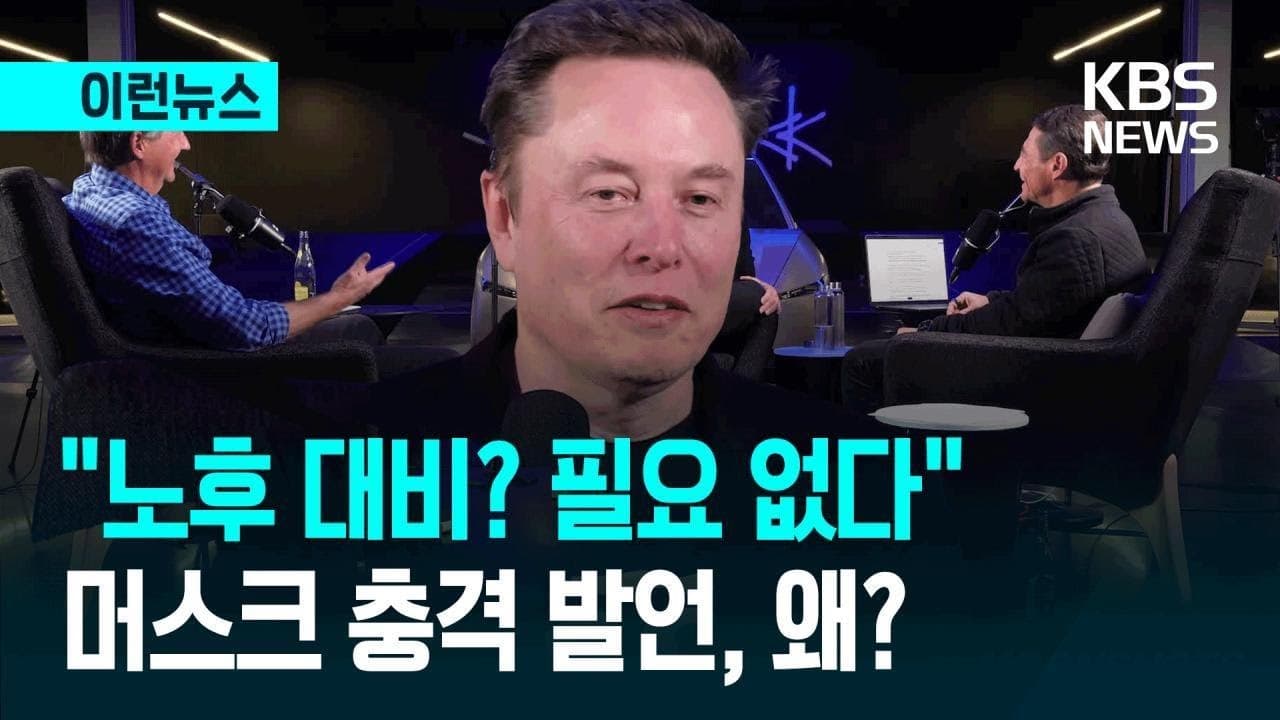
Elon Musk predicts that retirement savings could become irrelevant within 10 or 20 years if AI and robotics make goods and services abundant and inexpensive. He expects production to grow faster than the money supply, pushing prices downward until housing, health care, entertainment, and other necessities become broadly available, although he admits the transition could be turbulent and his forecast remains uncertain.
Transcript
Yeah. Um well, one like side recommendation I have is like don't worry about like squirreling money away for uh retirement in like 10 or 20 years. It won't matter. >> You are you are personally. >> Yeah. >> Yeah. >> It's always AI assistant says >> we're going back to the theme of this talk. How can AI and exponential tech save America and the worl... Read More
Key Insights
- Musk's retirement advice is conditional on AI and robotics producing the economic transformation discussed in the interview. He says that saving for retirement could become irrelevant within 10 or 20 years because essential goods and services would already be available.
- AI is expected to make intelligence available at a minimal price. Musk's argument assumes that inexpensive machine intelligence will reduce the cost of producing goods and providing services, contributing to a major increase in overall economic output.
- Robotics is expected to transform labor costs into costs associated mainly with capital equipment and electricity. Under this forecast, the remaining production expenses would increasingly consist of materials and energy rather than human labor or costly intelligence.
- Deflation occurs in Musk's account when the output of goods and services grows faster than the money supply. He predicts that AI-driven production could expand rapidly enough to lower dollar prices even if governments try to increase the supply of money faster.
- Universal abundance may emerge through lower prices rather than taxation and redistribution. The discussion distinguishes universal high income from universal access to abundant goods and services, including housing, health care, entertainment, and other forms of support.
- The transition to an AI-driven economy is expected to be turbulent. Musk calls AI and robotics a supersonic tsunami and says their development is accelerating without a velocity control or off switch, while also acknowledging that he does not know every answer.
- Company profitability could rise sharply if labor and intelligence costs approach zero while production continues increasing. The interview identifies a remaining economic question: consumers must still have sufficient capital or access to resources to obtain the expanding supply of products and services.
- Economic measurements may not fully capture the predicted expansion in useful output. Musk uses a joke about two economists generating measured activity without improving their position to illustrate his skepticism about equating recorded monetary transactions with genuine increases in goods and services.
Install to Summarize YouTube Videos and Get Transcripts
Explore YouTube Video Summarizer or Get YouTube Transcript Extractor
Questions & Answers
Q: Why does Musk think retirement savings may become unnecessary?
Musk thinks retirement savings may become unnecessary if AI and robotics make essential goods and services extremely abundant and inexpensive within 10 or 20 years. His forecast assumes that housing, health care, entertainment, and other services will be available without requiring large personal savings. He presents this as a conditional prediction, not a settled outcome, and admits that he has not figured out every aspect of the transition.
Q: How could AI and robotics reduce the prices of goods and services?
AI could make intelligence available at a minimal price, while robotics could reduce the human labor required for production and service delivery. Musk argues that costs would then shift mainly toward capital equipment, electricity, and raw materials. As efficiency and output rise, businesses could provide more goods and services at lower cost, causing consumer prices to fall toward the underlying costs of materials and energy.
Q: What does universal high stuff and services mean?
Universal high stuff and services refers to broad access to abundant products and essential services rather than a government program focused only on distributing money. In the discussion, the concept includes sufficient housing, health care, entertainment, and other support. Musk suggests that rapidly falling prices could create this access directly, because AI-driven production would expand supply and reduce costs across much of the economy.
Q: Why does Musk predict deflation from artificial intelligence?
Musk predicts deflation because he expects the output of goods and services to grow faster than the money supply. He describes dollar prices as reflecting the relationship between economic output and available money. If AI and robotics cause production to expand more quickly than governments expand the money supply, prices would fall. He believes this could occur even if governments deliberately accelerate monetary growth.
Q: What costs would remain if labor and intelligence became nearly free?
If AI makes intelligence nearly free and robotics sharply reduces labor costs, Musk says production would still require capital equipment, electricity, and materials. Goods and services would therefore not become literally costless. Instead, their prices could move closer to these basic inputs as expensive human labor and intelligence contribute less to total production costs, making a much larger volume of output affordable.
Q: Does Musk claim to know exactly how the AI transition will unfold?
Musk does not claim certainty about how the transition will unfold. He repeatedly says that he is offering his best guess, remains open to ideas, and does not have all the answers. He expects a turbulent journey even while choosing an optimistic interpretation. His retirement comment is explicitly tied to the condition that the predicted changes in productivity, abundance, and service availability actually occur.
Q: How could AI affect company profits and consumer purchasing?
The discussion suggests that company profits could rise sharply if the costs of labor and intelligence approach zero while businesses continue producing more products and services. However, it also raises an unresolved demand problem: someone must be able to acquire what companies produce. The participants question whether governments would tax and redistribute profits or whether falling prices and abundant services would make direct income redistribution less important.
Q: Why does Musk call AI and robotics a supersonic tsunami?
Musk calls AI and robotics a supersonic tsunami to convey that the technologies are advancing rapidly and could create sweeping economic change. The discussion says there is no velocity control or simple on and off switch for this acceleration. Although the metaphor sounds alarming, the participants frame awareness as important because society currently lacks a complete system for ensuring that the transition produces beneficial outcomes.
Summary & Key Takeaways
-
Musk advises people not to worry excessively about accumulating retirement savings for 10 or 20 years from now. His reasoning is conditional: if AI and robotics develop as discussed, abundant housing, health care, entertainment, and other services could make personal retirement assets unnecessary rather than merely supplementing them through redistributed income.
-
The predicted economic mechanism is rapid productivity growth. AI would provide intelligence at minimal cost, while robotics would reduce labor costs toward capital expenditure and electricity. As production becomes more efficient, goods and services could approach the basic costs of materials and energy, allowing prices to fall substantially across the economy.
-
Musk expects output of goods and services to increase faster than the money supply, creating deflationary pressure even if governments accelerate monetary expansion. He describes AI and robotics as an accelerating force with no practical off switch, but acknowledges that the transition may be turbulent and that he does not have definitive answers.
Read in Other Languages (beta)
Share This Summary 📚
Summarize YouTube Videos and Get Video Transcripts with 1-Click
Try YouTube Summary with ChatGPT & Claude or YouTube Transcript Generator
Explore More Summaries from KBS News 📚

Summarize YouTube Videos and Get Video Transcripts with 1-Click
Try YouTube Summary with ChatGPT & Claude or YouTube Transcript Generator