Does P Equal NP? Unpacking a Complex Conjecture
TL;DR
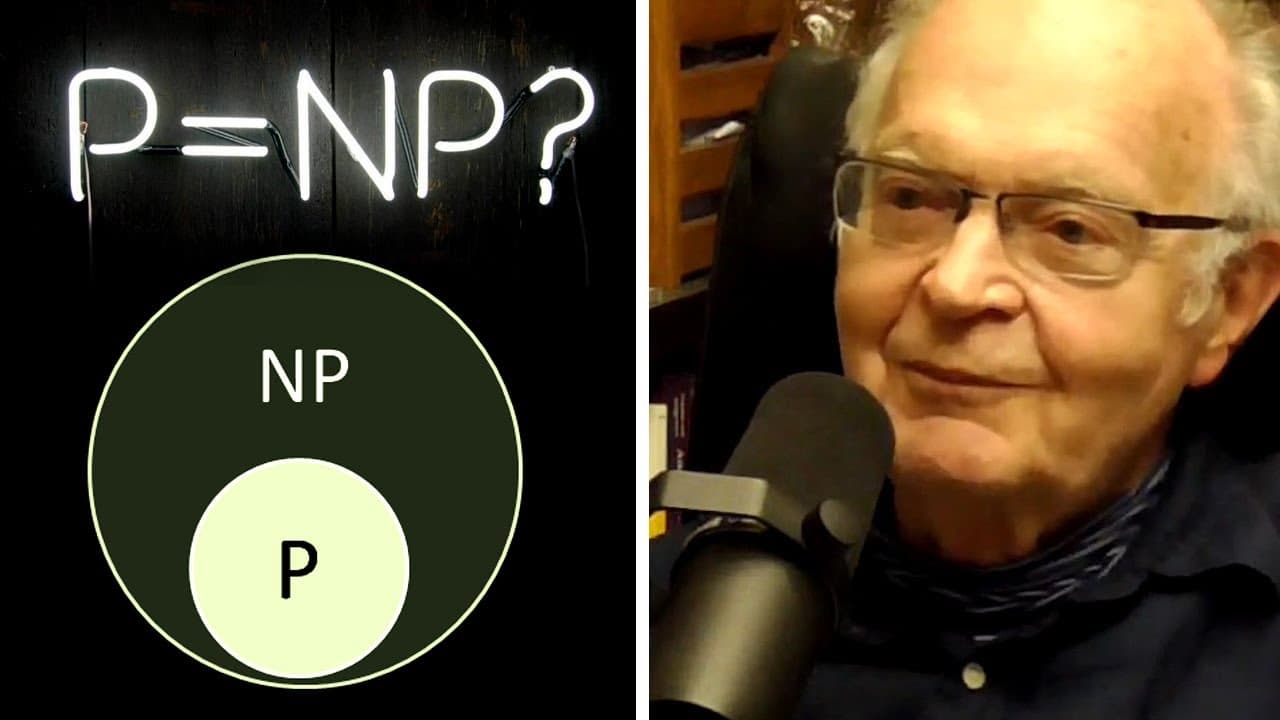
P might equal NP, but proving it won't guarantee practical algorithms due to the immense complexity of existing algorithms that are beyond human understanding. While solutions can be shown to exist, specific algorithms to find those solutions remain elusive, highlighting a significant gap in our comprehension of problem-solving within computer science.
Transcript
you've mentioned over the past few years that you believe P may be equal to NP but that it's not really you know if somebody does prove that P equals NP it will not directly lead to an actual algorithm to solve difficult problems can you explain your intuition here has it been changed and in general on the difference between easy and difficult prob... Read More
Key Insights
- 💄 Many algorithms exist that are beyond human comprehension, making it difficult to find and understand them.
- 👍 The existence of a solution can be proven for certain problems, but finding the corresponding algorithm is a challenge.
- 📈 The theorem in graph theory provides a framework for determining if a graph belongs to a specific class efficiently.
- 📈 The finiteness of the minimum graphs in graph theory allows for polynomial time algorithms, even if the specific graphs are not known.
- 👍 The researcher's intuition suggests that P might be equal to NP, but this is not a proven statement.
- 👾 The vastness of the space of possibilities and the failure to find an algorithm so far do not determine the truth of the P vs NP problem.
Install to Summarize YouTube Videos and Get Transcripts
Explore YouTube Video Summarizer or Get YouTube Transcript Extractor
Questions & Answers
Q: Why is it difficult to find algorithms for certain problems, even if their existence can be proven?
The vast number of algorithms that exist and the fact that many are beyond human comprehension make it challenging to discover and understand them. While the existence of a solution can be proven, finding the specific algorithm remains a difficult task.
Q: How does the theorem in graph theory contribute to solving problems for specific graph classes?
The theorem states that for any class of graphs closed under taking minors, there exists a finite number of minimum graphs that serve as obstructions. By checking if a given graph contains one of these obstructions, one can determine whether it belongs to the particular graph class, solving problems efficiently for that class.
Q: Why is the finite number of minimum graphs significant in the context of algorithms?
While the exact number of minimum graphs may be unknown, the finiteness ensures that there are a limited number of possibilities to explore. This allows for the creation of polynomial time algorithms that can determine if a given graph belongs to a certain class, even if the specific graphs within that class are not known.
Q: What is the researcher's intuition regarding the P vs NP problem?
The researcher holds the intuition that P might be equal to NP, but acknowledges that this is not proven. They believe that ruling out the vast number of possible algorithms is necessary, and the failure to find an algorithm so far does not necessarily mean one does not exist.
Key Insights:
- Many algorithms exist that are beyond human comprehension, making it difficult to find and understand them.
- The existence of a solution can be proven for certain problems, but finding the corresponding algorithm is a challenge.
- The theorem in graph theory provides a framework for determining if a graph belongs to a specific class efficiently.
- The finiteness of the minimum graphs in graph theory allows for polynomial time algorithms, even if the specific graphs are not known.
- The researcher's intuition suggests that P might be equal to NP, but this is not a proven statement.
- The vastness of the space of possibilities and the failure to find an algorithm so far do not determine the truth of the P vs NP problem.
- The comparison to the search for aliens highlights the possibility of existence despite the lack of evidence so far.
Summary & Key Takeaways
-
The researcher explains that while it is believed that an algorithm exists for certain problems, there is often no understanding or knowledge of what those algorithms actually are.
-
There are cases where the existence of a solution can be proven, but finding the algorithm to solve it remains a challenge.
-
A powerful theorem in graph theory states that for any class of graphs closed under taking minors, there is a polynomial time algorithm to determine if a graph is in that class or not.
Read in Other Languages (beta)
Share This Summary 📚
Summarize YouTube Videos and Get Video Transcripts with 1-Click
Try YouTube Summary with ChatGPT & Claude or YouTube Transcript Generator
Explore More Summaries from Lex Fridman 📚



Summarize YouTube Videos and Get Video Transcripts with 1-Click
Try YouTube Summary with ChatGPT & Claude or YouTube Transcript Generator