What Is the Compound Probability of Multiple Events?
TL;DR
Compound probability involves calculating the likelihood of multiple events, which can be classified as independent or dependent. Independent events do not affect each other's probabilities, while dependent events do. The product rule is used for sequences of events, and the addition rule applies when considering multiple outcomes.
Transcript
good day welcome to Tech math Channel what we're going to be having a look at in this video is probability involving multiple steps or multiple events it's part of a series of videos where I've been having a look at probability and it's going to be a few things we're going to cover in this particular video we're going to cover uh independent and de... Read More
Key Insights
- ❓ Probability involving multiple events can be classified as independent or dependent.
- ⏮️ Independent events are not affected by any other event, while dependent events are influenced by previous events.
- 📏 The product rule is used when calculating the probability of multiple events occurring in a series.
- 📏 The addition rule is used when calculating the probability of at least one event occurring out of multiple possibilities.
- 🌲 Tree diagrams can be helpful in visualizing and calculating probabilities in multiple event scenarios.
- ❓ The concept of replacement in probability calculations can affect whether events are considered independent or dependent.
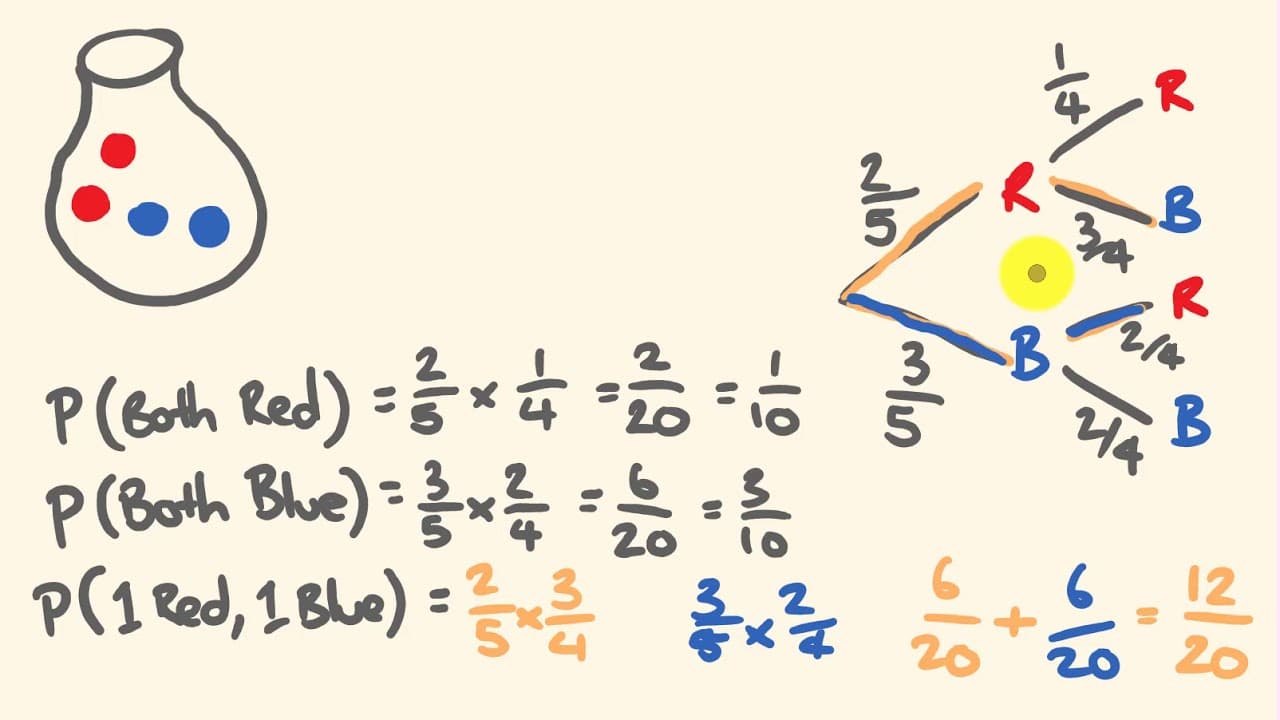
- 😪 The probability of getting both red or both blue marbles from a bag can be calculated using the product rule.
- 😪 The probability of getting one red and one blue marble from a bag can be calculated using the addition rule.
Install to Summarize YouTube Videos and Get Transcripts
Explore YouTube Video Summarizer or Get YouTube Transcript Extractor
Questions & Answers
Q: What is the difference between independent and dependent events in probability?
Independent events are not influenced by any other event, while dependent events are affected by previous events.
Q: Can you provide an example of an independent event?
Tossing a coin where each toss is not influenced by any previous toss is an example of an independent event.
Q: How does the probability change in dependent events?
In dependent events, the probability of an event occurring is influenced by the outcome of previous events.
Q: How does the addition rule work in probability calculations?
The addition rule is used when multiple outcomes are considered. The probabilities of the individual outcomes are added together to calculate the total probability.
Summary & Key Takeaways
-
The video introduces the concepts of independent and dependent events in probability.
-
Independent events are those where each event is not affected by any other event, while dependent events are affected by previous events.
-
The video also discusses the product and addition rules that are used when multiple events occur in probability calculations.
Read in Other Languages (beta)
Share This Summary 📚
Summarize YouTube Videos and Get Video Transcripts with 1-Click
Try YouTube Summary with ChatGPT & Claude or YouTube Transcript Generator
Explore More Summaries from tecmath 📚



Summarize YouTube Videos and Get Video Transcripts with 1-Click
Try YouTube Summary with ChatGPT & Claude or YouTube Transcript Generator