Why S&P 500 Index Funds Face Concentration Risk

TL;DR
Market-cap-weighted index funds can become heavily dependent on a small group of dominant technology companies, weakening the diversification investors expect. The presenter recommends checking portfolio overlap and concentration, understanding how automatic fund flows affect the largest holdings, and considering adjustments or hedges based on personal circumstances and professional advice.
Transcript
Hidden power players are gambling with your retirement and they're profiting massively from a risk that almost nobody is talking about. We're talking index funds, SPY, VU, IVV, the investments everyone says are safe and diversified. What if I told you they're actually a massive risk? And the reason Wall Street won't tell you this because it's incre... Read More
Key Insights
- Index-fund diversification is limited by market-cap weighting because the largest companies receive the greatest allocations. An investor may technically hold hundreds of businesses while remaining highly dependent on the performance of a small group of dominant technology companies.
- Market-cap weighting is a mechanical allocation system that increases a company's index weight as its market value rises. Fund managers do not independently reduce a position merely because it has become unusually large relative to the rest of the index.
- Index-fund inflows can reinforce market leadership because new money is automatically directed toward companies according to their existing index weights. The presenter describes this as a feedback loop in which strong performance produces greater weight and greater weight attracts more automatic investment.
- Index-fund outflows can reverse the same feedback process because redemptions require funds to reduce holdings. The presenter argues that the largest index components may receive the greatest selling pressure, potentially accelerating declines when market sentiment turns negative.
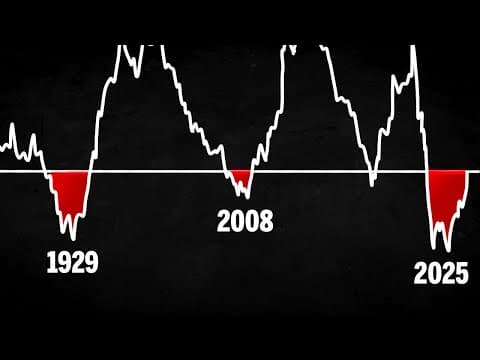
- Historical concentration is presented as a warning rather than proof of an imminent crash. The presenter compares current market leadership with conditions surrounding the dot-com bubble and uses the comparison to emphasize vulnerability, while acknowledging that the leading companies are profitable businesses.
- Portfolio overlap is a practical risk because investors may hold similar large companies through several funds or accounts. Owning multiple products does not necessarily improve diversification when each product directs substantial capital toward the same dominant index constituents.
- Large asset managers possess meaningful shareholder influence because they hold major stakes on behalf of fund investors. The presenter says this influence can include executive access, voting power, participation in corporate actions, and an ability to affect board-level decisions.
- Investor protection begins with understanding actual holdings rather than relying on a fund's broad label. The presenter recommends checking concentration and overlap, then considering position adjustments, hedging, or maintaining current holdings according to individual circumstances and professional guidance.
Install to Summarize YouTube Videos and Get Transcripts
Explore YouTube Video Summarizer or Get YouTube Transcript Extractor
Questions & Answers
Q: Why can an S&P 500 index fund be less diversified than expected?
An S&P 500 index fund can be less balanced than its broad company coverage suggests because it generally weights holdings by market capitalization. The largest businesses therefore receive much more of each invested dollar than smaller constituents. According to the presenter, current exposure is especially concentrated in a small group of major technology companies, making index performance unusually dependent on their results.
Q: How does market-cap weighting affect index-fund holdings?
Market-cap weighting assigns larger portfolio positions to companies with greater market values. When a company's share price rises and its market value expands, it automatically becomes a larger component of the index. New index-fund contributions are then allocated according to that larger weight, without a manager deciding whether the resulting concentration is prudent or whether the position should be reduced.
Q: Why can index-fund inflows create a feedback loop?
Index-fund inflows can create a feedback loop because incoming money is allocated according to existing market weights. Companies that have already grown large receive the biggest portions of new contributions. The presenter argues that this buying can support further price appreciation, increase those companies' index weights, and cause an even greater share of later contributions to flow into the same holdings.
Q: What happens when investors withdraw money from index funds?
When investors withdraw money, funds must meet redemptions by reducing their holdings according to the fund's structure. The presenter argues that the largest weighted companies may consequently face the strongest selling pressure in dollar terms. This reverses the mechanism that supported them during periods of inflows and could amplify declines if widespread withdrawals occur alongside deteriorating market sentiment.
Q: How can investors check whether their portfolios are overexposed?
Investors can examine the underlying holdings and weights of every fund they own, then identify companies repeated across products and accounts. The important question is not simply how many funds or securities appear in the portfolio, but how much total exposure ultimately depends on the same dominant businesses. The presenter recommends evaluating this concentration before considering adjustments or hedges.
Q: Why does owning several index funds not guarantee diversification?
Owning several index funds does not guarantee meaningful diversification when those products contain many of the same large companies. Different fund names can conceal substantial overlap, particularly when each portfolio uses market-cap weighting and tracks a broad American equity benchmark. Investors should combine repeated positions across all holdings to understand their actual company and sector exposure rather than counting fund names.
Q: Why are BlackRock, Vanguard, and State Street discussed?
BlackRock, Vanguard, and State Street are discussed because the presenter identifies them as dominant index-fund managers with significant holdings throughout the major American stock index. Because funds hold shares on behalf of investors, these firms can exercise shareholder voting rights and interact with corporate leaders. The presenter argues that their broad ownership creates questions about corporate influence and market competition.
Q: What actions does the presenter suggest for concerned index investors?
The presenter suggests first determining what the portfolio actually owns, including concentrated positions and overlapping exposure across funds. Possible responses include adjusting positions, adding a hedge, or leaving the portfolio unchanged after understanding the risks. The description emphasizes that the material is educational, not personalized investment advice, and recommends consulting an authorized investment professional before making decisions.
Summary & Key Takeaways
-
The presenter challenges the assumption that an S&P 500 fund always provides balanced diversification. Because holdings are weighted by market capitalization, the largest companies receive a disproportionately large share of every investment. Strong performance by a small group can therefore make the overall index increasingly dependent on those same companies.
-
Market-cap weighting creates a mechanical feedback process. Rising companies become larger index components, so incoming index-fund money allocates more capital to them. The presenter argues that this process can amplify gains during favorable markets and may also intensify losses when sentiment changes and investors begin withdrawing money from index funds.
-
The discussion also examines the influence of BlackRock, Vanguard, and State Street, which collectively manage substantial index-fund assets and hold significant stakes across major companies. The presenter argues that this concentration creates corporate-governance and competition concerns, while advising investors to examine exposure, overlap, possible adjustments, and hedging choices carefully.
Read in Other Languages (beta)
Share This Summary 📚
Summarize YouTube Videos and Get Video Transcripts with 1-Click
Try YouTube Summary with ChatGPT & Claude or YouTube Transcript Generator
Explore More Summaries from Felix & Friends (Goat Academy) 📚



Summarize YouTube Videos and Get Video Transcripts with 1-Click
Try YouTube Summary with ChatGPT & Claude or YouTube Transcript Generator