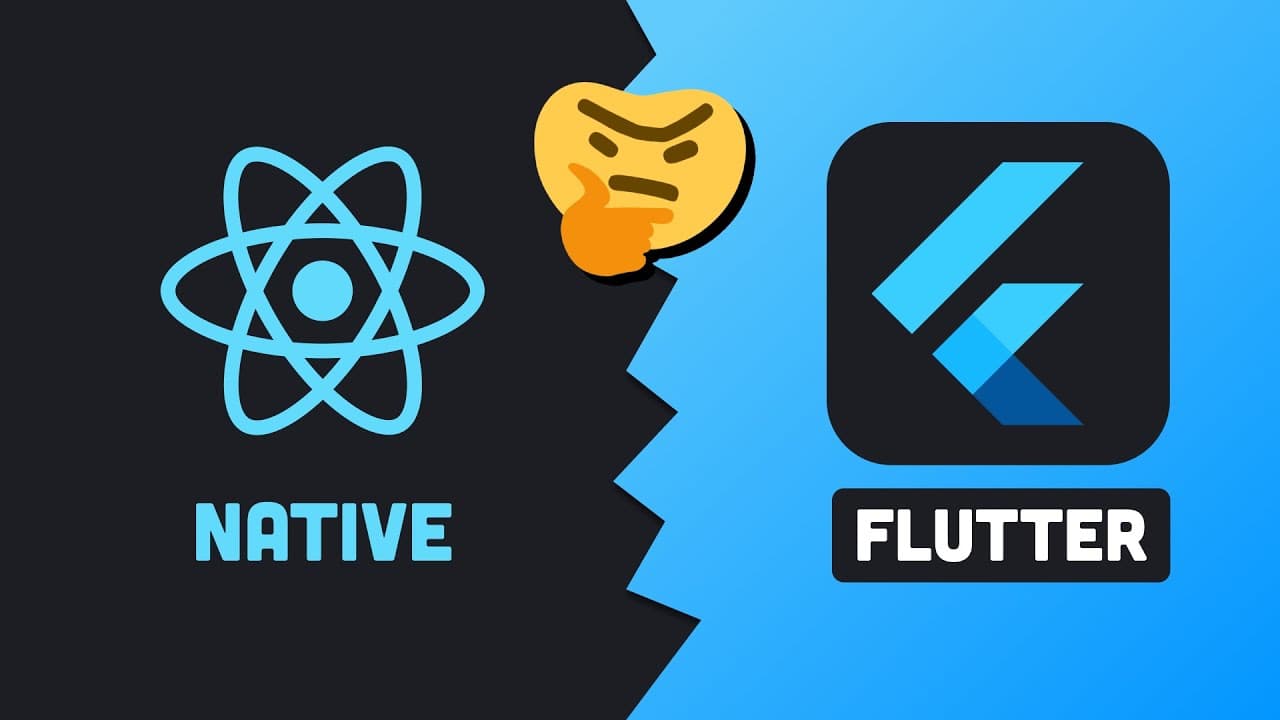
React Native vs Flutter - I built the same chat app with both
TL;DR
Neither React Native nor Flutter is universally best: React Native favors developers who want JavaScript, native UI components, and ecosystem flexibility, while Flutter offers Dart, a large built-in widget library, and its own high-performance rendering engine. The comparison uses the same Firebase-backed chat app to examine code, tooling, architecture, developer experience, and performance, so read on to see which framework better fits your priorities.
Transcript
if you're building a cross-platform mobile app today there are two heavyweights competing for your mindshare in the red corner we have flutter from google and in the blue corner we have react native from facebook these tools can achieve the same fundamental goal build apps for multiple platforms like ios android and the web from a single code base ... Read More
Key Insights
- ❓ Language Choice: Dart vs. JavaScript in Flutter and React Native offers developers a choice of familiar vs. optimized language.
- 🍃 Ecosystem Support: React Native relies on community contributions while Flutter offers a comprehensive widget library and maintained plugins.
- 😒 Architecture: React Native bridges JavaScript and native platforms, while Flutter uses compiled native code for rendering.
- 💪 Developer Experience: React Native provides flexibility but requires more setup, while Flutter offers simplicity and strong tooling.
- 🥺 Tooling: React Native allows for various tooling options, leading to decision fatigue, while Flutter's tooling is robust, efficient, and reliable.
- 👨💻 Performance: Flutter tends to outperform React Native due to direct compilation to machine code, crucial for demanding applications.
- 🪆 UI Development: Flutter's widget system simplifies UI development at the cost of potentially complex nesting, while React Native offers more flexibility but may require customization.
Install to Summarize YouTube Videos and Get Transcripts
Explore YouTube Video Summarizer or Get YouTube Transcript Extractor
Questions & Answers
Q: React Native vs Flutter: which is better for cross-platform app development?
Neither framework is presented as universally better. React Native suits developers who prefer JavaScript, React, and native platform components, while Flutter suits those who value Dart, extensive built-in widgets, maintained plugins, and custom pixel-level rendering.
Q: What app was built to compare React Native and Flutter?
The presenter built the exact same chat app with both React Native and Flutter. Firebase was used as the backend so the comparison could focus on features, tooling, developer experience, performance, and code.
Q: Which programming languages do React Native and Flutter use?
React Native uses JavaScript with React as its required UI library, and it also supports TypeScript for adding a type system. Flutter uses Dart, which supports ahead-of-time and just-in-time compilation and has syntax that somewhat resembles TypeScript.
Q: How do the React Native and Flutter ecosystems differ?
React Native provides base components but generally depends on community-built third-party packages for additional features. Flutter includes a large widget library, team-maintained plugins for features such as native camera access, and open-source packages distributed through Dart's Pub package manager.
Q: How does React Native work under the hood?
React Native runs separate JavaScript threads for the native platform and the application's business logic. A bridge passes serialized messages between them, allowing JavaScript code to render truly native components on each platform.
Q: How does Flutter render its user interface?
Flutter uses its own rendering engine built with C++ and Skia instead of relying on native UI components. It renders custom pixels with compiled native code, can reproduce iOS and Android widgets, and uses platform channels when it needs native features or native-code integration.
Q: How do you start a new React Native app?
A new React Native app can be generated from the command line with npx react native init. Developers can optionally use a template such as NativeBase or choose Expo instead of the default React Native CLI for a more complete starting point.
Q: What are the main performance differences between Flutter and React Native?
React Native coordinates JavaScript and native-platform threads through a bridge, while Flutter renders with compiled native code and does not need that bridge for graphics. The existing comparison concludes that Flutter tends to outperform React Native, especially for demanding applications.
Summary & Key Takeaways
-
Flutter and React Native compete in cross-platform app development, with differences in language, ecosystem, and architecture.
-
React Native uses JavaScript, while Flutter uses Dart, offering different development philosophies and developer experiences.
-
Tooling, ecosystem support, architecture, and performance are key factors in choosing between Flutter and React Native.
Read in Other Languages (beta)
Share This Summary 📚
Summarize YouTube Videos and Get Video Transcripts with 1-Click
Try YouTube Summary with ChatGPT & Claude or YouTube Transcript Generator
Explore More Summaries from Fireship 📚





Summarize YouTube Videos and Get Video Transcripts with 1-Click
Try YouTube Summary with ChatGPT & Claude or YouTube Transcript Generator