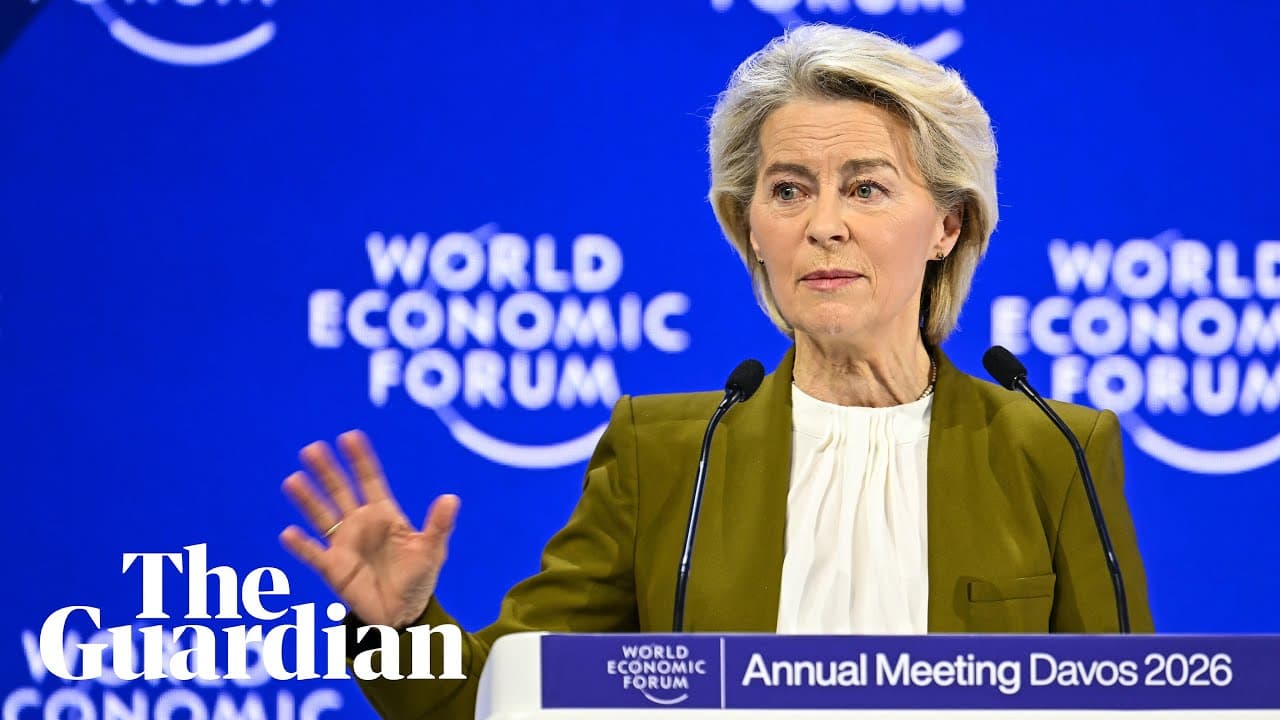
Why Does Davos Say Dialogue Must Rebuild Trust at Ursula von der Leyen's WEF Special Address?
TL;DR
Davos says dialogue must rebuild trust because cooperation, wider participation, transparency, and genuine listening are necessary to find shared interests and give economic decisions legitimacy. The WEF meeting gathered 3,000 participants from 130 countries while confronting unequal prosperity and concerns that AI gains favor owners of models, data, and infrastructure. Read on for the specific economic figures, criticisms, and proposed responses.
Transcript
honor to welcome you to the World Economic Forum's annual meeting doubles. With us are 3,000 participants from 130 countries including a record level political leaders, more than 400 political leaders, 65 heads of state and government and 850 global cos and chairs. And in addition uh we have the young global leaders, the shapers, the social attribe... Read More
Key Insights
- The meeting includes 3,000 participants from 130 countries, with more than 400 political leaders, 65 heads of state and government, and 850 chief executives and chairs. Organizers describe these participation levels as historic for the annual gathering.
- The global economy is presented as more resilient than feared, with expected economic growth of 3.3% and trade growth of 3%. These figures are used to challenge the impression that economic activity is broadly contracting amid geopolitical uncertainty.
- New technology investment is identified as a potential driver of growth for decades. The transcript states that $1.5 trillion was invested in new technologies during the previous year, while emphasizing that positive results depend on managing those technologies effectively.
- Cooperation and dialogue are described as the foundation for identifying shared interests and practical paths forward. The annual meeting's theme, the spirit of dialogue, reflects the belief that governments and businesses must keep communicating despite uncertainty and disagreement.
- Trust in the World Economic Forum is acknowledged as significantly weakened. Larry Fink argues that rebuilding it requires wider participation, greater transparency, and stronger engagement with people who do not feel represented in elite international gatherings.
- Economic success is defined as more than aggregate growth, GDP, or company market capitalization. The address argues that prosperity should be judged by whether many people can see it, experience it, and use it to build their own futures.
- AI gains are described as initially flowing toward owners of models, data, and infrastructure. The central challenge is to create credible plans for broader participation, particularly if AI affects white-collar workers in ways comparable to globalization's effects on blue-collar workers.
- Environmental action is presented as urgent because humanity has transgressed seven of nine planetary boundaries, according to the cited September 2025 planetary health check. Andrea Hoffmann calls for collective responsibility, decisive leadership, meaningful dialogue, and movement beyond awareness toward action.
Install to Summarize YouTube Videos and Get Transcripts
Explore YouTube Video Summarizer or Get YouTube Transcript Extractor
Questions & Answers
Q: Why does the World Economic Forum emphasize dialogue?
Dialogue is described as the foundation for cooperation and the only way to identify shared interests and short pathways forward together. The annual meeting therefore adopted the theme, the spirit of dialogue, amid geopolitical, economic, and technological uncertainty.
Q: How can the World Economic Forum rebuild public trust?
The forum can rebuild trust by widening who has a voice, becoming more transparent, and engaging people who do not feel represented in Davos. Larry Fink acknowledges that the world places far less trust in the organization to help shape what comes next.
Q: Who attended the World Economic Forum annual meeting in Davos?
The meeting brought together 3,000 participants from 130 countries. They included more than 400 political leaders, 65 heads of state and government, 850 global CEOs and chairs, academics, labor and faith leaders, and 10 Nobel laureates.
Q: What economic outlook was presented at the Davos meeting?
The IMF figures cited in the remarks showed 3.3% expected economic growth this year. Trade was also growing at 3%, despite a difficult geopolitical backdrop and previous fears of a decade of slow growth.
Q: How could new technologies support economic growth?
The speakers said $1.5 trillion US was invested in new technologies last year. If managed correctly, those technologies could drive growth for decades and help address the debt level, described as the highest since 1945.
Q: Why is GDP considered an incomplete measure of prosperity?
Aggregate growth, GDP, and company market capitalization do not show whether prosperity reaches many people. Economic success should be judged by whether people can see, touch, and feel its benefits and build their own futures on them.
Q: What concern did Larry Fink raise about AI and workers?
Early AI gains are flowing to owners of models, data, and infrastructure, leaving open what happens to everyone else. Fink says leaders must confront the possibility that AI could affect white-collar workers as globalization affected blue-collar workers and create a credible plan for broad participation.
Q: Why does Davos face a legitimacy problem?
Many people see the meeting as an elite institution that feels out of step with an age of populism and deep institutional mistrust. Its influence will lack legitimacy unless it includes broader voices, clearly shows its work, and engages people outside rooms like Davos.
Summary & Key Takeaways
-
Definition: The spirit of dialogue means using cooperation and conversation to identify shared interests and short pathways forward together.
-
Number: The annual meeting welcomed 3,000 participants from 130 countries.
-
Number: Attendees included more than 400 political leaders, 65 heads of state and government, and 850 global CEOs and chairs.
-
Who: Young global leaders, academics, labor leaders, faith leaders, civil society representatives, startups, and 10 Nobel laureates also participated.
-
Number: IMF figures showed 3.3% expected economic growth this year, while trade was growing at 3%.
-
Number: Last year, $1.5 trillion US was invested in new technologies that could drive growth for decades.
-
Compare: Prosperity should be measured by people's ability to experience and build on growth, not only by GDP or company market capitalization.
-
Definition: Rebuilding WEF trust requires wider participation, greater transparency, and engagement with people who feel unrepresented.
-
Compare: Early AI gains favor owners of models, data, and infrastructure, while the consequences for everyone else remain unresolved.
-
Step 1: Confront AI's effects on white-collar workers today and create a credible plan for broad participation in its gains.
-
Definition: Capitalism must turn more people into owners of growth instead of spectators watching it happen.
Read in Other Languages (beta)
Share This Summary 📚
Summarize YouTube Videos and Get Video Transcripts with 1-Click
Try YouTube Summary with ChatGPT & Claude or YouTube Transcript Generator
Explore More Summaries from Guardian News 📚





Summarize YouTube Videos and Get Video Transcripts with 1-Click
Try YouTube Summary with ChatGPT & Claude or YouTube Transcript Generator