What Is Gradient Descent and How Does It Work?
TL;DR
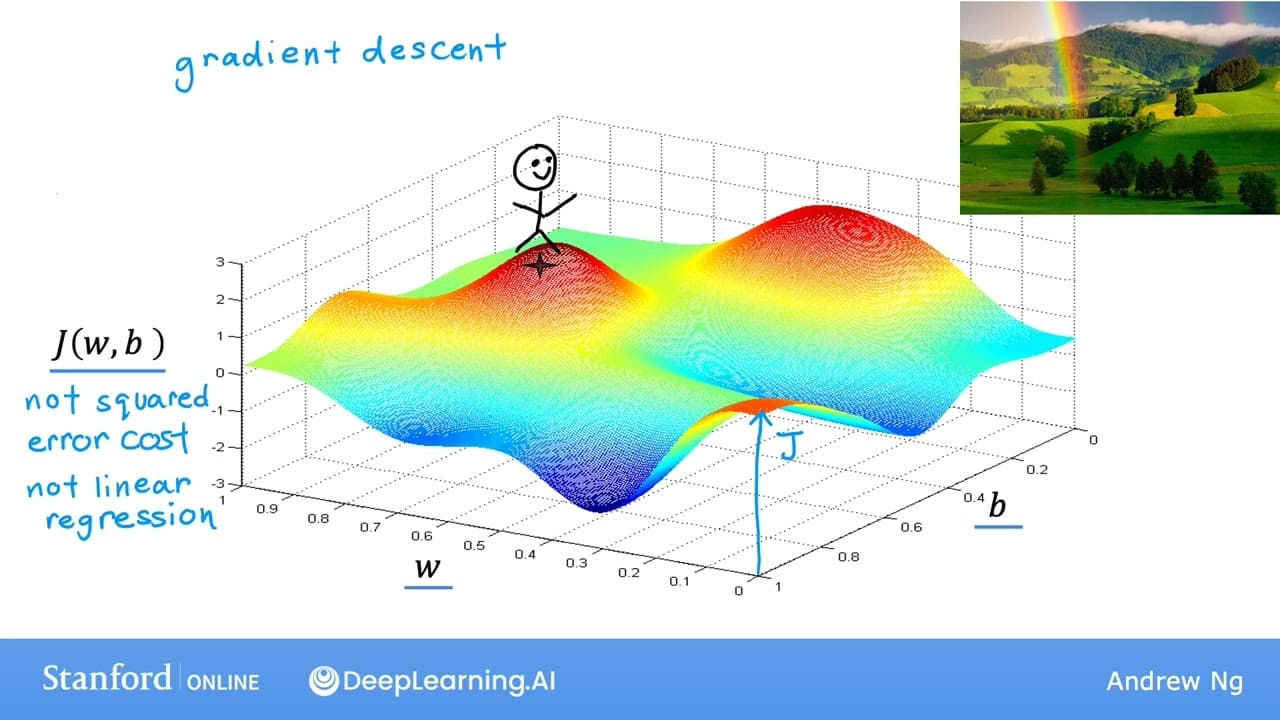
Gradient descent is an optimization algorithm that minimizes a cost function by iteratively adjusting parameters in the direction of steepest descent. It is applicable to various models, including linear regression and neural networks, enabling the efficient discovery of optimal values for model parameters.
Transcript
welcome back in the last video we saw visualizations of the cost function J and how you can try different choices that the parameters wnb and see what cost value that gets you it would be nice if we had a more systematic way to find the values of w and B the results in the smallest possible cost J of WB it turns out there's an algorithm called grad... Read More
Key Insights
- 🎰 Gradient descent is widely used in machine learning for parameter optimization in various models.
- 🇨🇷 It can be applied to minimize any cost function, not just in linear regression.
- ❓ The algorithm iteratively updates the parameters in the direction of steepest descent to find the minimum.
Install to Summarize YouTube Videos and Get Transcripts
Explore YouTube Video Summarizer or Get YouTube Transcript Extractor
Questions & Answers
Q: What is gradient descent and why is it important in machine learning?
Gradient descent is an algorithm used to minimize the cost function in machine learning models. It is important because it helps find optimal values for parameters that result in the smallest possible cost.
Q: Does gradient descent only apply to linear regression?
No, gradient descent can be applied to any function, including cost functions for models with multiple parameters, such as neural networks. It is a versatile algorithm used in various machine learning applications.
Q: How does gradient descent work?
Gradient descent starts with initial guesses for the parameters and iteratively updates them in the direction of steepest descent. By taking small steps towards the minimum, it gradually reduces the cost function and finds the optimal parameter values.
Q: What happens if there are multiple local minima in the cost function?
Gradient descent may find different local minima depending on the starting point. It is possible to get stuck in a local minimum and not reach the global minimum. Identifying and addressing this issue is an ongoing challenge in machine learning.
Summary & Key Takeaways
-
Gradient descent is a systematic algorithm used to find optimal values for parameters in machine learning models.
-
It can be applied to minimize any cost function, not just in linear regression, but also in more complex models like neural networks.
-
By iteratively updating the parameters in the direction of steepest descent, gradient descent helps in finding the minimum value of the cost function.
Read in Other Languages (beta)
Share This Summary 📚
Summarize YouTube Videos and Get Video Transcripts with 1-Click
Try YouTube Summary with ChatGPT & Claude or YouTube Transcript Generator
Explore More Summaries from DeepLearningAI 📚




Summarize YouTube Videos and Get Video Transcripts with 1-Click
Try YouTube Summary with ChatGPT & Claude or YouTube Transcript Generator