How Did Marantz Lose Its Hi-Fi Identity?
TL;DR
Marantz evolved from Saul Marantz’s uncompromising American hi-fi company into a brand repeatedly transferred among larger corporate owners. Although investment, broader distribution, offshore production, shared engineering, and home-theater products helped support growth, the account argues that these changes weakened the brand’s exclusivity and shifted attention away from the distinctive two-channel sound associated with its vintage equipment.
Transcript
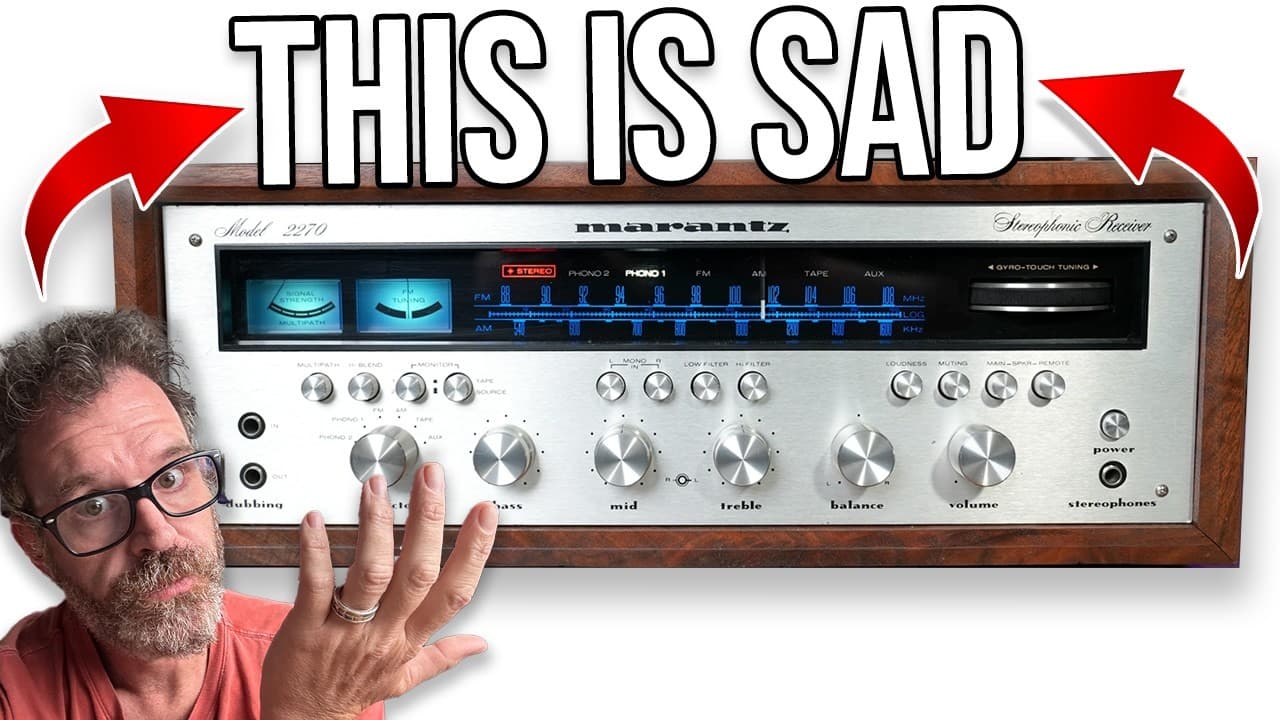
Oh, Morance. From hi-fi icon to hi-fi footnote. If you're my age, when you hear the word Morance, you think of warm, lush sound, blue lights, silver faces, and that iconic horizontal tuner wheel. Their7s receivers are some of the most sought after vintage receivers on eBay or other places. But it ain't all roses and donuts. Things have gotten a lit... Read More
Key Insights
- Marantz began as Saul Marantz’s response to inadequate playback equipment. He founded the company in Queens in 1952 and built the Audio Consolette preamplifier to provide better control over equalization and levels when records required substantial adjustment.
- The first Marantz products reflected direct founder involvement and strict standards. Saul Marantz personally made the first 100 Audio Consolette units, controlled both appearance and sound, and initially had no intention of creating a company until demand grew through personal recommendations.
- The Model 7 established Marantz as a prestigious tube-audio manufacturer. Released in 1958, the preamplifier is described as a holy grail among audiophiles and exemplified the company’s early emphasis on clean, functional design, rigorous quality control, and no-compromise engineering.
- Financial pressure forced Marantz to surrender its independence. Competition from Sansui, Sony, and Pioneer brought lower prices and substantial power, while solid-state technology was emerging, leading Marantz to sell to Superscope in 1964 despite its respected products and growing demand.
- Superscope’s ownership changed how Marantz products were developed. Executives increasingly determined target prices, which affected construction and sound, while Saul Marantz became disheartened by the compromises and left the organization by the late 1960s.
- Philips used Marantz’s established reputation to support its CD-player business. After acquiring non-North American rights in 1980 and later obtaining the whole brand, Philips sold products including the CD63, which the account identifies as a CD player that remains famous.
- D&M Holdings combined Marantz and Denon under one organization. The brands retained their own engineers, but mid-tier and lower-tier manufacturing moved to contractors in China and Southeast Asia, while the high-end reference series continued to be manufactured in Japan.
- Sound United pushed Marantz further toward home theater and mass-market distribution. Marantz and Denon shared HDMI boards, DSP, and room-correction technology, while fewer engineering resources made the musical character of dedicated two-channel Marantz products a lower priority.
Install to Summarize YouTube Videos and Get Transcripts
Explore YouTube Video Summarizer or Get YouTube Transcript Extractor
Questions & Answers
Q: Who founded Marantz, and why was it created?
Saul Bernard Marantz, a classically trained musician, industrial designer, and audio perfectionist born in 1911 in New York City, founded Marantz in Queens in 1952. Frustrated with available music-playback equipment, he built the Audio Consolette preamplifier in his basement to improve control over equalization and levels because records of the period often required adjustment to sound better.
Q: How did Marantz first become a respected hi-fi brand?
Marantz earned its early reputation through uncompromising construction, careful sound tuning, clean functional design, and rigid quality control. Saul Marantz personally made the first 100 Audio Consolette units and controlled how products looked and sounded. The 1958 Model 7 preamplifier strengthened that reputation and is described in the account as a holy grail of tube preamplifiers among many audiophiles.
Q: Why did Marantz sell to Superscope in 1964?
Marantz faced growing demand, the need to integrate technologies such as FM tuners, increasing competition from lower-cost manufacturers, and the rise of solid-state equipment. Companies including Sansui, Sony, and Pioneer entered the American market with lower prices and substantial power. Unable to compete effectively while maintaining its approach, Marantz sold to Superscope in 1964 and received needed financial support.
Q: How did Superscope change Marantz products?
Superscope initially gave Marantz the cash needed to respond to competition, but mounting price pressure changed product decision-making. Executives began setting the amount products should cost, which consequently affected their construction and sound. People close to Saul Marantz said he was disheartened as the products became less aligned with his standards, and he left by the late 1960s.
Q: How did Philips become the owner of Marantz?
Superscope depended heavily on distributing Sony reel-to-reel and cassette products, but Sony established its own North American distribution operation. Under financial strain, Superscope sold the non-North American Marantz rights to Philips in 1980. Superscope later failed, and by the mid-1980s Philips owned Marantz as a whole, using the recognized brand to market CD players such as the CD63.
Q: What changed when Marantz and Denon joined D&M Holdings?
Philips spun Marantz off to the newly formed Japanese holding company D&M Holdings in 2001. D&M acquired Denon in 2002, placing both hi-fi brands under one owner. Their engineers remained separate, but mid-tier and lower-tier products increasingly came from manufacturing companies in China and Southeast Asia. The high-end Marantz reference series, however, continued to be made in Japan.
Q: How did Sound United affect the Marantz brand?
Sound United purchased D&M Holdings in 2017 and grouped Marantz with brands including Polk, Definitive Technology, Bowers & Wilkins, Boston Acoustics, and HEOS. Manufacturing shifted further offshore, while engineering was reduced and shared. Marantz and Denon used common HDMI boards, DSP, and room-correction systems, and Marantz moved strongly into home theater and mass-market distribution.
Q: Why does the account argue that Marantz lost its identity?
The account links Marantz’s weakened identity to repeated ownership changes, cost-focused management, offshore manufacturing, shared engineering, mass-market retail, and growing emphasis on home theater. Although Marantz retained a somewhat different sound from Denon and reportedly achieved significant revenue growth under Sound United, it became less exclusive, while distinctive two-channel musical performance received less engineering priority.
Summary & Key Takeaways
-
Saul Marantz founded Marantz in Queens in 1952 after building the Audio Consolette preamplifier to gain better control over poorly recorded records. He personally assembled the first 100 units. Products such as the 1958 Model 7 established a reputation for clean design, strict quality control, distinctive sound, and uncompromising construction.
-
Competition from lower-priced Japanese manufacturers and the emergence of solid-state technology strained the company’s finances. Superscope purchased Marantz in 1964 and supplied needed capital, but pressure to reduce prices placed executives in control of decisions affecting construction and sound. Saul Marantz became disheartened and departed by the late 1960s.
-
Marantz subsequently passed through Philips, D&M Holdings, Sound United, and Masimo. Production increasingly moved to China and Southeast Asia, while Marantz and Denon shared technologies including HDMI boards, DSP, and room correction. The brand expanded into home theater and mass-market retail, but the account argues that growth reduced its distinctiveness and brand equity.
Read in Other Languages (beta)
Share This Summary 📚
Summarize YouTube Videos and Get Video Transcripts with 1-Click
Try YouTube Summary with ChatGPT & Claude or YouTube Transcript Generator
Explore More Summaries from cheapaudioman 📚
Summarize YouTube Videos and Get Video Transcripts with 1-Click
Try YouTube Summary with ChatGPT & Claude or YouTube Transcript Generator