300 mm DRO with Arduino (ATTiny85 and Nano)
TL;DR
The video explains how to use a digital readout (DRO) with Arduino for precise measurements.
Transcript
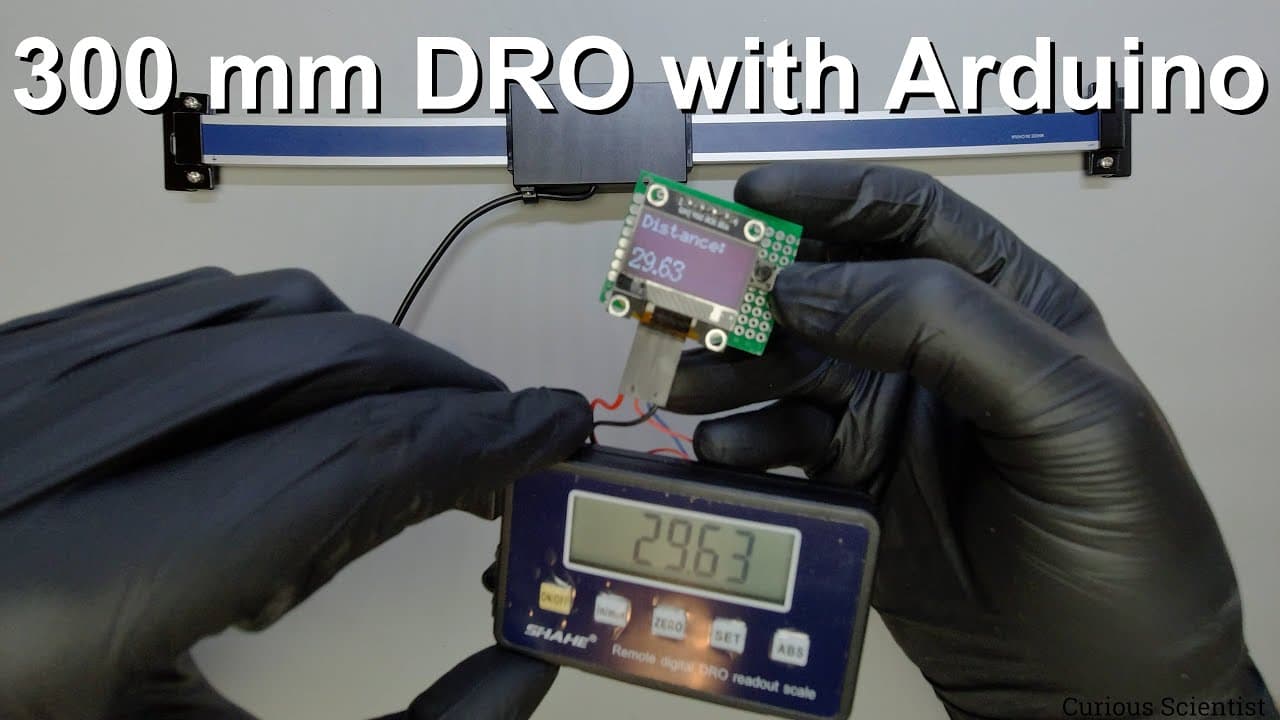
welcome everyone in this video i'm going to talk about this dro i have a few videos where i discuss similar topic but here i will do a bit more deeper discussion and this is a different product as compared to the others that i showed so it were to work with it so what we can see here is a dro which works in the same principles as a digital caliper ... Read More
Key Insights
- ✋ The digital readout (DRO) can measure distances up to 30 centimeters and offers a resolution of 0.01 millimeters for high precision.
- 📡 The device operates using a combination of clock and data signals, with specific wiring for power, data, and signal integrity ensuring reliable measurements.
- 🔨 Comparison of DRO functionality with traditional digital calipers emphasizes the technological advancements in measurement tools.
- 👻 The integration with Arduino allows for versatile data processing options, enabling users to customize their measurements for various applications.
- 👤 Understanding the signal processing of the DRO can empower users to connect it with other electronic components for advanced engineering projects.
- 👨💻 The presenter offers resources for further exploration, including wiring diagrams and coding examples, available on their website.
- 💦 The importance of metric units in engineering and scientific work is underscored by the presenter’s preference for millimeter measurements.
Install to Summarize YouTube Videos and Get Transcripts
Explore YouTube Video Summarizer or Get YouTube Transcript Extractor
Questions & Answers
Q: What is the primary function of the digital readout (DRO) discussed in the video?
The primary function of the digital readout (DRO) is to accurately measure lengths, providing readings in both millimeters and inches. The video highlights the displacement measurement capability of the DRO, where it communicates with a microcontroller to display precise values based on shifts along its measuring route.
Q: How does the DRO communicate data signals to a microcontroller like Arduino?
The DRO sends distance readings to the microcontroller using a combination of clock and data signals. This is facilitated through a coded wiring connection that captures 24 bits of information, of which 21 bits are significant for measuring values converted into user-defined units. This ensures real-time display and processing of measurements.
Q: What resolution does the DRO boast, and why is that significant?
The DRO boasts a resolution of 0.01 millimeters, which is significant for precision measurement in engineering and scientific contexts. Such granularity allows users to obtain detailed and accurate readings, which are critical in applications where even the slightest deviation can impact outcomes.
Q: What types of projects could benefit from the DRO integration with an Arduino?
Projects that involve precise automation, robotics, or measurement applications could benefit from DRO integration with an Arduino. For example, setups requiring exact positional adjustments, like CNC machines or 3D printing, can utilize the DRO's capabilities to enhance operational precision and efficiency.
Q: What are the electronics involved in the operation of this DRO?
The DRO's operation involves split electronics, meaning that one box handles distance reading while another box contains a microcontroller for processing and displaying the data. Power is supplied via batteries, and communication occurs through different wiring configurations for data and clock functions, enabling accurate measurement readings.
Q: What precautions did the presenter take when demonstrating the assembly of the DRO?
The presenter was cautious about disassembly, noting the meticulous nature of working with tiny screws. They avoided further disassembling to maintain the integrity of the unit for demonstration purposes. This highlights the importance of careful handling in electronic assembly tasks, especially when dealing with delicate components.
Summary & Key Takeaways
-
The video provides a detailed explanation of how a digital readout (DRO) works, comparing it to traditional digital calipers and focusing on its optical mechanics and data processing.
-
Key information includes the DRO's ability to capture lengths up to 30 centimeters with a resolution of 0.01 millimeters, and the electronics involved in distance reading and data communication.
-
The presenter demonstrates how the DRO can be integrated with Arduino systems, showcasing specific wiring, signal processing, and coding for effective data handling.
Read in Other Languages (beta)
Share This Summary 📚
Summarize YouTube Videos and Get Video Transcripts with 1-Click
Try YouTube Summary with ChatGPT & Claude or YouTube Transcript Generator
Explore More Summaries from Curious Scientist 📚
Summarize YouTube Videos and Get Video Transcripts with 1-Click
Try YouTube Summary with ChatGPT & Claude or YouTube Transcript Generator