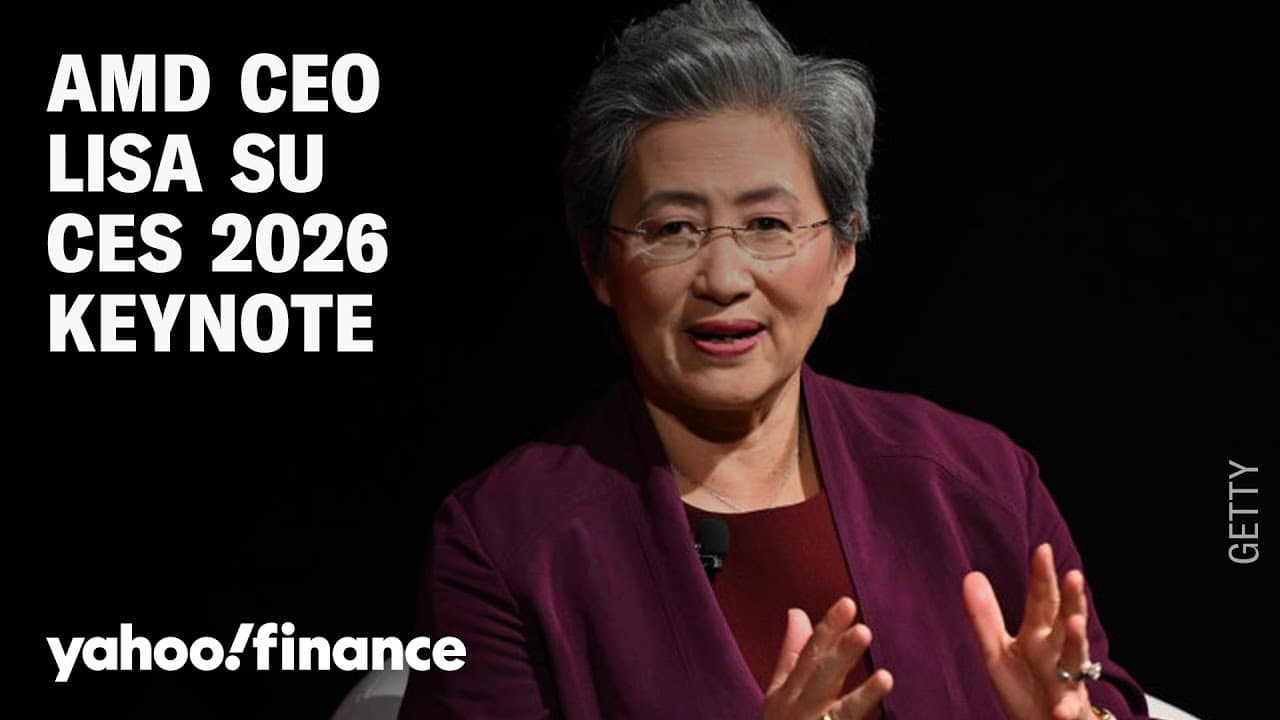
Why Does AMD CEO Lisa Su Say AI Needs 10,000x More Compute? | CES 2026 Keynote
TL;DR
AI needs 10,000 times more compute than the world had in 2022 because adoption and workloads are scaling rapidly, according to AMD CEO Lisa Su’s CES 2026 keynote. Global capacity rose from about one zettaflop in 2022 to more than 100 zettaflops in 2025, but Su says it must exceed 10 yottaflops within five years. Read on for the numbers, infrastructure strategy, and compute engines behind that forecast.
Transcript
At CES [music] 2026, innovators from every corner of the globe show up to the most powerful tech event in the world. We'll rally together, imagining what's next. And [music] we'll make it real. Solving the greatest challenges facing our world and proving that technology [music] isn't just moving us forward. It's creating new possibilities. Here, AI... Read More
Key Insights
- Global compute infrastructure grew from about one zettaflop in 2022 to more than 100 zettaflops in 2025, a hundredfold increase in a few years. Lisa Su says another hundredfold increase, to more than 10 yottaflops, is needed over the next five years.
- A yottaflop is a one followed by 24 zeros, so the 10 yottaflop target Su described represents 10,000 times more compute than the world had in 2022. She called it something that has never happened before in the history of computing.
- AI adoption went from a million people to more than a billion active users since ChatGPT launched a few years ago, a ramp Su contrasted with the internet, which took decades to reach the same milestone. AMD projects growth to over five billion active users.
- AMD's stated mission is to push the boundaries of high performance and AI computing to help solve the world's most important challenges. Su said AMD technology touches billions of lives daily across cloud data centers, supercomputers, 5G networks, transportation, and gaming.
- Su calls AI the most important technology of the last 50 years and AMD's number one priority. She argues it is already reshaping healthcare, science, manufacturing, and commerce, and that the industry is still only scratching the surface of what the technology can do.
- Delivering AI everywhere requires it in every compute platform: the cloud, where it runs continuously to deliver intelligence globally; PCs, where it helps people work smarter and personalize experiences; and the edge, where it powers machines making real-time decisions in the real world.
- AMD claims to be the only company with the full range of compute engines needed for AI, spanning GPUs, CPUs, NPUs, and custom accelerators. Su's argument is that each workload needs the right engine, tuned for the application to give both the best performance and the most cost-effective solution.
- The cloud is where the largest models are trained and where intelligence reaches billions of users in real time. Su noted most people experience AI there today through ChatGPT, Gemini, Grok, and coding copilots, and said every major cloud provider runs on AMD EPYC CPUs.
Install to Summarize YouTube Videos and Get Transcripts
Explore YouTube Video Summarizer or Get YouTube Transcript Extractor
Questions & Answers
Q: Why does Lisa Su say AI needs 10,000 times more compute?
AI adoption has risen from one million people to more than a billion active users since ChatGPT launched, and AMD projects more than five billion active users. Su also said models are becoming more capable at reasoning and decision-making, creating demand for over 10 yottaflops of global capacity within five years, about 10,000 times the roughly one zettaflop available in 2022.
Q: How much global compute capacity does AMD say AI will need?
Su said global compute capacity must increase another 100 times within five years, reaching more than 10 yottaflops. That would follow growth from about one zettaflop in 2022 to more than 100 zettaflops in 2025.
Q: What is a yottaflop, according to Lisa Su’s CES 2026 keynote?
Su described a yottaflop as a one followed by 24 zeros. She used the unit to express AI’s projected infrastructure requirement of more than 10 yottaflops within five years.
Q: How quickly has AI adoption grown compared with the internet?
Su said AI grew from one million users to more than a billion active users within a few years of ChatGPT’s launch. She contrasted that pace with the internet, which took decades to reach the same billion-user milestone, and said AMD projects AI adoption will exceed five billion active users.
Q: Where does Lisa Su say AI computing must operate?
Su said AI must operate across the cloud, PCs, and the edge. The cloud delivers intelligence globally, PCs support smarter and more personalized work, and edge systems enable machines to make real-time decisions in the physical world.
Q: Which compute engines does AMD offer for AI workloads?
AMD’s portfolio spans GPUs, CPUs, NPUs, and custom accelerators. Su said different workloads require the right engine tuned for the application to deliver strong performance and a cost-effective solution.
Q: Why is the cloud central to AMD’s AI strategy?
The cloud is where the largest models are trained and where intelligence can reach billions of users in real time. Su said it gives developers immediate access to large-scale compute and tools, and that every major cloud provider runs on AMD EPYC CPUs.
Q: What was Lisa Su’s main message at the CES 2026 keynote?
Su called AI the most important technology of the last 50 years and AMD’s number one priority. Her message was that AI is already reshaping healthcare, science, manufacturing, and commerce, while the industry is still only beginning to realize its potential.
Summary & Key Takeaways
-
Gary Shapiro of the Consumer Technology Association opened CES 2026 with the year's first keynote and introduced Dr. Lisa Su, AMD chair and CEO since 2014. He credited her with leading AMD through a transformation in high performance and AI computing, delivering products that power AI training and inference, scientific research, enterprise workloads, cloud infrastructure, and everyday consumer devices.
-
Su framed her keynote around the theme "you ain't seen nothing yet," arguing the industry is only starting to realize AI's power. She called AI the most important technology of the last 50 years and AMD's number one priority, already touching healthcare, science, manufacturing, and commerce, with AMD building the compute foundation to make that future real for every company and person.
-
The keynote's central numbers concerned scale: AI went from one million to more than a billion active users since ChatGPT's launch, faster than the internet reached the same milestone, with five billion projected. Global compute infrastructure grew from about one zettaflop in 2022 to more than 100 zettaflops in 2025, and Su said another 100x increase to over 10 yottaflops is needed within five years.
-
Su argued AI must live in every compute platform: the cloud for continuous global intelligence delivery, PCs for smarter and personalized work, and the edge for real-time decisions in the physical world. She positioned AMD as the only company with the full range of compute engines, GPUs, CPUs, NPUs, and custom accelerators, each tunable per workload for the best performance and most cost-effective solution.
-
The keynote was structured as a journey through chapters covering cloud, PCs, healthcare, and more, with guests from industry giants and breakthrough startups. Su opened with the cloud, where the largest models are trained, developers get instant compute and tools, and most people experience AI today through ChatGPT, Gemini, Grok, or coding copilots. She said every major cloud provider runs on AMD EPYC CPUs.
Read in Other Languages (beta)
Share This Summary 📚
Summarize YouTube Videos and Get Video Transcripts with 1-Click
Try YouTube Summary with ChatGPT & Claude or YouTube Transcript Generator
Explore More Summaries from Yahoo Finance 📚






Summarize YouTube Videos and Get Video Transcripts with 1-Click
Try YouTube Summary with ChatGPT & Claude or YouTube Transcript Generator