How to Build a Business From Zero: 8 Simple Steps
TL;DR
You can build a cash-flowing business from $0 without university by following eight steps, starting with getting one client. Getting clients is easier than people think: you simply have to ask, because it's not who you know, it's who you ask. Narrowing to a niche, naming and trademarking your brand, and building case studies that show outcomes then compound your credibility.
Transcript
Morgan is about to spend $260,000 to go to university and become a graphic designer. But what if I told you she could save those four years of her life and build her business for $0 today. In this video, I'm going to show you the eight simple steps anyone can follow to build a business starting with 0 and turn it into a cash flowing machine using M... Read More
Key Insights
- Getting your first client comes down to asking, not connections. As Simon puts it, 'it's not who you know, it's who you ask,' and most people simply don't ask enough. Walking into a business and offering to fix their weak brand often gets a yes.
- Sales is just storytelling, which lowers the fear around it. A soft pitch like 'I'm a student, let me try, and if you like it, pay me' costs nothing because a no leaves you exactly where you started with nothing lost.
- Your network is a client source, but its real value is second-degree reach. Parents' friends who own companies, or friends who know someone with a company, can become customers because almost everyone knows someone running a business.
- Social media is an introvert's friend for building a brand. Documenting your process, such as photographing sketchbook pages and posting them, can attract clients for free because one person seeing a single post may DM you for work.
- Being niche is more compelling than targeting everyone. Specializing in one group, like branding for purpose-driven social media influencers, shrinks the audience but creates a clearer target and a felt connection, whereas generic graphic designers face vast competition.
- Naming your business creates commitment and ahead-of-time thinking about co-founders and time off. Simon chose 'fluid' with the tagline 'design and marketing' because it was trademarkable, a word he could own, and he registered it back in 2000.
- Securing a professional domain from day one makes a business feel real and builds branding and trust. The video's sponsor do.store offers domains for 99 cents with code Simon, unlocking over $2,500 in perks from tools like Canva and Shopify.
- Credibility comes from showing what you did, not telling. Strong case studies 'sell the sizzle, not the steak' by focusing on the outcome a design change produced for the client, such as enabling new hoodie and drinks brand launches, rather than the logo itself.
Install to Summarize YouTube Videos and Get Transcripts
Explore YouTube Video Summarizer or Get YouTube Transcript Extractor
Questions & Answers
Q: How do you get your first client with no experience?
Getting your first client comes down to asking, because as Simon says, 'it's not who you know, it's who you ask,' and people don't ask enough. You can walk into a business with a weak brand and offer to fix it, tap your parents' and friends' networks who likely know company owners, or post your work process on social media. A soft, low-risk pitch works because if they say no, you've lost nothing.
Q: Why is finding a niche more powerful than appealing to everyone?
A niche is more compelling because it gives you a clearer target group and a smaller, more manageable audience that feels a connection to you. Simon explains that saying you're a graphic designer means your competition is vast, but specializing, for example only working with social media influencers who have a purpose, makes people recognize your expertise. Most marketers try to hit everybody, but the power of niche is that a specific group gets to know you as the focused expert.
Q: How should you name and protect a new business brand?
You should name your business with the future in mind, considering whether you'll have a co-founder and how you'll eventually take time off. Simon named his agency 'fluid' over the alternative 'pink tank' because his more established clients found pink tank too edgy, and importantly fluid was a word he could trademark and own, which he did back in 2000. Naming it creates commitment, like having a dog or kid you can't give back, which motivates you.
Q: Why does getting a domain name matter when starting a business?
Securing your domain makes the business feel real and gives your brand a home once you have a name and a clear idea of what you're selling. Simon says a strong professional domain is essential from day one for branding and trust, not just for having a link to share. The sponsor do.store offers domains for 99 cents with code Simon, and claims .store sites see up to 87% more traffic and double the Google rankings.
Q: What makes a good case study for a service business?
A good case study shows what you did rather than telling people, because credibility comes from demonstrated results. Simon advises focusing not just on the look of the product but on what that change achieved for the client, a principle he calls 'sell the sizzle, not the steak.' Instead of saying you changed a logo, you describe the outcome, such as how new branding let a client launch a hoodie brand and a drinks brand and monetize in new ways.
Q: Is university necessary to become a graphic designer or start a business?
According to Simon, university is not the only pathway. Morgan was about to spend $260,000 and four years to become a graphic designer, but he argues she could save that time and money by building her business for $0 today. The video's premise is that anyone can start a business from nothing by following eight simple steps, using getting a client, finding a niche, naming a brand, and building case studies rather than a formal degree.
Q: How can an introvert build a brand without being on camera?
Social media is described as an introvert's friend for building a brand because you don't need to talk to a camera. Simon suggests documenting your process in your own way, such as photographing your sketchbook pages or showing the brief and what you're working on that day, and posting it to Instagram. Posting costs nothing, and it only takes one person seeing a single post to DM you and ask you to work on their brand.
Q: Why is asking so important when trying to find clients?
Asking is key because most people never do it, and opportunities go unclaimed as a result. Simon used to ring companies and tell them their brand was bad and that his company fluid could fix it, and many replied that they had been meaning to sort it out but hadn't found someone. He frames this as luck you create, noting that sales is just storytelling and that a no leaves you with nothing lost, so there is no real downside to asking.
Summary & Key Takeaways
-
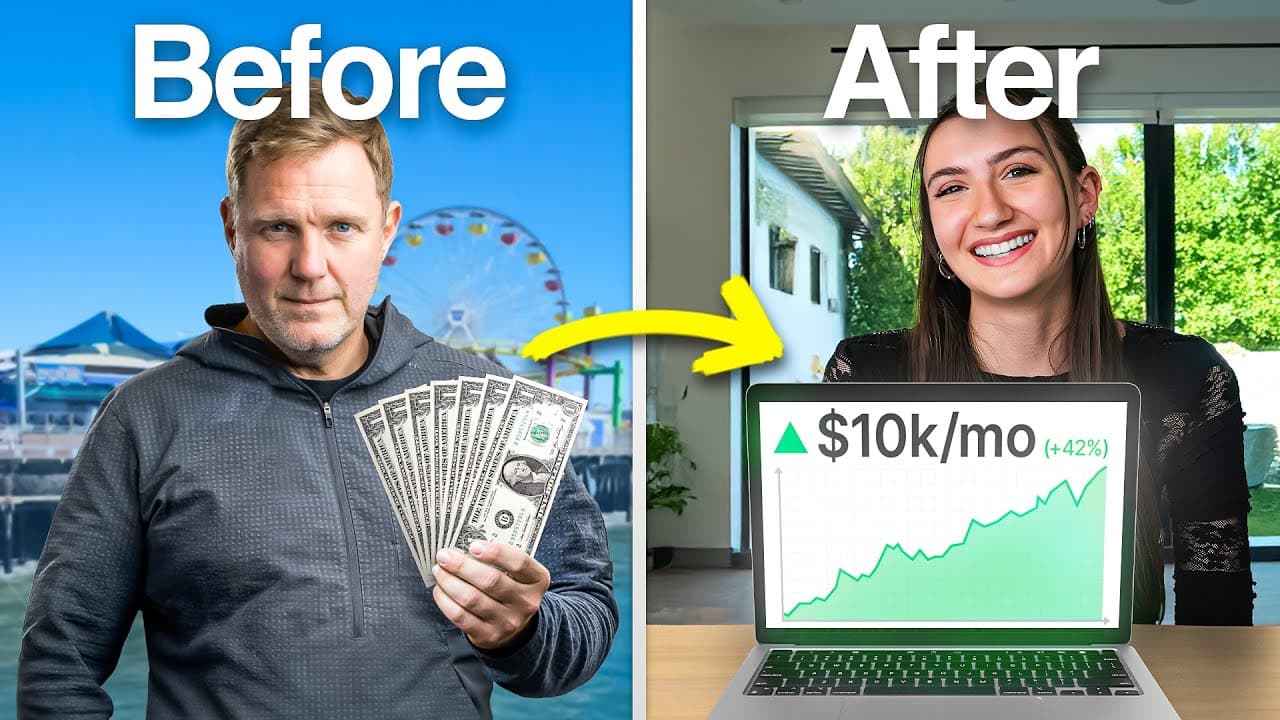
Morgan planned to spend $260,000 and four years at university to become a graphic designer, but Simon argues she could build a cash-flowing business for $0 today by following eight simple steps, using her design dream as the working example throughout the video.
-
The first step is getting one client, which is easier than people think. You just have to ask, tap your network and their contacts, and use social media to document your process, since it's not who you know but who you ask, and a no costs nothing.
-
Finding a niche, like branding for purpose-driven influencers, beats targeting everyone because it creates a clearer target and connection. Next you name and trademark the brand, secure a professional domain to make it real, then build case studies that sell the outcome your work delivers, not just the look.
Read in Other Languages (beta)
Share This Summary 📚
Summarize YouTube Videos and Get Video Transcripts with 1-Click
Try YouTube Summary with ChatGPT & Claude or YouTube Transcript Generator
Explore More Summaries from Simon Squibb 📚


Summarize YouTube Videos and Get Video Transcripts with 1-Click
Try YouTube Summary with ChatGPT & Claude or YouTube Transcript Generator