How to think about risk in investing and downside
TL;DR
Risk is the probability of loss, not just price volatility, and it cannot be fully quantified in advance or after the fact. Successful investing means recognizing asymmetry, accepting a range of possible outcomes, and avoiding selling at the bottom. Focus on how much risk is taken to achieve returns, not only how markets move in the short term.
Transcript
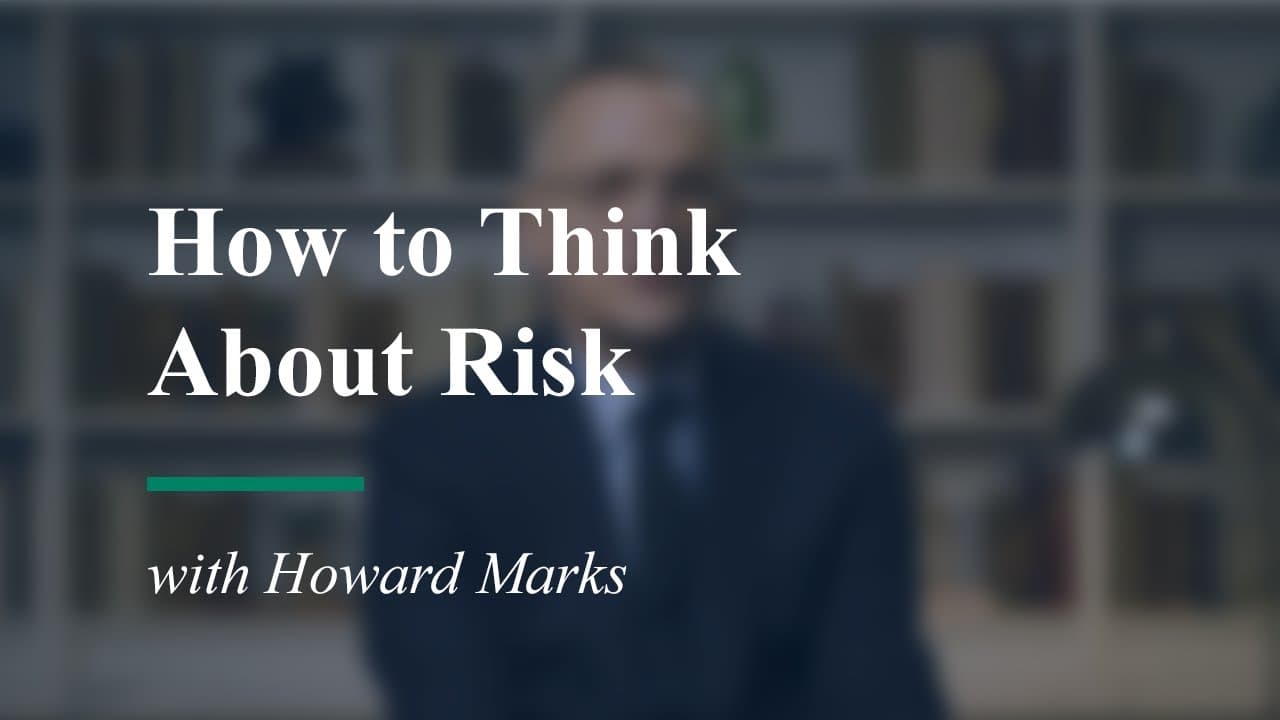
hi I'm Howard marks and this is how to think about risk the title of this class is how to think about risk that's an important title not what to think how to think the first question is what is risk risk in my opinion is the ultimate test of an Investor's skill the return alone doesn't tell you how good a job the manager did the key question is you... Read More
Key Insights
- Risk means the probability of loss, not just price fluctuations.
- Volatility is not synonymous with risk and is only a rough indicator.
- Risk is not quantifiable in advance or after the fact due to unknown outcomes.
- There are many forms of risk, including the chance of missing opportunities and being forced out at the bottom.
- Asymmetry matters: better performance in up markets and smaller declines in down markets.
- Tail events and rare outcomes can drive risk more than typical volatility.
- Selling at the bottom is a cardinal sin in investing.
- The future should be viewed as a range of possibilities, not a fixed outcome.
Install to Summarize YouTube Videos and Get Transcripts
Explore YouTube Video Summarizer or Get YouTube Transcript Extractor
Questions & Answers
Q: What is risk in investing according to the speaker?
Risk is the probability of loss in an investment. It reflects the possibility that the investment will perform poorly and require a higher return to compensate for that risk. This concept emphasizes the downside rather than just how volatile prices appear in the short term, and it guides how investors demand risk premia and manage their portfolios.
Q: Why is volatility not the same as risk?
Volatility measures price fluctuations, but it does not directly capture the chance of losing money. The speaker argues that risk is the probability of loss and that volatility is only a symptom that can indicate risk but does not define it. Therefore, relying solely on volatility can misstate the true risk an investor faces.
Q: Can risk be quantified in advance or after the fact?
No, risk cannot be quantified in advance, and it cannot be determined with certainty after the fact. Outcomes depend on a range of possible scenarios, and even when you know probabilities, you do not know which specific outcome will occur. This uncertainty is a core feature of risk in investing.
Q: What are some forms of risk beyond loss magnitude?
Beyond the potential for loss, risk includes missing opportunities, being forced out at the bottom, and other less obvious forms. The speaker notes that there are many forms of risk, some serious and some less important, but all contribute to the uncertainty investors must manage.
Q: What does asymmetry mean in the context of risk?
Asymmetry refers to achieving better upside performance than downside losses, i.e., favorable gains when markets rise and smaller losses when markets fall. This asymmetry is what the speaker identifies as a form of value added and a desirable characteristic of a manager or strategy.
Q: What role do tail events play in risk, and how should they be considered?
Tail events are highly unlikely outcomes that can have outsized impact. The speaker emphasizes that risk includes the possibility of these rare events and that they are often misunderstood because they are outside standard probability ranges. Recognizing tail risks helps in designing portfolios that survive extreme scenarios.
Q: Why is selling at the bottom considered a cardinal sin in investing?
Selling at the bottom means missing out on subsequent recoveries and deviating from the investment track. It represents a loss of staying power and a failure to participate in future gains, which the speaker highlights as a major mistake for investors who hope to build long-term wealth.
Q: How should we view the future and risk according to the lecturer?
The future should be viewed as a range of possibilities rather than a fixed outcome. This view requires accounting for multiple potential paths and their likelihoods, accepting that even with probabilities, you do not know which specific outcome will occur. This mindset underpins prudent risk management and portfolio design.
Summary & Key Takeaways
-
In investing, risk is defined as the probability of loss and is not the same as volatility. Understanding risk requires considering what could go wrong, not just what the market does day to day. Good risk management seeks asymmetry where upside exceeds downside and avoids the common mistake of selling at the bottom.
-
Risk cannot be forecast with precision, either before or after the event. The future is a range of possibilities and tail events matter, so investors should prepare for outcomes outside the most likely scenarios.
-
Risk is best viewed as a spectrum of possible outcomes rather than a fixed result. A disciplined approach mixes defensiveness with the ability to participate in gains, while protecting against large drawdowns and missed opportunities.
Read in Other Languages (beta)
Share This Summary 📚
Summarize YouTube Videos and Get Video Transcripts with 1-Click
Try YouTube Summary with ChatGPT & Claude or YouTube Transcript Generator
Explore More Summaries from Oaktree 📚

Summarize YouTube Videos and Get Video Transcripts with 1-Click
Try YouTube Summary with ChatGPT & Claude or YouTube Transcript Generator