Can The Crisis in Cosmology Be SOLVED With Cosmic Voids?
TL;DR
Exploring cosmic voids may resolve cosmology's dark energy and expansion rate mysteries.
Transcript
Two of the greatest mysteries in cosmology are the nature of dark energy and the apparent conflict in our measurements of the expansion rate of the early versus the modern universe that even dark energy can’t account for. Could both of these be explained by looking to a part of the universe that we’ve largely ignored so far? Could cosmic voids be d... Read More
Key Insights
- Dark energy and the differing expansion rates of the universe are two major cosmological mysteries that current models struggle to explain.
- The standard LCDM model may be flawed due to its assumption of an evenly distributed matter in the universe, which doesn't account for cosmic lumpiness.
- Cosmic voids, or underdense regions, could be influencing the universe's expansion, potentially explaining the Hubble tension.
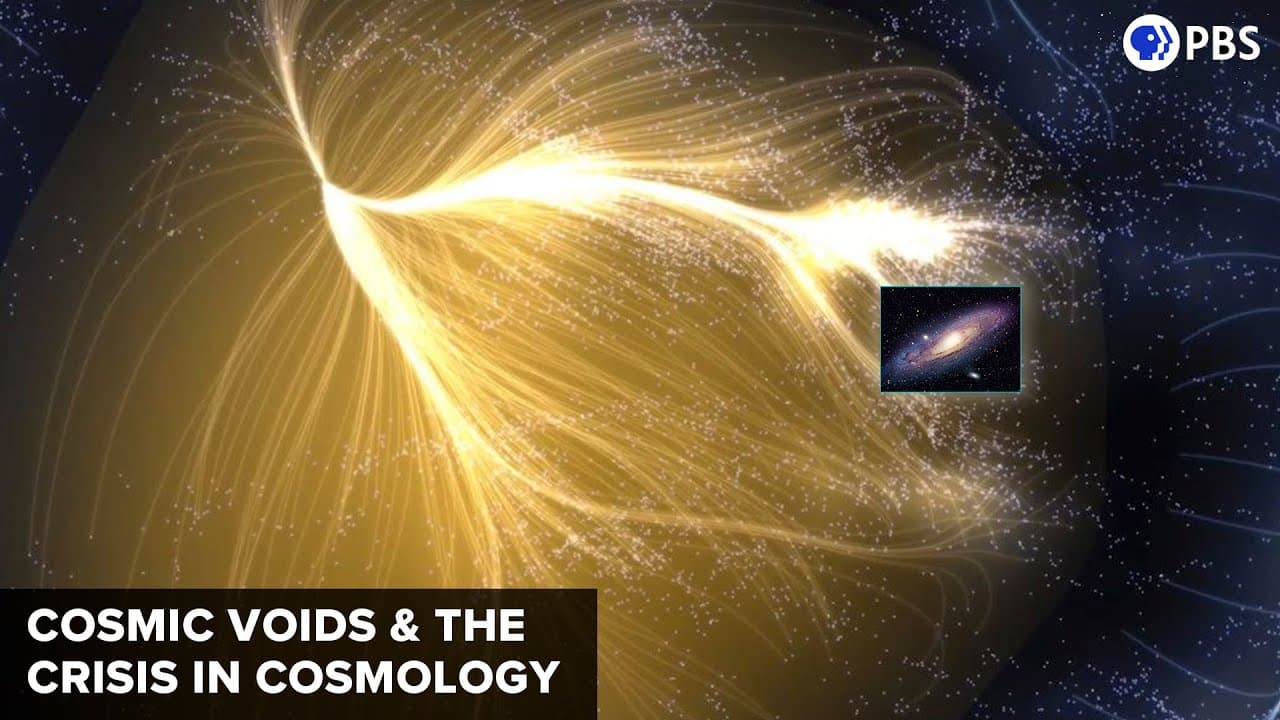
- Local cosmic structures like the Laniakea supercluster and the Local Hole may skew measurements of the Hubble constant, complicating our understanding of universal expansion.
- Recent studies suggest that cosmic voids might produce a negative pressure similar to dark energy, potentially explaining the universe's accelerating expansion.
- The Local Hole's existence and impact on cosmological measurements are debated, with some suggesting it challenges the LCDM model.
- Modified Newtonian dynamics (MOND) and alternate gravitational models have been proposed to explain cosmic anomalies, though they face significant criticism.
- If cosmic voids mimic dark energy, it implies that the universe's expansion dynamics could evolve over time, challenging current cosmological models.
Install to Summarize YouTube Videos and Get Transcripts
Explore YouTube Video Summarizer or Get YouTube Transcript Extractor
Questions & Answers
Q: What are the main mysteries in cosmology discussed in the video?
The video discusses two main mysteries: the nature of dark energy and the discrepancy in measuring the universe's expansion rate, known as the Hubble tension. These mysteries challenge current cosmological models, as dark energy is not fully understood, and the expansion rate measurements from the early and modern universe do not align.
Q: How might cosmic voids impact our understanding of the universe's expansion?
Cosmic voids, being underdense regions, could affect the universe's expansion by creating a negative pressure similar to dark energy. This might explain the Hubble tension by influencing the velocities of galaxies, making the measured expansion rate appear faster than predicted by the LCDM model.
Q: What is the Hubble tension and why is it significant?
The Hubble tension refers to the discrepancy between the measured expansion rate of the universe in the modern era and the rate predicted by observations of the early universe. It is significant because it suggests that either our measurements or our cosmological models, like LCDM, might be incorrect or incomplete.
Q: What role do local cosmic structures play in measuring the Hubble constant?
Local cosmic structures, such as the Laniakea supercluster and the Local Hole, can skew measurements of the Hubble constant. Their gravitational influences might lead to measurements that differ from those predicted by the LCDM model, complicating our understanding of the universe's expansion rate.
Q: How does the video propose cosmic voids could explain dark energy?
The video proposes that cosmic voids might mimic dark energy by producing a negative pressure, similar to the surface tension of bubbles. This could drive the accelerating expansion of the universe, suggesting that the observed effects of dark energy might be due to the structure of cosmic voids.
Q: What challenges does the Local Hole present to current cosmological models?
The Local Hole, being a massive underdense region, challenges current cosmological models like LCDM by suggesting that such large structures might not fit within the model's predictions. Its existence could imply inaccuracies in our understanding of matter distribution and gravitational dynamics in the universe.
Q: What alternative models are mentioned in the video to address cosmological anomalies?
The video mentions modified Newtonian dynamics (MOND) as an alternative model to address cosmological anomalies. MOND proposes different gravitational dynamics that might explain dark matter and other cosmic phenomena, though it faces significant criticism and has more points against it than for it.
Q: What implications would cosmic voids as dark energy have on the universe's expansion dynamics?
If cosmic voids act as dark energy, it implies that the universe's expansion dynamics could evolve over time. Initially, voids might contribute to accelerating expansion, but as they change, the dynamics could shift, suggesting that our understanding of cosmic expansion needs to account for temporal variations in void structures.
Summary & Key Takeaways
-
The video explores the potential role of cosmic voids in explaining two major cosmological mysteries: dark energy and the differing expansion rates of the universe. By examining cosmic lumpiness, it suggests that voids might influence these phenomena.
-
It discusses how the standard LCDM model's assumptions about matter distribution might be flawed, potentially leading to the Hubble tension. Local structures like the Laniakea supercluster and the Local Hole are examined for their impact on Hubble constant measurements.
-
The concept of cosmic voids producing a negative pressure akin to dark energy is explored, suggesting that voids might drive the universe's accelerating expansion. This challenges current models and proposes that expansion dynamics could change over time.
Read in Other Languages (beta)
Share This Summary 📚
Summarize YouTube Videos and Get Video Transcripts with 1-Click
Try YouTube Summary with ChatGPT & Claude or YouTube Transcript Generator
Explore More Summaries from PBS Space Time 📚
Summarize YouTube Videos and Get Video Transcripts with 1-Click
Try YouTube Summary with ChatGPT & Claude or YouTube Transcript Generator