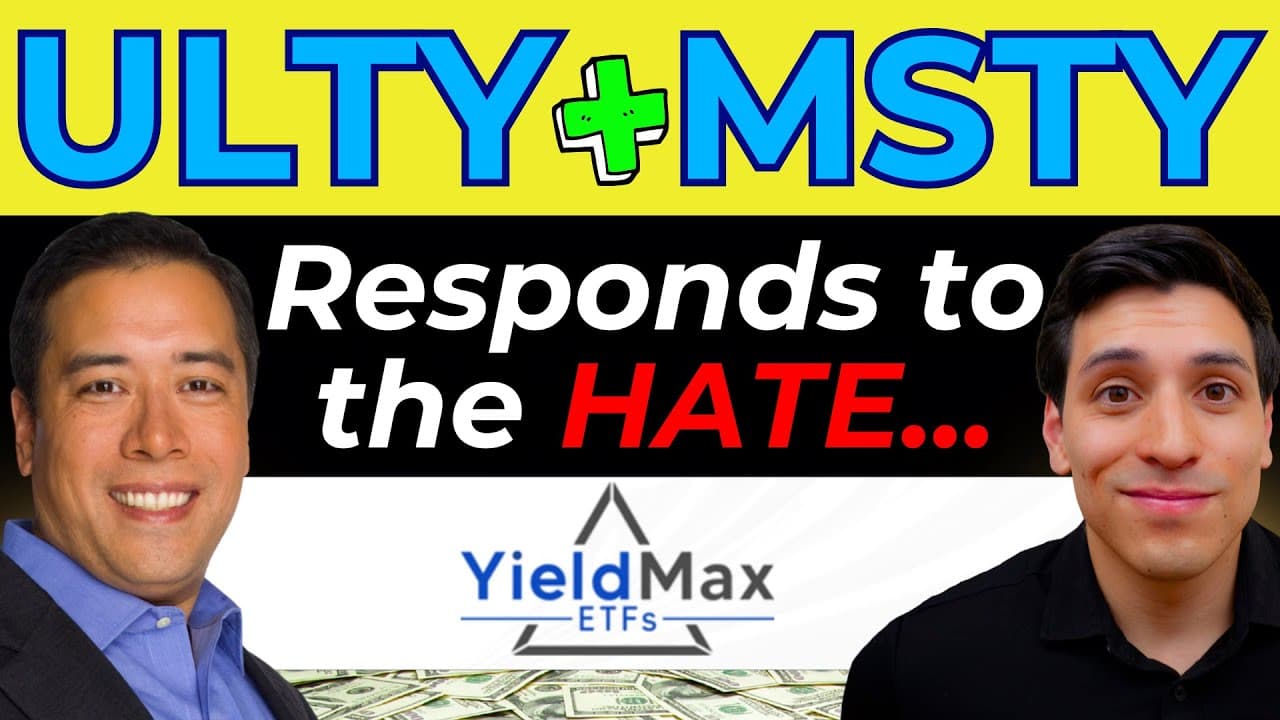
Why Are Investors Selling YieldMax ULTY and MSTY Weekly Dividend ETFs, and What Causes NAV Erosion?
TL;DR
YieldMax says NAV erosion in ULTY and MSTY can result from falling underlying assets and rules requiring at least 90% of realized gains to be distributed. When stocks rise, realized capital gains go to shareholders, while covered-call premiums are distributed when stocks fall, leaving NAV stable at best. Read on for details about weekly payouts, Target 12, Target 25, and BIGY.
Transcript
What do you have to say to investors who took out Helocks or loans to invest in Misti at its prime before strategy basically took the dump from all-time highs? Is this product flawed? Some of them taking their money out of YieldMax products and buying competitor products that have leverage. Did I give you your own money back? Has YieldMax ETFs in, ... Read More
Key Insights
- NAV erosion in YieldMax funds stems partly from construction: when the underlying asset falls, like the S&P inside MSTY, the value of the fund holding those securities also declines along with the market.
- RIC and IRS rules obligate YieldMax to distribute at least 90% of realized gains, or the fund faces a 30% corporate income tax that benefits no shareholder, which is why gains cannot simply be reinvested internally.
- The distribution mechanics mean NAV stays stable at best: when stocks rise you must distribute the realized capital gains, and when stocks fall you must distribute the covered-call premium collected.
- Target 12 funds are designed for roughly 1% monthly distributions with NAV stability and some upside participation, contrasting with the aggressive single-stock covered-call ETFs.
- BIGY, a target 12 fund started November 21 of last year, is up 16% on distributions taken as cash and 17% if reinvested, outperforming SPY's 14% by about 300 basis points on a reinvested basis.
- The Target 25 ETFs are slated to launch on the 18th and are intended to capture a bigger portion of the underlying asset's potential appreciation than the single-stock covered-call funds.
- Switching from monthly to weekly distributions is a frequency issue with no meaningful impact on underlying investment performance, since the strategies already sell weekly options and hold treasury collateral.
- More frequent distributions give shareholders greater flexibility to adjust positions, though they create additional operational work; YieldMax already held weekly distribution meetings because of its A, B, C, and D tranches.
Install to Summarize YouTube Videos and Get Transcripts
Explore YouTube Video Summarizer or Get YouTube Transcript Extractor
Questions & Answers
Q: Why does NAV erosion happen in YieldMax ETFs like ULTY and MSTY?
YieldMax says NAV erosion can happen partly because of how the funds are constructed and partly because their underlying assets decline. When the underlying securities fall, the value of the fund holding them also falls.
Q: Why cannot YieldMax reinvest all realized gains instead of distributing them?
RIC and IRS rules require the funds to distribute at least 90% of realized gains. Otherwise, the registered investment company would face a 30% corporate income tax, which YieldMax says would not benefit shareholders.
Q: How do covered-call distributions affect NAV when stocks rise or fall?
When stocks rise and gains are realized, the fund must distribute those capital gains. When stocks fall but a covered call generates premium, that realized premium must also be distributed, so YieldMax says NAV will probably be stable at best in these strategies.
Q: Does switching YieldMax ETFs from monthly to weekly dividends change investment performance?
YieldMax describes the switch as a change in distribution frequency, not a meaningful change in underlying investment performance. The strategies already sell weekly options and hold treasuries and short-term cash as collateral.
Q: What benefit do weekly YieldMax distributions provide investors?
More frequent distributions give shareholders greater flexibility to adjust their positions. YieldMax says the change adds operational work, although it already held weekly distribution meetings because of its A, B, C, and D tranches.
Q: What are YieldMax Target 12 funds designed to do?
Target 12 funds aim to distribute roughly 1% a month. Their priorities include NAV stability and some participation in gains when the underlying assets rise.
Q: How are YieldMax Target 25 funds different from Target 12 funds?
Target 25 funds are intended to capture a larger portion of an underlying asset's potential appreciation. They were slated to launch on the 18th, barring something unforeseen.
Q: How has YieldMax BIGY performed since inception?
BIGY began on November 21 of last year and was up 16% when distributions were taken as cash. It was up 17% with distributions reinvested, compared with 14% for SPY over the same period, an advantage of about 300 basis points.
Summary & Key Takeaways
-
Definition: NAV erosion can reflect declining underlying assets and the distribution mechanics of YieldMax covered-call funds.
-
Number: RIC and IRS rules require distribution of at least 90% of realized gains.
-
Number: Retaining required distributions could expose the registered investment company to a 30% corporate income tax.
-
Definition: Realized capital gains are distributed when stocks rise, while realized covered-call premiums are distributed when stocks fall.
-
Compare: YieldMax says NAV will probably remain stable at best in these covered-call strategies.
-
Number: Target 12 funds are intended to distribute roughly 1% a month while emphasizing NAV stability and upside participation.
-
When: Target 25 funds were slated to launch on the 18th, barring something unforeseen.
-
Number: BIGY was up 16% with cash distributions and 17% with distributions reinvested since inception.
-
Compare: BIGY's 17% reinvested result compared with 14% for SPY, about 300 basis points higher.
-
Definition: Weekly distributions change payout frequency and investor flexibility, not the funds' underlying investment performance.
Read in Other Languages (beta)
Share This Summary 📚
Summarize YouTube Videos and Get Video Transcripts with 1-Click
Try YouTube Summary with ChatGPT & Claude or YouTube Transcript Generator
Explore More Summaries from Marcos Milla 📚
Summarize YouTube Videos and Get Video Transcripts with 1-Click
Try YouTube Summary with ChatGPT & Claude or YouTube Transcript Generator