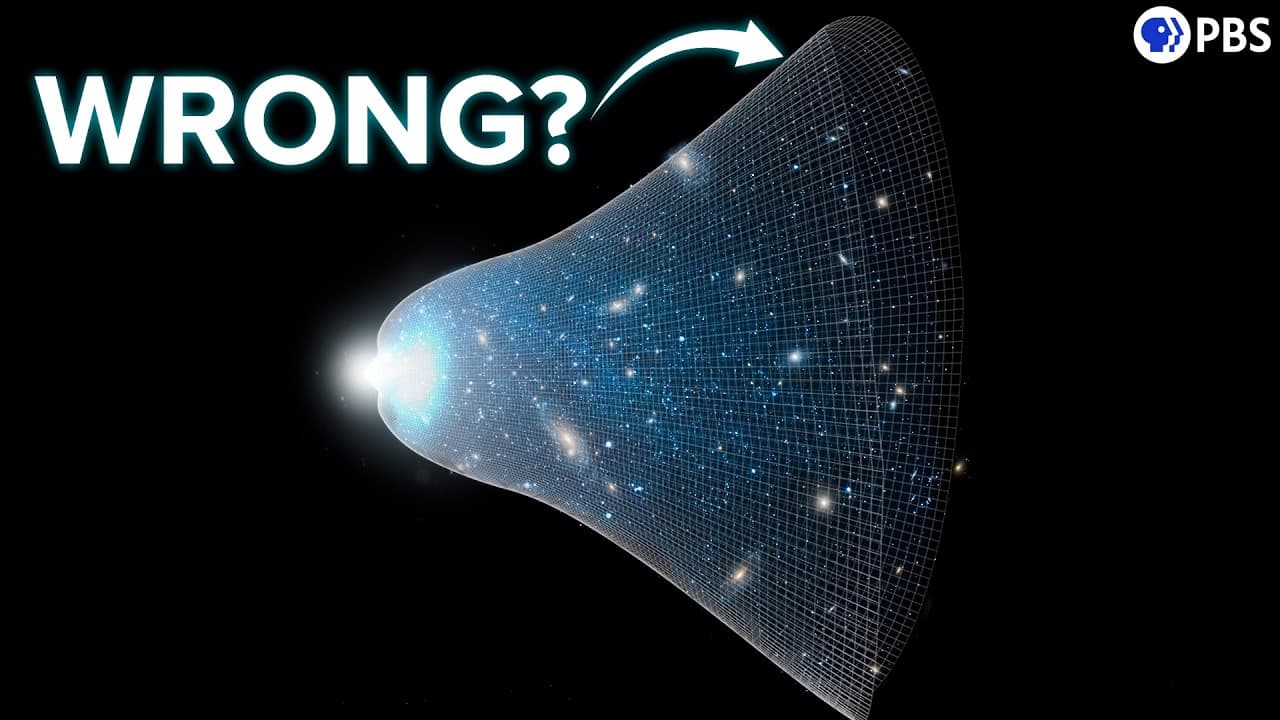
Is Our Model of Dark Energy WRONG? | New 4.2σ Results
TL;DR
Dark energy might be decreasing, challenging current cosmological models.
Transcript
thank you to Anyesk for supporting PBS the biggest news in cosmology in recent years is that the mysterious universe accelerating entity that we call dark energy may be fading away the evidence for this is now strong enough that enormous effort is going into confirming the result so what's it going to take and when are we going to know hey everyone... Read More
Key Insights
- Recent findings suggest that dark energy, the force accelerating the universe's expansion, may be weakening, challenging existing cosmological models.
- The Dark Energy Science Instrument (DESI) has provided data indicating a potential change in dark energy, but further confirmation is needed.
- DESI uses galaxy redshift surveys and baryon acoustic oscillations to measure the universe's expansion history.
- Combining DESI data with other measurements like cosmic microwave background radiation and supernovae provides stronger constraints on cosmological models.
- Upcoming surveys such as the Euclid satellite and the Legacy Survey of Space and Time (LSST) are expected to improve precision in measuring cosmic expansion.
- Gravitational lensing offers an independent method to measure cosmic distances, providing additional data for cosmological models.
- The combination of various data sources is crucial to distinguishing between different models of dark energy.
- Precision cosmology aims to refine our understanding of dark energy, dark matter, and the universe's evolution.
Install to Summarize YouTube Videos and Get Transcripts
Explore YouTube Video Summarizer or Get YouTube Transcript Extractor
Questions & Answers
Q: What recent findings have been made about dark energy?
Recent findings from the Dark Energy Science Instrument (DESI) suggest that dark energy, the mysterious force accelerating the universe's expansion, may be decreasing in strength. This challenges the current lambda CDM cosmological model, which assumes dark energy as a constant force. The evidence, while not yet definitive, has reached a confidence level close to a formal detection, prompting further investigations.
Q: How does DESI measure the universe's expansion history?
DESI measures the universe's expansion history using galaxy redshift surveys and baryon acoustic oscillations (BAO). By capturing the light from thousands of galaxies, DESI can determine their redshifts, which encode the expansion history. BAO patterns, remnants of sound waves from the early universe, serve as a standard ruler to track the universe's size at different times, providing crucial data for cosmological models.
Q: What role does gravitational lensing play in cosmology?
Gravitational lensing offers an independent method to measure cosmic distances, providing additional data for cosmological models. Strong lensing creates multiple images of distant objects, while weak lensing slightly distorts the shapes of background galaxies. By analyzing these distortions and time delays, astronomers can infer cosmic distances, offering insights into the universe's expansion history and helping to constrain models of dark energy.
Q: What are the anticipated contributions of the Euclid satellite to cosmology?
The Euclid satellite, launched by the European Space Agency, is expected to study over a billion galaxies using both imaging and spectroscopy. Its most important contribution to cosmology will be measuring galaxy clustering and weak lensing. These measurements are anticipated to significantly reduce uncertainty in cosmological parameters, particularly the equation of state parameters, leading to a more precise understanding of dark energy and cosmic expansion.
Q: How will the Legacy Survey of Space and Time (LSST) enhance cosmological research?
The Legacy Survey of Space and Time (LSST) on the Rubin Observatory will enhance cosmological research by mapping much of the southern sky repeatedly over 10 years. It will provide a vast dataset of type 1a supernovae, crucial for measuring late-time cosmic expansion. LSST will also discover numerous lensed quasars, enabling detailed studies of gravitational lensing time delays, offering an independent measure of the universe's expansion history.
Q: What challenges exist in improving supernova measurements?
Improving supernova measurements involves refining the calibration of type 1a supernovae as standard candles. These measurements rely on a chain of distance indicators, where errors can accumulate unnoticed. Major efforts are underway to identify and correct potential issues. Additionally, finding independent methods to measure cosmic distances, such as gravitational lensing, is essential to verify and complement supernova data.
Q: How do baryon acoustic oscillations (BAO) help measure cosmic expansion?
Baryon acoustic oscillations (BAO) are large-scale patterns in the distribution of galaxies, remnants of sound waves from the early universe. These patterns serve as a standard ruler, allowing astronomers to measure the universe's size at different times. By comparing the observed BAO scale with the expected scale, researchers can infer the rate of cosmic expansion, providing critical data for testing cosmological models and understanding dark energy.
Q: What is the significance of combining different cosmological data sets?
Combining different cosmological data sets is crucial for distinguishing between models of dark energy and refining our understanding of the universe. Each data set, such as galaxy redshifts, supernovae, and gravitational lensing, provides unique insights into cosmic expansion. By integrating these diverse measurements, researchers can constrain cosmological parameters more accurately, teasing apart complex interactions and improving the precision of cosmological models.
Summary & Key Takeaways
-
Recent data from the Dark Energy Science Instrument (DESI) suggests that dark energy may be weakening, challenging the current lambda CDM cosmological model. While the evidence is not yet definitive, it has prompted further investigations to confirm these findings and understand their implications for our understanding of the universe.
-
DESI utilizes galaxy redshift surveys and baryon acoustic oscillations to track the universe's expansion history. By combining this data with other measurements like cosmic microwave background radiation and supernovae, researchers can better constrain cosmological models and explore the possibility of a changing dark energy.
-
Future surveys, including the Euclid satellite and the Legacy Survey of Space and Time (LSST), aim to improve precision in measuring cosmic expansion. These efforts, alongside gravitational lensing techniques, will help refine our understanding of dark energy, dark matter, and the universe's evolution, potentially leading to new insights into the universe's ultimate fate.
Read in Other Languages (beta)
Share This Summary 📚
Summarize YouTube Videos and Get Video Transcripts with 1-Click
Try YouTube Summary with ChatGPT & Claude or YouTube Transcript Generator
Explore More Summaries from PBS Space Time 📚



Summarize YouTube Videos and Get Video Transcripts with 1-Click
Try YouTube Summary with ChatGPT & Claude or YouTube Transcript Generator