Are Dietary Supplements Safe or Just a Money Trap?
TL;DR
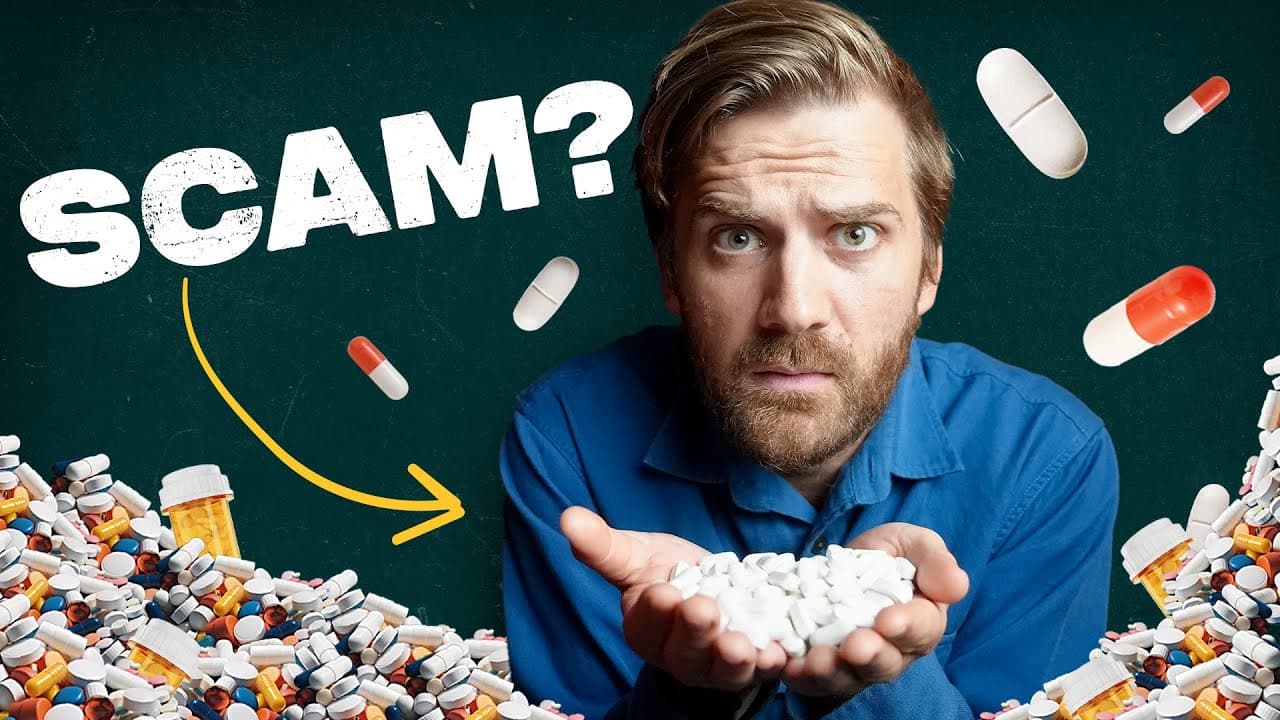
Many dietary supplements are unsafe, with studies revealing that 28% contain illegal substances, while 92% have bacterial contamination. The 1994 law allows the industry to self-regulate, leading to misleading claims and minimal oversight. Most vitamins provide little health benefit unless there is a deficiency, and many consumers may be wasting money on unnecessary products.
Transcript
(dramatic music) - Imagine you're getting ready to go to the gym, you grab your keys and your bag, and then you take a supplement, and you feel like it's working. It might be working a little too well. What you don't know is that this supplement, one that you bought at the health aisle at your grocery store is laced with an anabolic steroid, an ill... Read More
Key Insights
- 👻 The lack of regulation and oversight in the dietary supplement industry allows for the presence of illegal substances, bacterial and fungal contamination, and inaccurate labeling.
- 🥘 The 1994 law classified dietary supplements as food rather than medicine, resulting in minimal FDA oversight and allowing supplement companies to self-regulate.
- 🧑⚕️ Studies have shown that vitamins and supplements have little or no benefit in preventing major health conditions like cancer and cardiovascular disease.
- 🥺 Some supplements, such as melatonin, can be harmful at incorrect dosages, leading to overdoses and adverse effects.
- ❓ The industry's aggressive lobbying efforts and the profitability of the supplement market hinder efforts to implement stricter regulations and protections for consumers.
- 🎮 Increased FDA authority and resources, along with better enforcement of quality control measures, are necessary to ensure the safety and accuracy of dietary supplements.
Install to Summarize YouTube Videos and Get Transcripts
Explore YouTube Video Summarizer or Get YouTube Transcript Extractor
Questions & Answers
Q: How much of the tested supplements contained illegal substances or contaminants?
Out of the 3000 tested supplements, 28% were found to have illegal substances, mostly steroids, while 92% had bacterial contamination and 87% had fungal contamination.
Q: Are dietary supplements regulated like medicine?
No, dietary supplements are regulated as food and not subject to the same rigorous testing and approval process that medicines undergo.
Q: What are the potential risks of consuming contaminated supplements?
Contaminated supplements can cause adverse health effects, ranging from bacterial and fungal infections to severe and potentially life-threatening conditions. In some cases, contaminated supplements have led to deaths.
Q: How should consumers navigate the dietary supplement market?
It is recommended that consumers get their blood tested to determine if they have any deficiencies before considering taking dietary supplements. Additionally, research and choose reputable brands that undergo third-party testing and have quality standards in place.
Summary & Key Takeaways
-
Over 3000 tested supplements were found to contain illegal substances or contaminants, including steroids, leading to unintentional doping among consumers.
-
Studies have revealed that 92% of supplements tested have bacterial contamination and 87% have fungal contamination, posing health risks.
-
CBD supplements were found to have inaccurate labeling, with 55% having either significantly more or less CBD than stated on the label.
Read in Other Languages (beta)
Share This Summary 📚
Summarize YouTube Videos and Get Video Transcripts with 1-Click
Try YouTube Summary with ChatGPT & Claude or YouTube Transcript Generator
Explore More Summaries from Johnny Harris 📚






Summarize YouTube Videos and Get Video Transcripts with 1-Click
Try YouTube Summary with ChatGPT & Claude or YouTube Transcript Generator