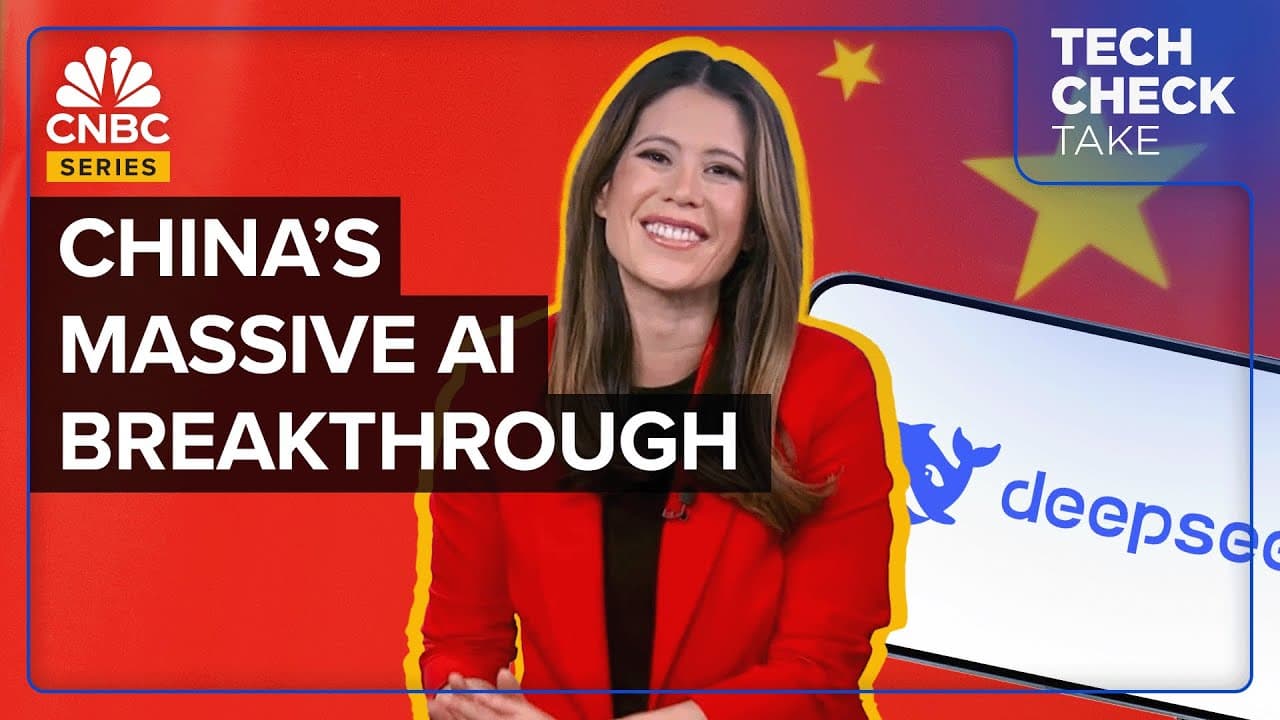
How China’s New AI Model DeepSeek Is Threatening U.S. Dominance
TL;DR
DeepSeek threatens U.S. AI dominance by producing free, open-source models that matched or beat leading American systems in cited tests while using fewer resources. DeepSeek reportedly built version 3 for $5.6 million in two months using Nvidia H-800 chips despite U.S. semiconductor restrictions, while its R1 reasoning model outperformed OpenAI’s o1 in some third-party tests. Read on for the benchmarks, cost comparisons, and competitive implications.
Transcript
China's latest AI breakthrough has leapfrogged the world. I think we should take the development out of China very, very seriously. A game changing move that does not come from OpenAI, Google or Meta. There is a new model that has all of the valley buzzing. But from a Chinese lab called Deepseek. It's opened a lot of eyes of like wh... Read More
Key Insights
- DeepSeek, a Chinese AI lab, developed a groundbreaking AI model in just two months for under $6 million, challenging U.S. tech giants.
- The model surpasses leading American AI models like OpenAI's GPT-4o and Meta's Llama 3.1 in various performance tests.
- DeepSeek's success raises concerns about the U.S.'s diminishing lead in AI, despite heavy investments by companies like Google and Microsoft.
- The Chinese model's efficiency highlights the potential of open-source AI, which could disrupt traditional closed-source dominance.
- DeepSeek's advancements come amid U.S. semiconductor restrictions, showcasing China's ability to innovate under constraints.
- The open-source nature of DeepSeek allows developers worldwide to build on its technology, potentially shifting the AI landscape.
- DeepSeek's model challenges the notion that massive financial investments are necessary for cutting-edge AI development.
- The emergence of efficient, cost-effective AI models like DeepSeek's could democratize AI technology, altering global tech dynamics.
Install to Summarize YouTube Videos and Get Transcripts
Explore YouTube Video Summarizer or Get YouTube Transcript Extractor
Questions & Answers
Q: Why is DeepSeek considered a threat to U.S. AI dominance?
DeepSeek produced free, open-source models that matched or outperformed leading American models in several cited evaluations while reportedly spending far less. Its results also challenge the belief that access to the most powerful chips and enormous investments is essential for competitive AI development.
Q: How much did DeepSeek version 3 reportedly cost and how long did it take to build?
DeepSeek said its development took two months and less than $6 million. More specifically, the report states that the lab spent $5.6 million to build DeepSeek version 3.
Q: Which American AI models did DeepSeek outperform in the cited tests?
The report says DeepSeek beat Meta’s Llama, OpenAI’s GPT-4o, and Anthropic’s Claude Sonnet 3.5 on accuracy across wide-ranging tests. Its R1 reasoning model also outperformed OpenAI’s o1 in some third-party tests.
Q: What evaluations were used to compare DeepSeek with other AI models?
The comparisons included a subset of 500 math problems, an AI math evaluation, coding competitions, and a test involving the detection and repair of code bugs. Humanity’s Last Exam, built from difficult questions supplied by professors in fields including math, physics, biology, and chemistry, placed DeepSeek at the top or roughly on par with the best American models.
Q: How did DeepSeek work around U.S. semiconductor restrictions?
U.S. restrictions prevented China from receiving powerful chips such as Nvidia’s H-100 GPUs. DeepSeek instead used Nvidia’s less performant H-800 chips and used its available hardware more efficiently to build its latest model.
Q: What role does open source play in DeepSeek’s competitive impact?
DeepSeek released a free, open-source model that developers can build on. The report describes it as the best open-source model and says American developers were already building on it, expanding its potential influence beyond DeepSeek itself.
Q: Who founded DeepSeek, and where did the lab come from?
DeepSeek’s founder is Liang Wenfeng, although the report says very little is publicly known about him or the lab. According to Chinese media reports, DeepSeek emerged from High Flyer Quant, a Chinese hedge fund managing about $8 billion in assets.
Q: How does DeepSeek’s reported spending compare with major U.S. AI investments?
DeepSeek reportedly spent $5.6 million to build version 3. The report contrasts that with OpenAI spending $5 billion annually, Google expecting more than $50 billion in 2024 capital expenditures, and Microsoft investing more than $13 billion in OpenAI, though these figures cover different kinds and scales of spending.
Summary & Key Takeaways
-
DeepSeek, a Chinese AI lab, has developed an AI model that outperforms top U.S. models, costing significantly less and built in a mere two months. This development has alarmed Silicon Valley, questioning the U.S.'s AI dominance.
-
Despite U.S. semiconductor restrictions, DeepSeek has innovated efficiently, using less powerful chips to create a model that challenges the necessity of massive investments by American tech giants.
-
The open-source nature of DeepSeek's model allows for widespread developer access, potentially shifting global AI dynamics and democratizing AI technology by providing a cost-effective alternative to closed-source models.
Read in Other Languages (beta)
Share This Summary 📚
Summarize YouTube Videos and Get Video Transcripts with 1-Click
Try YouTube Summary with ChatGPT & Claude or YouTube Transcript Generator
Explore More Summaries from CNBC 📚





Summarize YouTube Videos and Get Video Transcripts with 1-Click
Try YouTube Summary with ChatGPT & Claude or YouTube Transcript Generator