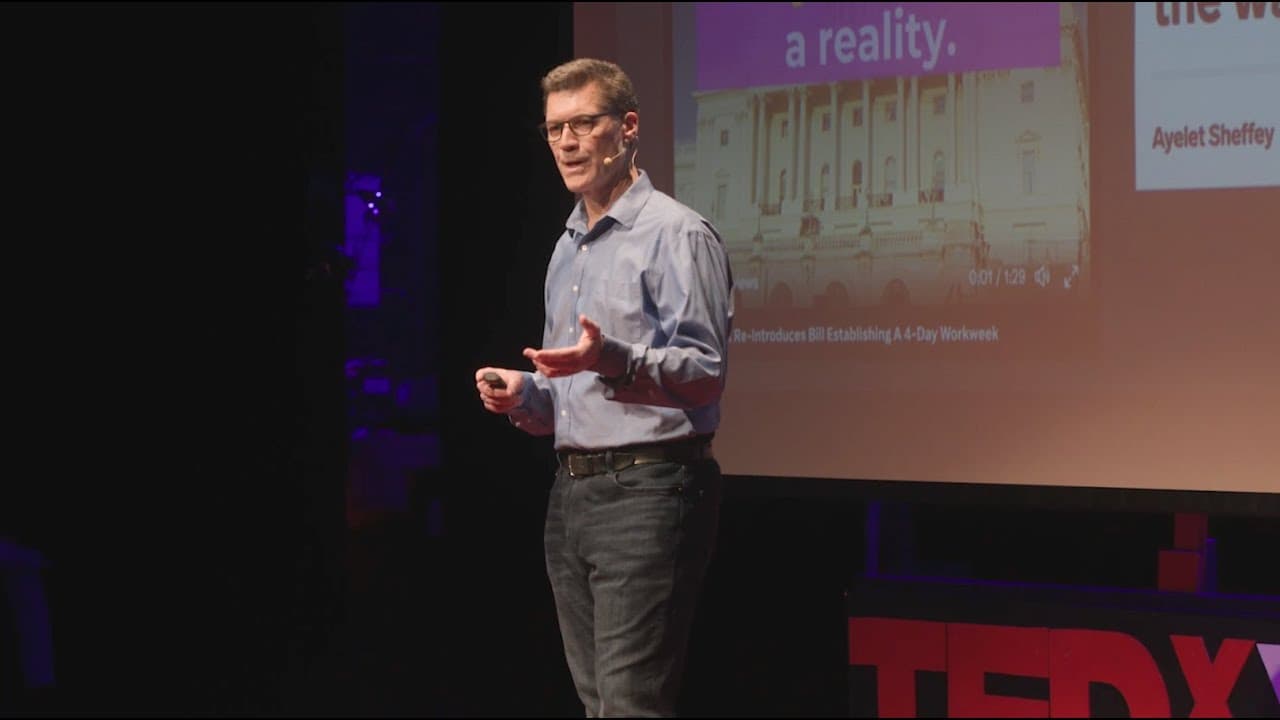
The Four-Day Work Week: A Post Pandemic Panacea | Jim Jordan | TEDxYouth@SHC
TL;DR
A four-day work week can significantly improve productivity and reduce stress. Evidence shows that companies adopting this model experience increased employee engagement, with examples like Microsoft's 40% productivity boost post-implementation. The post-pandemic environment presents a unique opportunity to embrace this shift and foster a healthier work-life balance.
Transcript
Transcriber: Sandra Balabenute Reviewer: Michael Nystrom Tell your story. Change the conversation. Organized by students. TEDxYouth at SHC. If I promise you my talk won’t be too long, what does that mean? I mean, obviously, it’s good news. I get that. But what is too long for a talk? Is it a number or is it more about your engagement level? You may... Read More
Key Insights
- 🥺 Society's obsession with speed and productivity has led to increased stress levels and societal breakdown.
- 💦 The adoption of a four-day work week has shown positive results in reducing stress, improving productivity, and enhancing work-life balance.
- 🌍 The post-pandemic world offers a unique opportunity for societal change and a shift towards deceleration.
- 💦 The conversation around deceleration and work-life balance is gaining momentum globally.
- 🧑⚕️ Societal change towards deceleration can have positive impacts on mental health, productivity, and overall well-being.
- 🥳 The shift to a four-day work week is supported by evidence of increased employee engagement and productivity.
- 💦 Post-pandemic reconstruction presents a chance for meaningful societal change and a recalibration of work-life balance.
Install to Summarize YouTube Videos and Get Transcripts
Explore YouTube Video Summarizer or Get YouTube Transcript Extractor
Questions & Answers
Q: What are the negative effects of society's obsession with speed and productivity?
Society's rush has led to high stress levels, societal breakdown, and a focus on speed over quality and wellbeing. In turn, this has resulted in social, political, and environmental challenges.
Q: How has the four-day work week shown to be successful in enhancing work-life balance?
The adoption of a four-day work week has resulted in reduced stress, increased productivity, better employee engagement, and improved overall well-being. Countries like Iceland and companies like Microsoft have seen positive outcomes.
Q: What societal shifts are prompting the conversation around deceleration and a four-day work week?
The COVID-19 pandemic has forced people to reevaluate their priorities, leading to a search for meaning and a desire for a better work-life balance. This has sparked discussions around societal change and post-pandemic reconstruction.
Q: How can embracing deceleration positively impact society as a whole?
Embracing deceleration through initiatives like a four-day work week can lead to reduced stress, improved mental health, better social interactions, and a more sustainable approach to work and life.
Summary
In this talk, the speaker discusses the detrimental effects of a fast-paced, technology-driven society and explores the potential benefits of implementing a four-day work week. They argue that our obsession with speed and productivity has led to negative consequences such as heightened anxiety, political polarization, and a climate crisis. However, they also highlight the promising signs of societal change and the unique opportunity we have now, post-pandemic, to reevaluate our priorities and work towards a more balanced and meaningful life.
Questions & Answers
Q: Why are attention spans seemingly shorter today than in the past?
The speaker believes that technology, particularly smartphones and the internet, has contributed to the shortening of attention spans. However, they also argue that the issue goes deeper than that, suggesting that our fast-paced lifestyles and constant pursuit of productivity have created a culture of hurry sickness, in which we feel compelled to always be on the move and multitasking.
Q: What signs of societal breakdown can be observed today?
The speaker points out several signs of societal breakdown, such as the prevalence of rage and political berating in social and mainstream media, skyrocketing anxiety and stress levels, and mass shootings becoming normalized. These indicators support the idea that our current obsession with speed and efficiency is not leading to the resolution of pressing problems but instead exacerbating them.
Q: How can deceleration and a four-day work week help address these issues?
The speaker argues that shifting to a four-day work week can have a positive impact on people's well-being and overall society. They cite examples such as Iceland's successful implementation of this model, resulting in reduced stress and increased employee engagement. Microsoft Japan also reported a significant productivity increase after adopting a four-day work week. By prioritizing time and leisure, individuals can find more meaning in their lives, and communities can thrive by participating in social activities.
Q: What is the historical context of the five-day work week?
The five-day work week as we know it has only been around for a hundred years. It was popularized by Henry Ford in the 1930s, who noticed that his assembly line workers were more productive when they worked for five days instead of six. Although remote work has become more prevalent, a large portion of the workforce still operates on the traditional 40-hour five-day model, which affects the division of work and leisure time for many families.
Q: Why do we always prioritize speed and productivity over other aspects of life?
The speaker suggests that our obsession with speed and productivity stems from a generational goal of doing things faster than the previous generation. Our culture values progress, innovation, and efficiency, often equating speed with success. However, they argue that this mindset fails to address critical issues such as climate change, poverty, a broken electoral system, and homelessness. Despite the lack of substantial progress, the desire for faster outcomes persists.
Q: Why does the speaker continue to be hopeful despite the challenges?
The speaker explains that we are currently in the intermediate phase of the pandemic, which historically prompts people to reflect on what is essential and reevaluate their lives. They note that the pandemic has already led many individuals to seek more meaningful work and prompted cities to reimagine downtown office spaces as social and cultural hubs. This unique moment of societal change, coupled with a widespread desire for a more balanced and fulfilling life, fuels the speaker's hope for a deceleration and a four-day work week.
Q: How does the speaker respond to potential resistance toward a four-day work week?
While acknowledging that societal change on such a large scale often faces resistance, the speaker emphasizes that the current environment is different. They reference sociologist Nick Christakis' observations on how pandemics prompt people to search for meaning and bring about societal transformations. The post-pandemic reconstruction offers a unique opportunity to challenge societal norms and advocate for a more balanced work-life dynamic.
Q: Are there economic benefits to implementing a four-day work week?
The speaker suggests that a four-day work week could have positive economic effects. Allowing people an extra day off would provide more time and opportunities for people to engage in social activities, such as going to cafes and museums, which could stimulate the economy. Additionally, reducing stress and increasing employee engagement could lead to increased productivity in the remaining four work days.
Q: What are some indicators that people are looking for a change in society?
The speaker mentions that during the pandemic, many individuals chose not to return to their old jobs, indicating a desire for something new and more meaningful. Cities around the world are also planning to repurpose office spaces into social venues, recognizing the need for communal spaces and interactions. These examples signal a collective shift in values and a rejection of returning to the pre-pandemic "normality."
Q: What is the speaker's call to action?
The speaker urges society to embrace deceleration and prioritize a more balanced approach to work and life. They encourage individuals to channel their inner Henry Ford and advocate for a four-day work week, envisioning a future where people work to live, rather than live to work. They believe that this is an opportune moment for transformative change and collective action.
Takeaways
The speaker highlights the negative consequences of our fast-paced society, emphasizing the urgent need for deceleration. They argue that adopting a four-day work week could improve well-being, increase productivity, and allow for more meaningful lives. In light of the post-pandemic reconstruction and a growing desire for change, the speaker calls on individuals and society to prioritize a more balanced work-life dynamic. This moment presents a unique opportunity for transformative societal change.
Summary & Key Takeaways
-
Modern society's obsession with speed and productivity has led to increased stress levels and societal breakdown.
-
The adoption of a four-day work week has shown positive results in reducing stress, improving productivity, and enhancing work-life balance.
-
The post-pandemic world offers a unique opportunity for societal change and a shift towards deceleration.
Read in Other Languages (beta)
Share This Summary 📚
Summarize YouTube Videos and Get Video Transcripts with 1-Click
Try YouTube Summary with ChatGPT & Claude or YouTube Transcript Generator
Explore More Summaries from TEDx Talks 📚



![The future of Employment Everything] is Social & Digital | Syed Aiyaz Uddin | TEDxVIFT thumbnail](/_next/image?url=https%3A%2F%2Fi.ytimg.com%2Fvi%2F9Ta_I24CB-M%2Fhqdefault.jpg&w=750&q=75)


Summarize YouTube Videos and Get Video Transcripts with 1-Click
Try YouTube Summary with ChatGPT & Claude or YouTube Transcript Generator