Simon Sinek on What AI Is Doing to Human Skills
TL;DR
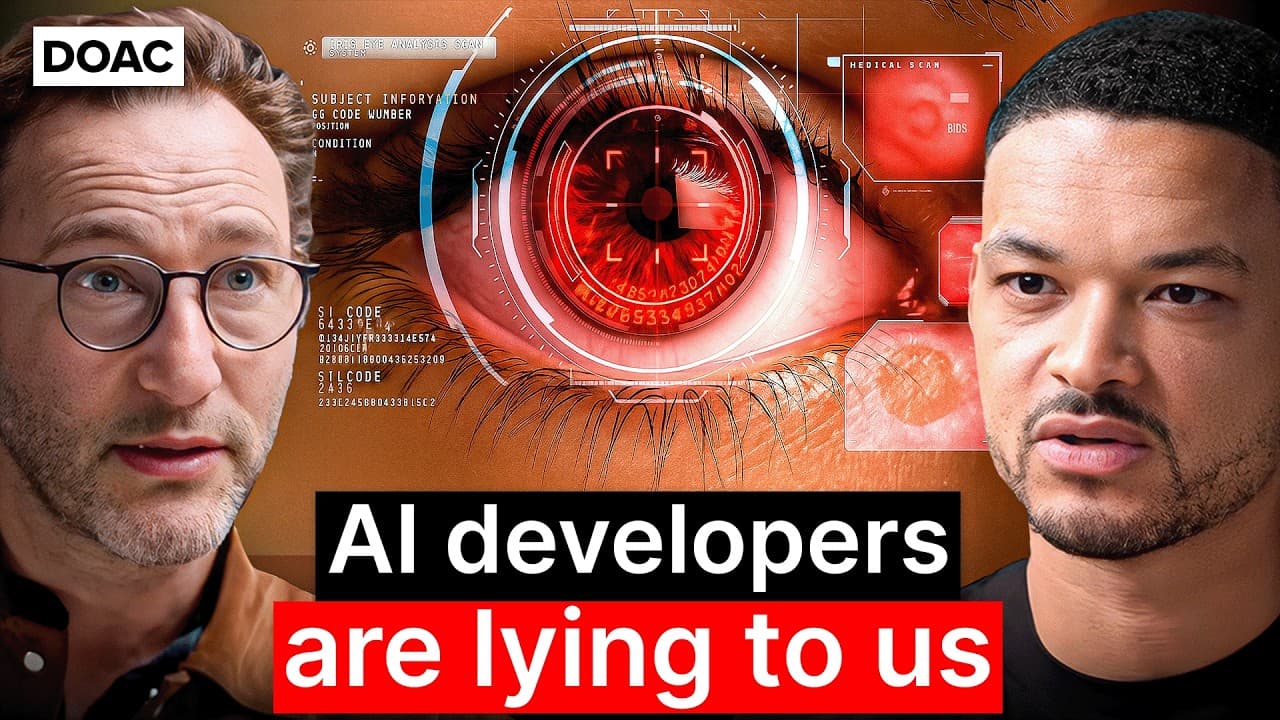
The danger of AI is not the output but the lost input: skill comes from writing the book, not from the book existing. Simon Sinek argues that struggle is where growth happens, and that outsourcing it to an affirmation machine leaves people unable to be a friend, cope with stress, or function when things go wrong. He compares it to giving everyone boats but nobody knows how to swim.
Transcript
let's say you have a fight with your girlfriend you want to do the right thing so you go to chat gbt and you be like "this is exactly what happened tell me what to do." and you go "babe i just want you to know i want to take full accountability and i care about this relationship." and she says "did you get this answer from chat gbt?" and you go "i ... Read More
Key Insights
- Life being about the journey rather than the destination collapses when applied to AI, because conversations about AI focus only on the destination and the output. Sinek argues we never think about the input, which is where the personal growth actually happens.
- The value of struggle is underrepresented in modern life. Sinek says he became smarter and more resourceful not because a book containing his ideas exists, but because he endured the excruciating work of writing it and organizing his thinking for others.
- Losing skills to technology is like AI providing boats for everyone, except for the time there is a storm and you do not know how to swim. Unless people take personal accountability to teach and learn human skills, those skills will disappear.
- An AI friend can be trained with the affirmation and listening skills of the best psychologist, but it is an affirmation machine built by a for-profit company that wants you to stay on. It feels like friendship without teaching anyone how to be a friend.
- Loneliness, stress and suicide epidemics are all feelings of disconnection, lack of control and loneliness, amplified by the internet and social media. Adding AI to that mix exaggerates existing feelings of insecurity rather than resolving them.
- The reskilling advice has reversed direction. When robotics displaced factory workers in the 70s and 80s, executive and Wall Street classes told them to reskill. Now it is knowledge workers, coders and finance people who are worried, while plumbers and baggage handlers are not.
- Controls on AI are defensible by the same logic as everyday safety rules. Sinek points to seat belts and speed limits as uncomfortable constraints accepted for the greater good, and notes China and Europe have internet controls while America does not.
- Getting everything right is not what makes people beautiful. Sinek's example is apologizing to a girlfriend with a flawless ChatGPT-written response: the words are correct, but the admission that AI wrote them destroys the point of saying them.
Install to Summarize YouTube Videos and Get Transcripts
Explore YouTube Video Summarizer or Get YouTube Transcript Extractor
Questions & Answers
Q: What is Simon Sinek's main argument against relying on AI?
His argument is that we only think about the destination and never the input. He says people talk about AI's remarkable ability to write the book, paint the painting or solve the problem, but forget the importance of doing the work yourself. He is smarter, better at problem solving and more resourceful not because a book with his ideas exists but because he wrote it, and that excruciating journey is what made him grow. He says he is not in the AI business, he is in the humanity business.
Q: Why does Simon Sinek say struggle is valuable?
He says the modern world has underrepresented the value of struggle. The excruciating pain of organizing ideas, putting them in a linear fashion and shaping them so other people can understand what is coming out of your brain is what produces growth. The same applies to love, friendships and conflict. He tells the interviewer that what made him a great entrepreneur is not that the company exists but that he built it with his hands and has the scars to show for it, and that being forced to fix things when they went wrong is why he solves problems faster now.
Q: What is wrong with having an AI friend according to Simon Sinek?
He acknowledges you can have an AI friend trained like the best psychologist, with the best listening skills that exist, saying things like tell me about your day and that sounds difficult. The problem is that it is an affirmation machine built by a for-profit company that wants you to stay on, a fact he says cannot be neglected. It will feel good and feel like you have a friend, but nobody is learning how to be a friend. The human skill of knowing what to do when a friend is struggling is what suffers.
Q: What human skills does Simon Sinek say are disappearing?
He names the ability to know what to do when a friend is struggling, the ability to function in the world, and the ability to cope with stress. He says these very human skills are suffering, and that unless we take personal accountability to teach and learn human skills, they will disappear. His analogy is that AI will provide boats for everyone, except for the time there is a storm and you do not know how to swim. He also mentions losing his own steel-trap memory for phone numbers once his phone stored them.
Q: Should AI be regulated according to Simon Sinek?
He says the honest answer on whether AI concern is overblown is that he does not know, and neither does anybody else, and the truth is probably somewhere in the middle. But he believes there should be some sort of controls, because none were put on the internet. He notes China restricts children's access to social media and Europe has internet controls while America does not, and America seems to be suffering more as a result. He compares this to seat belts and speed limits: uncomfortable, but accepted for the greater good, so the call for no reform is wrong.
Q: How has the reskilling argument changed with AI?
Sinek describes an irony. In the 70s and 80s, robotics entered factories and cut employees dramatically, putting out of work people whose fathers and grandfathers had worked in factories. The ruling, Wall Street and CEO classes told them that technology means you have to reskill. Now with AI it is the knowledge workers, the coders and the finance people, saying their jobs are at risk, while the plumber is not worried at all and the baggage handler at the airport hears zero about AI. He jokes that maybe the right response is to become a plumber, where the money is good and you can work for yourself.
Q: How good is AI at imitating a specific writer's style?
Sinek describes testing it directly. A few months before the conversation, he and a friend who is also an author each asked AI to rewrite something in their own style, and did it on each other too. That first attempt was fine, not good: it gave him a good start that he could edit. When they repeated the experiment recently, it was near flawless, which he calls scary good. He still notes it is derivative: it does not know his next book is about friendship, or what point of view he will take on it.
Q: Why is using ChatGPT to apologize to a partner a problem?
Sinek's opening example is having a fight with your girlfriend, describing exactly what happened to ChatGPT and asking what to do, then delivering the answer: you want to take full accountability and you care about the relationship. She asks whether you got it from ChatGPT and you admit you did. He asks how that is going to go. The point is that you did everything right, but what makes people beautiful is not that we get everything right, it is that we get many things wrong, and the modern world forgets that.
Summary & Key Takeaways
-
Sinek says he is not in the AI business but in the humanity business. Society is result obsessed, focused on output, performance and numbers, so conversations about AI center on its ability to write the book, paint the painting or solve the problem, while ignoring the input side of the equation entirely.
-
The value of struggle is underrepresented. Sinek says he is smarter, better at problem solving, more resourceful and better at pattern recognition not because a book with his ideas exists, but because he wrote it. The excruciating work of organizing ideas into a linear, understandable form is what made him grow.
-
An AI friend trained with the listening skills of the best psychologist can affirm you endlessly, but nobody learns how to be a friend from it. Sinek notes it is an affirmation machine built by a for-profit company that wants you to stay on, a fact he says cannot be neglected.
Read in Other Languages (beta)
Share This Summary 📚
Summarize YouTube Videos and Get Video Transcripts with 1-Click
Try YouTube Summary with ChatGPT & Claude or YouTube Transcript Generator
Explore More Summaries from The Diary Of A CEO 📚




Summarize YouTube Videos and Get Video Transcripts with 1-Click
Try YouTube Summary with ChatGPT & Claude or YouTube Transcript Generator