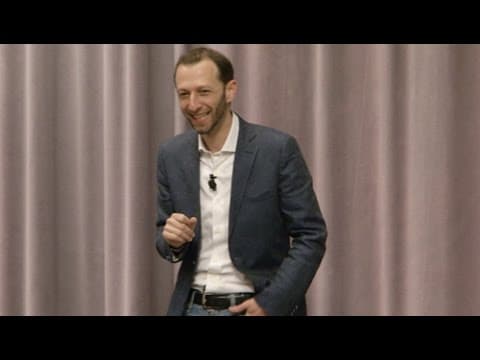
Brendan Boyle: How to Brainstorm Better

Transcript
Read and summarize the transcript of this video on Glasp Reader (beta).
Install to Summarize YouTube Videos and Get Transcripts
Explore YouTube Video Summarizer or Get YouTube Transcript Extractor
Summary
In this video, the interviewee discusses the effectiveness of brainstorming in their group. They explain that brainstorming is just one technique in the design process, which involves gaining inspiration, framing opportunities, and generating ideas. The interviewee mentions that brainstorming often gets a bad reputation because people don't know how to properly use it. They compare it to playing musical instruments, where only those who are practiced and knowledgeable can produce good results. The interviewee emphasizes the importance of divergent thinking and keeping an open mind for generating creative and potentially brilliant ideas.
Questions & Answers
Q: Why do people often say that brainstorming doesn't work?
Many people believe that brainstorming doesn't work because they haven't been able to achieve success with it. However, this perception arises from a lack of understanding about brainstorming and its role in the design process. Brainstorming is just one technique among several others that can be used to generate ideas effectively. It's important to properly learn and practice brainstorming before dismissing its effectiveness.
Q: How is brainstorming viewed in the interviewee's group?
In the interviewee's group, brainstorming is considered a valuable and successful tool. They have mastered the art of brainstorming and understand how to use it effectively. The interviewee suggests that the negative perception of brainstorming is mainly driven by individuals who have attempted it without the necessary knowledge or experience.
Q: Are there alternative techniques to brainstorming?
Absolutely, brainstorming is just one of many techniques to stimulate ideation. For example, some people may find inspiration in the shower and have great ideas in that setting. However, not all techniques are equally repeatable or applicable to every situation. Brainstorming, when done correctly, offers a structured and collaborative approach to generating ideas and can yield excellent results.
Q: Can you elaborate on the analogy of playing musical instruments in relation to brainstorming?
Sure, the analogy highlights the importance of skill and expertise in achieving success with brainstorming. Just as a group of musicians who are skilled in playing their respective instruments would create harmonious music together, a group of individuals who are knowledgeable and practiced in brainstorming can generate valuable ideas. On the other hand, individuals who lack the necessary understanding and experience might not achieve the desired results.
Q: What is the role of divergent thinking in brainstorming?
Divergent thinking is a critical aspect of brainstorming. It refers to the ability to think broadly and generate a wide range of ideas. The interviewee explains that many people are naturally skilled at convergent thinking, which involves making decisions and finding quick solutions. However, divergent thinking requires keeping the mind open, exploring outrageous or ridiculous ideas, and pushing boundaries. It is through this process of divergent thinking that truly innovative and potentially brilliant ideas can be discovered.
Q: Can you explain the misconception about creative people and divergent thinking?
The interviewee highlights a common misconception about creative individuals, which is that they are constantly in a state of divergent thinking. On the contrary, creative people understand when to switch between divergent and convergent thinking. They know when to turn on their divergent thinking mode to explore possibilities and generate ideas, and they know when to switch to convergent thinking to make decisions and find solutions. This ability to switch between thinking modes is a valuable skill in the ideation process.
Takeaways
It is important to understand that brainstorming is just one technique among many others for generating ideas. The effectiveness of brainstorming relies on proper knowledge and practice. People often perceive brainstorming as ineffective because they have not taken the time to learn and master the technique. Divergent thinking plays a crucial role in brainstorming, allowing for the exploration of a broad range of ideas and potentially uncovering brilliant solutions. Creative individuals understand the balance between divergent and convergent thinking and know when to employ each approach.
Read in Other Languages (beta)
Share This Summary 📚
Summarize YouTube Videos and Get Video Transcripts with 1-Click
Try YouTube Summary with ChatGPT & Claude or YouTube Transcript Generator
Explore More Summaries from Stanford eCorner 📚

![Brit Morin: Inspiring Creativity with Great Content [Entire Talk] thumbnail](/_next/image?url=https%3A%2F%2Fi.ytimg.com%2Fvi%2FPn-gi0EXZIE%2Fhqdefault.jpg&w=750&q=75)


![John Lilly: White Space is Everywhere [Entire Talk] thumbnail](/_next/image?url=https%3A%2F%2Fi.ytimg.com%2Fvi%2FTqyQnxD-vgg%2Fhqdefault.jpg&w=750&q=75)
Summarize YouTube Videos and Get Video Transcripts with 1-Click
Try YouTube Summary with ChatGPT & Claude or YouTube Transcript Generator