What Is Reality? Donald Hoffman on Space-Time as a Headset
TL;DR
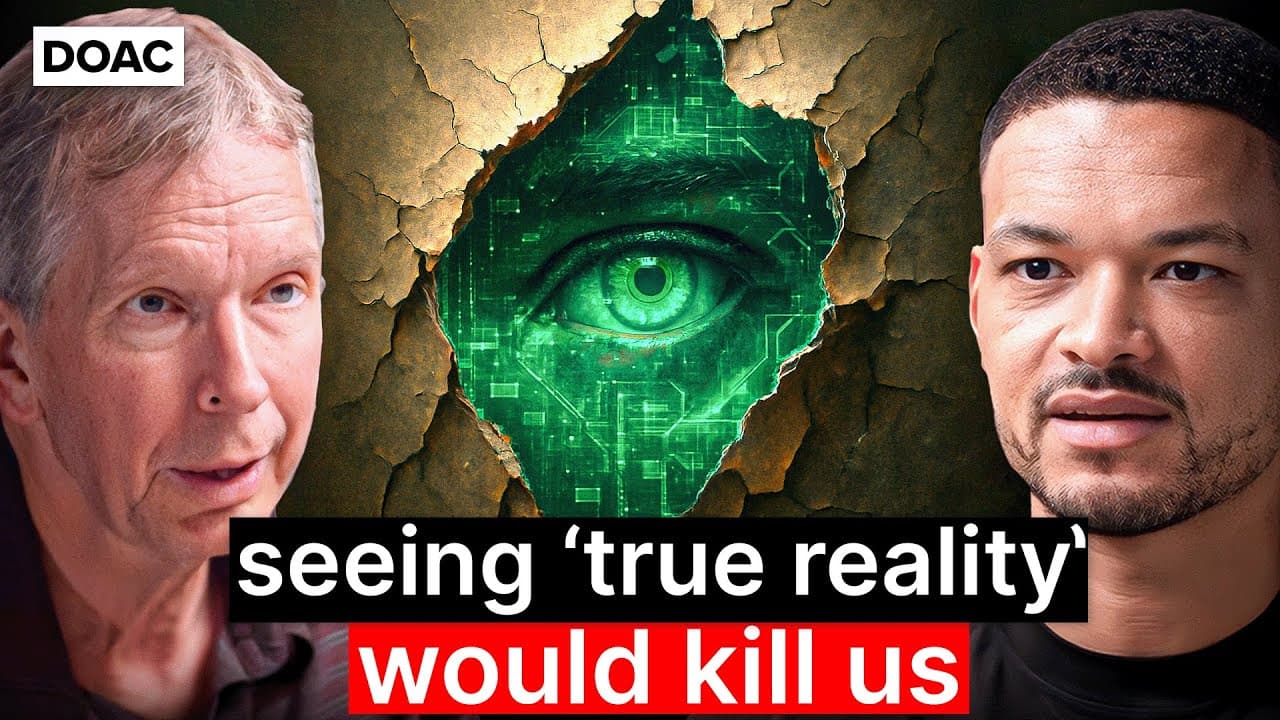
Donald Hoffman argues that perceived reality is a virtual-reality interface rather than the fundamental truth. He says Einstein’s theory and quantum theory indicate that space-time loses effective mathematical meaning at 10^-33 centimeters and 10^-43 seconds, while evolution shaped human senses for reproductive fitness rather than accuracy. His headset analogy, evolutionary argument, and ideas about life beyond perceived reality make the full discussion worth exploring.
Transcript
The world that you're seeing isn't the true world. All of this that I'm seeing right now is just a virtual reality. It's like you're born with a headset on playing a video game. That's your reality. But if you're the programmer who wrote the code for the game, you know that there's an entire world outside of it. And as the programmer, you can do mi... Read More
Key Insights
- Space-time cannot be the fundamental nature of reality according to our best theories. Einstein's theory together with quantum theory places the breakdown precisely at 10^-33 centimeters and 10^-43 seconds, the scale at which the very notion of space-time stops having any effective meaning mathematically.
- Perception functions as a virtual reality headset rather than a window onto truth. Hoffman argues even a hard table is a VR object, and that the entire setting a person occupies is a virtual reality with a genuine reality outside it that science can explore.
- Reproductive fitness, not accuracy, is what Darwinian evolution optimizes. Fitness measures how likely an organism is to have and successfully raise offspring to maturity, so sensory and motor systems were shaped to keep you alive long enough to reproduce, not to reveal what is actually there.
- Seeing the truth is too costly in time and energy to be selected for. The brain withholds information it judges unnecessary for survival because processing it would be cognitively inefficient, which is why Hoffman's position feels counterintuitive to most people and to many experts.
- Hoffman claims mathematical proofs exist showing evolution does not shape organisms to perceive truth. This directly contradicts the common assumption, held even by very intelligent experts in the field, that an organism seeing reality accurately would compete more successfully in the game of life.
- The Grand Theft Auto analogy separates interface from substrate. A player turning a steering wheel is actually causing millions of voltages to toggle in an exact sequence inside a supercomputer with diodes and resistors, a realm utterly outside anything imaginable from within the game.
- Geometric objects outside space-time, which Hoffman calls obelisks, are being found by researchers, with this line of work dating roughly from 2010. He describes the door to that realm as having started to crack open just in the last few months.
- Knowing who you truly are removes the basis for comparison and competition. Hoffman argues that because conscious experiences are what your brain creates and you are the inventor of the whole thing, you have nothing to prove, and a boring world is a world of your own creation.
Install to Summarize YouTube Videos and Get Transcripts
Explore YouTube Video Summarizer or Get YouTube Transcript Extractor
Questions & Answers
Q: What is Donald Hoffman’s theory of reality?
Hoffman argues that space-time and everything perceived through the senses function like a virtual-reality headset, not a direct view of fundamental reality. He says an entirely different reality exists outside this interface and remains open to scientific exploration.
Q: Why does Hoffman say space-time is not fundamental reality?
He says Einstein’s theory together with quantum theory indicates that space-time cannot be fundamental. According to the discussion, space-time loses effective mathematical meaning at 10^-33 centimeters and 10^-43 seconds.
Q: Does Hoffman claim that physical objects are virtual-reality objects?
Yes. Hoffman says even the hard table in front of him is a VR object and that the entire setting perceived through eyes, ears, and other senses belongs to the space-time headset.
Q: Why does evolution prevent humans from seeing true reality, according to Hoffman?
Hoffman says evolution shaped sensory systems to keep organisms alive long enough to reproduce successfully, not to reveal truth. Seeing the truth would require too much time and energy, so perception presents information useful for survival instead.
Q: How does the video-game headset analogy explain Hoffman’s argument?
Hoffman compares human experience to being born wearing a headset while playing a video game. The player treats the game world as reality, while the programmer knows that another world and the game’s underlying code exist outside it.
Q: Does anyone understand the true nature of reality, according to Hoffman?
Hoffman says no one, including the most advanced professionals, truly understands reality’s nature. He describes it as one of science’s major open problems and says current science suggests human imagination is not yet large enough.
Q: What does Hoffman say exists outside space-time?
He says science is finding geometric objects outside space-time that might be called obelisks. He describes this research as brand new, dating roughly from 2010, while emphasizing that the reality beyond the headset still requires exploration.
Q: What does Hoffman’s theory mean for comparison and competition in life?
Hoffman argues that feelings of inadequacy and the need to compete arise from misunderstanding who we are within the perceptual headset. He says that if people truly understood who they are, they would see no need to compare or compete, and that a boring world is a world of their own creation.
Summary & Key Takeaways
-
Hoffman's central claim is that what people call reality, everything inside space and time, is a user interface rather than the truth. He compares it to being born wearing a virtual reality headset while playing Grand Theft Auto: the streets, cars and steering wheel are real to the player, but the actual substrate is a supercomputer toggling millions of voltages in a precise order that the player never sees.
-
The scientific basis he cites is that Einstein's theory combined with quantum theory says space-time cannot be the fundamental nature of reality. Going from meters to centimeters to millimeters to micrometers and smaller, at 10^-33 centimeters and 10^-43 seconds the equations say the very notion of space-time has no effective meaning. Hoffman notes this is his interpretation, not physics itself.
-
Evolution, not accuracy, shaped the senses. Darwin's framework defines fitness as how likely an organism is to have and successfully raise offspring, and Hoffman says organisms are shaped by that, not by truth, because seeing the truth takes too much time and energy. He states there are mathematical proofs of this, contradicting the intuition of many experts in the field.
-
The practical consequence Hoffman draws is about identity and comparison. If your conscious experiences are what your brain creates and you are the inventor of the whole thing, then feelings of inadequacy and the need to compete with others rest on a mistake. In his words, if you really knew who you are, you would see no need to compare or compete, and a boring world is one of your own creation.
-
Beyond the headset, Hoffman says science is finding geometric objects outside space-time that he calls obelisks, work that only began roughly since 2010. He says editing the code is exactly what he is working on now, opening technologies far more powerful than anything seen before, including time travel, with nuclear bombs comparable to firecrackers. He frames it as Pandora's box: nasty surprises alongside miraculous possibilities.
Read in Other Languages (beta)
Share This Summary 📚
Summarize YouTube Videos and Get Video Transcripts with 1-Click
Try YouTube Summary with ChatGPT & Claude or YouTube Transcript Generator
Explore More Summaries from The Diary Of A CEO 📚






Summarize YouTube Videos and Get Video Transcripts with 1-Click
Try YouTube Summary with ChatGPT & Claude or YouTube Transcript Generator