How to Create 3D Models and AI Videos
TL;DR
AI advancements now allow for real-time 3D modeling from a single image, AI-generated transparent videos, and immersive 3D video conversion. Nvidia introduces a personal AI supercomputer capable of handling large AI models. These tools significantly enhance workflows in design, animation, and video editing, offering new creative possibilities.
Transcript
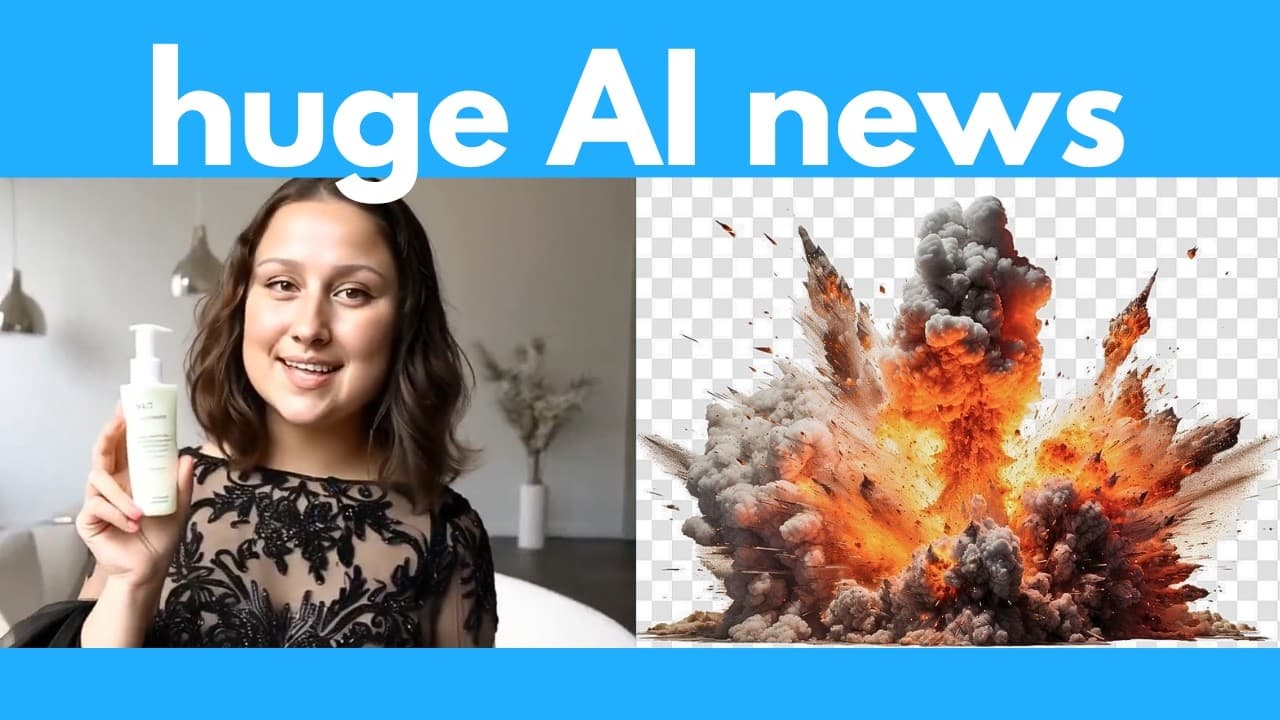
AI never sleeps and this week has been absolutely insane we have a new AI that can take one image and create a 3D model of it in real time like literally in under a second we have another AI that can take an image of an object and just directly add this object in an existing video we have another opsource video generator that can also control the c... Read More
Key Insights
- SPAR 3D can generate a 3D model from a single image in under a second, allowing for real-time editing.
- Gaze-LLE estimates where a person is looking in a video, using a vision transformer model.
- Stereocrafter converts 2D videos into immersive 3D experiences for VR headsets and 3D glasses.
- TransPixar generates videos with transparent elements, useful for special effects and animations.
- VideoAnydoor allows for inserting or replacing objects in videos with high accuracy, aligning colors and lighting.
- Nvidia's Digits is a compact AI supercomputer capable of running models with up to 200 billion parameters.
- The SE01 robot demonstrates lifelike walking posture, addressing challenges in humanoid robot design.
- Diffusion as Shader provides control over camera angles and movements in AI-generated videos.
Install to Summarize YouTube Videos and Get Transcripts
Explore YouTube Video Summarizer or Get YouTube Transcript Extractor
Questions & Answers
Q: How does SPAR 3D generate 3D models from images?
SPAR 3D utilizes a two-stage architecture to create 3D models from a single image. Initially, the input image is decoded and processed through a specialized point diffusion model to form a point cloud, capturing the object's structure. Subsequently, a triplane transformer integrates this data with the original image to generate detailed 3D geometry, texture, and illumination.
Q: What is the function of Gaze-LLE in video analysis?
Gaze-LLE employs a vision transformer model to estimate where a person in a video is looking. By analyzing video frames or images, it predicts the gaze direction and creates heat maps to indicate the AI's confidence in its predictions. This tool can be applied in surveillance and other fields requiring gaze tracking.
Q: How does Stereocrafter convert 2D videos into 3D?
Stereocrafter transforms 2D videos into 3D by generating depth maps to assess object distances from the camera. It then creates a warped video simulating a 3D effect. A diffusion model is applied to fill in missing parts, resulting in an immersive 3D video compatible with VR headsets and 3D glasses.
Q: What makes TransPixar's video generation unique?
TransPixar stands out by generating videos with transparent elements, facilitating overlays on existing videos for special effects. It incorporates an alpha channel in its diffusion transformer architecture, allowing for pixel-level transparency control. This capability is particularly valuable for creating complex animations and visual effects.
Q: How does VideoAnydoor improve video editing?
VideoAnydoor enhances video editing by enabling precise insertion or replacement of objects within a video. It adjusts the inserted object's color, brightness, and contrast to match the background video, ensuring seamless integration. This tool is useful for virtual try-ons, face swaps, and adding logos or effects to videos.
Q: What capabilities does Nvidia's Digits supercomputer offer?
Nvidia's Digits is a compact AI supercomputer designed to run AI models with up to 200 billion parameters locally. It features the GB10 Grace Blackwell super chip and allows for the combination of units to handle even larger models. This device supports advanced AI tasks and enhances computational power for individual users.
Q: What technological advancements does the SE01 robot demonstrate?
The SE01 robot showcases advancements in achieving lifelike walking posture in humanoid robots. It addresses the challenge of replicating human-like fluidity and shock absorption, typically difficult with hard materials. The robot's design incorporates innovative engineering to mimic natural human movements, setting a new benchmark in robotics.
Q: How does Diffusion as Shader enhance video creation?
Diffusion as Shader offers extensive control over video creation by allowing users to manipulate camera angles, movements, and object actions. It generates a 3D model from an input image, enabling users to specify detailed camera and object dynamics. This tool is highly flexible, supporting creative and precise video production.
Summary & Key Takeaways
-
AI tools like SPAR 3D and Gaze-LLE are revolutionizing the creation of 3D models and video editing. SPAR 3D can transform a single image into a 3D model in real-time, enhancing workflows in design and animation. Gaze-LLE uses AI to determine where individuals in videos are looking, adding a new dimension to video analysis.
-
Stereocrafter and TransPixar offer innovative video solutions. Stereocrafter converts 2D videos into 3D experiences for VR or 3D glasses, while TransPixar creates videos with transparent elements for special effects. These advancements open new possibilities for immersive and interactive video content.
-
Nvidia's Digits personal AI supercomputer and the SE01 robot highlight significant progress in AI hardware and robotics. Digits enables running large AI models locally, enhancing computational capabilities. The SE01 robot showcases advanced engineering for lifelike movements, setting a new standard in humanoid robotics.
Read in Other Languages (beta)
Share This Summary 📚
Summarize YouTube Videos and Get Video Transcripts with 1-Click
Try YouTube Summary with ChatGPT & Claude or YouTube Transcript Generator
Explore More Summaries from AI Search 📚

Summarize YouTube Videos and Get Video Transcripts with 1-Click
Try YouTube Summary with ChatGPT & Claude or YouTube Transcript Generator