How Can AI Improve Air Quality in Bogota?
TL;DR
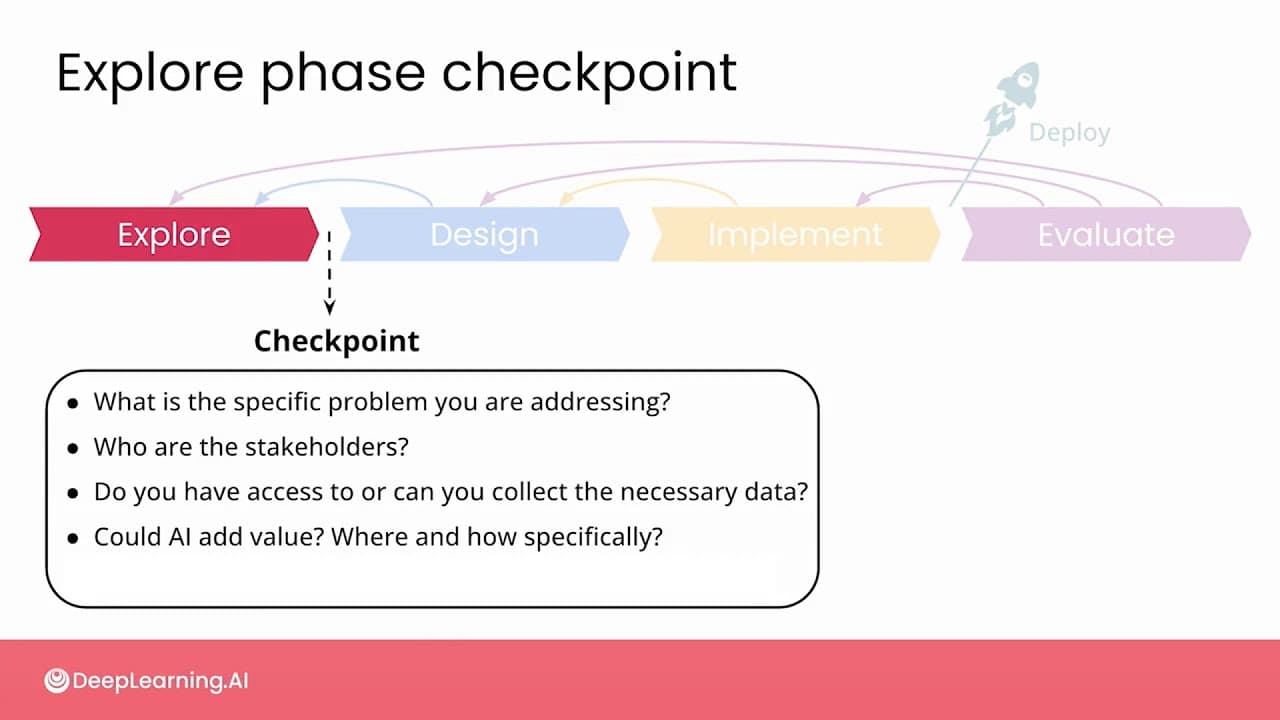
AI can enhance air quality monitoring in Bogota by providing real-time estimates based on historical sensor data. Key stakeholders, including public health professionals and citizens, must be engaged throughout the project to identify specific problems and ensure the data is accessible. The project's design phase will focus on developing models and ensuring that the solution informs the public about health risks effectively.
Transcript
in this week's materials you've been introduced to a framework for working through a life for good projects so you started out by walking through a case study uh focused on when I was working in maternal and infant Healthcare in Nigeria we saw how the project moved through each of the phases in detail and the considerations at each step of developm... Read More
Key Insights
- 📽️ Consideration of potential harms is crucial at each phase of project development.
- 😒 The explore phase involves identifying the specific problem, stakeholders, necessary data, and assessing the potential use of AI.
- 👱 Public health professionals and citizens are important stakeholders in improving air quality.
- 😫 Access to a relevant data set is crucial for developing a solution.
- 👱 AI can contribute to improving air quality by enhancing the accuracy of estimates.
- ❤️🩹 Although data privacy is not a major concern, the project's end application can have a direct impact on public health.
- ❤️🩹 Designing the end user experience should reflect the goal of informing the public about health risks.
Install to Summarize YouTube Videos and Get Transcripts
Explore YouTube Video Summarizer or Get YouTube Transcript Extractor
Questions & Answers
Q: What is the specific problem being addressed in the air quality project in Bogota?
The specific problem is the need for real-time estimates of air quality throughout Bogota to inform citizens about health risks and enable them to plan outdoor activities accordingly.
Q: Who are the stakeholders in the project?
The stakeholders include public health professionals working with the city of Bogota, citizens of Bogota, and the people maintaining the census.
Q: Is there access to the necessary data for the project?
Yes, the project has access to a rich data set of historical sensor measurements that can be used to develop a solution.
Q: How can AI potentially add value to the project?
AI could be suitable for estimating missing sensor values and making estimates for areas in between sensors, enhancing the accuracy of air quality estimates.
Summary & Key Takeaways
-
The content introduces a case study on maternal and infant healthcare in Nigeria, highlighting the importance of considering potential harms at each phase of development.
-
It then transitions to the explore phase of a project in Bogota, where public health professionals aim to provide real-time estimates of air quality throughout the city.
-
The specific problem, stakeholders, access to data, potential use of AI, and considerations of the "Do no harm" principle are discussed in relation to this project.
Read in Other Languages (beta)
Share This Summary 📚
Summarize YouTube Videos and Get Video Transcripts with 1-Click
Try YouTube Summary with ChatGPT & Claude or YouTube Transcript Generator
Explore More Summaries from DeepLearningAI 📚

![How Does the Logistic Regression Decision Boundary Work? — #33 Machine Learning Specialization [Course 1, Week 3, Lesson 1] thumbnail](/_next/image?url=https%3A%2F%2Fi.ytimg.com%2Fvi%2F0az8RjxLLPQ%2Fhqdefault.jpg&w=750&q=75)


Summarize YouTube Videos and Get Video Transcripts with 1-Click
Try YouTube Summary with ChatGPT & Claude or YouTube Transcript Generator