How to Use 3D Gaussian Splatting for Fast Rendering
TL;DR
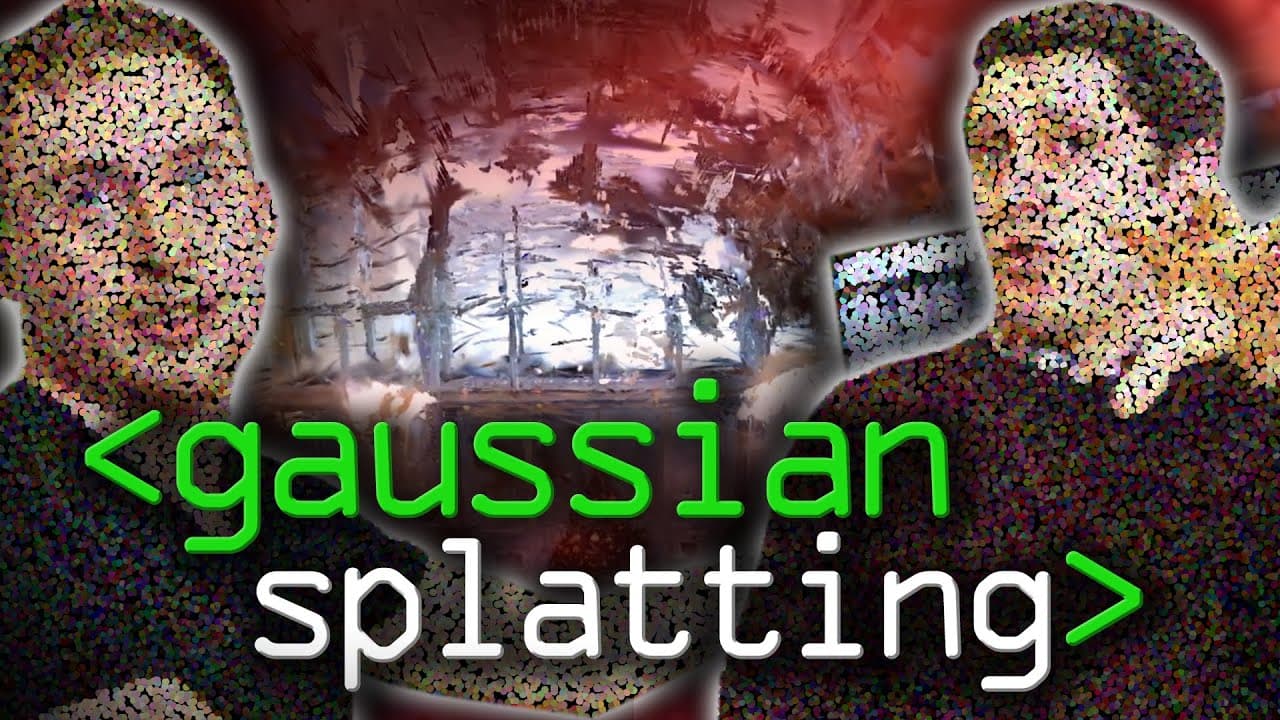
3D Gaussian Splatting is a technique that reconstructs 3D scenes from RGB images using neural networks, offering faster rendering speeds than NeRF. By representing scenes as a series of small Gaussian blobs, it allows for real-time rendering and easy integration into frameworks like Unity, enabling interactive manipulation and visualization.
Transcript
um now you may look at that and go that's all right it's not great but what happens when I increase the quality boom now that to me looks very very nice and the most impressive part is if we move it around look how quick it is you know granted my computer is not the best but you could not do this with a Nerf in the previous video whenever I moved t... Read More
Key Insights
- 3D Gaussian Splatting reconstructs 3D scenes from RGB images using a neural network.
- Gaussian Splatting offers faster rendering speeds compared to NeRF, achieving up to 100 FPS.
- Scenes are represented as a series of small Gaussian blobs, allowing for real-time rendering.
- Unlike NeRF, Gaussian Splatting uses rasterization instead of ray tracing, enhancing speed.
- Gaussians are like cells, they can move, change, duplicate, and divide to fit the scene.
- The technique allows for easy manipulation of objects within a scene, unlike NeRF.
- Integration into Unity allows for interactive visualization and manipulation of 3D scenes.
- Gaussians can be optimized through gradient descent to improve scene representation.
Install to Summarize YouTube Videos and Get Transcripts
Explore YouTube Video Summarizer or Get YouTube Transcript Extractor
Questions & Answers
Q: How does 3D Gaussian Splatting differ from NeRF?
3D Gaussian Splatting differs from NeRF by using rasterization instead of ray tracing, which enables faster rendering speeds. It represents scenes as a series of small Gaussian blobs, allowing for real-time rendering and easy manipulation of objects within a scene. This approach provides a significant speed advantage over NeRF, which is slower due to its reliance on ray tracing.
Q: What is the main advantage of using Gaussian Splatting for 3D rendering?
The main advantage of using Gaussian Splatting for 3D rendering is its ability to achieve real-time rendering speeds of up to 100 FPS, which is significantly faster than NeRF. This speed is achieved by representing scenes as a series of small Gaussian blobs and using rasterization techniques, making it suitable for interactive applications and easy integration into game development frameworks like Unity.
Q: How are scenes represented in 3D Gaussian Splatting?
In 3D Gaussian Splatting, scenes are represented as a series of small Gaussian blobs. These blobs act like cells, moving, changing, duplicating, and dividing to fit the scene accurately. This representation allows for real-time rendering and easy manipulation of objects within the scene, providing a flexible and efficient approach to 3D visualization.
Q: What role does gradient descent play in 3D Gaussian Splatting?
Gradient descent plays a crucial role in optimizing Gaussian blobs in 3D Gaussian Splatting. It is used to refine the size, opacity, and position of the blobs to improve the accuracy of the scene representation. This optimization process ensures that the 3D environment is accurately depicted, allowing for detailed and realistic visualizations from various viewpoints.
Q: Can 3D Gaussian Splatting be integrated into game development frameworks?
Yes, 3D Gaussian Splatting can be integrated into game development frameworks like Unity. This integration allows for interactive visualization and manipulation of 3D models within a game environment. The flexibility of Gaussian blobs enables easy manipulation of objects, making it a suitable technique for real-time applications and game development.
Q: What are the limitations of 3D Gaussian Splatting?
One limitation of 3D Gaussian Splatting is that it requires a comprehensive capture of the scene to accurately represent it. If parts of the scene are not captured during training, they will not be rendered, resulting in missing elements. Additionally, while Gaussian blobs offer flexibility, their initial estimates may not be accurate, requiring optimization through gradient descent.
Q: How does 3D Gaussian Splatting handle transparency and depth in rendering?
3D Gaussian Splatting handles transparency and depth by using a depth buffer and alpha blending techniques. The depth buffer prevents unnecessary rendering of Gaussian blobs that are occluded by others in front. Alpha blending is used to handle partially transparent blobs, ensuring that overlapping elements are rendered accurately, contributing to a realistic representation of the scene.
Q: What makes 3D Gaussian Splatting suitable for real-time applications?
3D Gaussian Splatting is suitable for real-time applications due to its use of rasterization instead of ray tracing, which significantly speeds up rendering. By representing scenes as small Gaussian blobs, it allows for fast rendering speeds of up to 100 FPS. This efficiency, combined with the flexibility of manipulating objects within the scene, makes it ideal for interactive applications and game development.
Summary & Key Takeaways
-
3D Gaussian Splatting reconstructs 3D scenes from RGB images using neural networks, offering faster rendering speeds than NeRF. By representing scenes as small Gaussian blobs, it allows for real-time rendering. The technique uses rasterization, not ray tracing, making it suitable for interactive applications.
-
Gaussians act like cells, moving, changing, duplicating, and dividing to better fit scenes. This flexibility enables easy manipulation of objects within scenes, a significant advantage over NeRF. Integration with frameworks like Unity allows for interactive visualization and manipulation of 3D models.
-
Optimization of Gaussian blobs is achieved through gradient descent, refining their size, opacity, and position to improve scene realism. This process ensures a more accurate representation of the 3D environment, allowing for detailed and realistic visualizations from various viewpoints.
Read in Other Languages (beta)
Share This Summary 📚
Summarize YouTube Videos and Get Video Transcripts with 1-Click
Try YouTube Summary with ChatGPT & Claude or YouTube Transcript Generator
Explore More Summaries from Computerphile 📚

Summarize YouTube Videos and Get Video Transcripts with 1-Click
Try YouTube Summary with ChatGPT & Claude or YouTube Transcript Generator