How to Add, Subtract, Multiply, and Divide Fractions
TL;DR
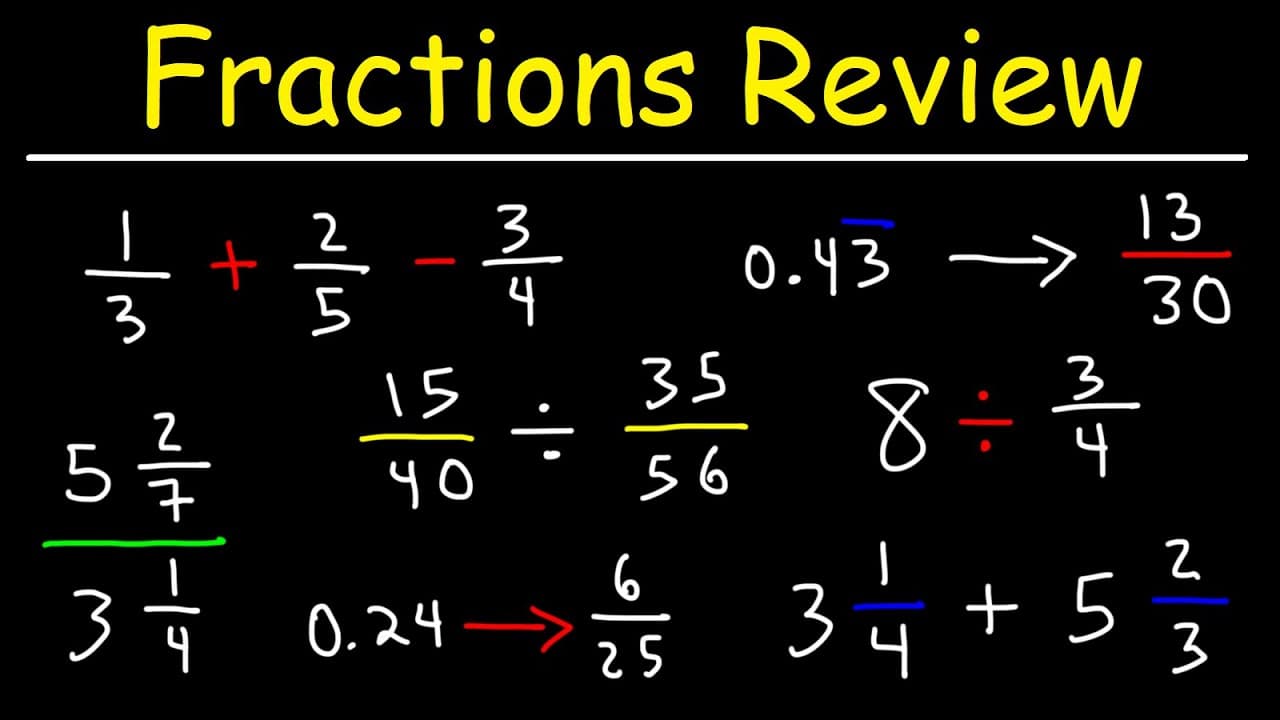
To add or subtract fractions, keep the common denominator and add or subtract the numerators. For unlike denominators, find the least common multiple to create a common denominator. Multiply fractions by multiplying their numerators and denominators, and divide fractions by flipping the second fraction and multiplying across.
Transcript
in this video we're gonna review fractions so let's start with this problem let's say we have three over five and we wish to add it to another fraction one over five what's the sum of these two fractions if the denominator of the two fractions are the same you can simply add the numerators of the two fractions so three plus one is four so this is f... Read More
Key Insights
- 🪜 Adding or subtracting fractions with like denominators simply requires adding or subtracting the numerators and keeping the common denominator.
- 👻 For fractions with unlike denominators, finding the least common multiple allows for finding a common denominator to add or subtract the fractions.
- ✖️ Multiplying fractions involves multiplying the numerators and denominators together.
- 🐬 Dividing fractions requires flipping the second fraction and multiplying the numerators and denominators.
- 🗂️ Converting fractions to decimals involves dividing the numerator by the denominator.
Install to Summarize YouTube Videos and Get Transcripts
Explore YouTube Video Summarizer or Get YouTube Transcript Extractor
Questions & Answers
Q: How do you add fractions with like denominators?
To add fractions with like denominators, simply add the numerators together and keep the common denominator. For example, 3/5 + 1/5 = 4/5.
Q: What is the process for subtracting fractions with like denominators?
Similar to adding fractions, to subtract fractions with like denominators, subtract the numerators and keep the common denominator. For example, 7/8 - 3/8 = 4/8, which can be simplified to 1/2.
Q: How do you add fractions with unlike denominators?
To add fractions with unlike denominators, find the least common multiple (LCM) of the denominators. Then, adjust the fractions to have the same denominator and add the numerators. For example, 7/5 + 1/4 = 28/20 + 5/20 = 33/20.
Q: What is the process for subtracting fractions with unlike denominators?
Similar to adding fractions with unlike denominators, find the LCM of the denominators. Then, adjust the fractions to have the same denominator and subtract the numerators. For example, 3/4 - 2/7 = 21/28 - 8/28 = 13/28.
Q: How do you multiply fractions?
To multiply fractions, multiply the numerators together and the denominators together. For example, 4/3 x 5/7 = 20/21.
Q: What is the process for dividing fractions?
To divide fractions, keep the first fraction the same, change division to multiplication, and flip the second fraction (take its reciprocal). Then, multiply the numerators and denominators. For example, 8/3 ÷ 7/5 = 8/3 x 5/7 = 40/21.
Q: How can you convert a fraction to a decimal?
To convert a fraction to a decimal, divide the numerator by the denominator. For example, 3/4 = 0.75.
Q: How do you convert a decimal to a fraction?
To convert a decimal to a fraction, write the decimal as a fraction with the decimal value as the numerator and a power of 10 as the denominator. Simplify if possible. For example, 0.2 = 2/10 = 1/5.
Summary & Key Takeaways
-
The video explains how to add and subtract fractions with like and unlike denominators by adding or subtracting the numerators and retaining the common denominator.
-
It demonstrates how to simplify fractions and find the least common multiple to find a common denominator for adding or subtracting unlike fractions.
-
The video also covers multiplying fractions by multiplying the numerators and the denominators, and dividing fractions by flipping the second fraction and multiplying.
Read in Other Languages (beta)
Share This Summary 📚
Summarize YouTube Videos and Get Video Transcripts with 1-Click
Try YouTube Summary with ChatGPT & Claude or YouTube Transcript Generator
Explore More Summaries from The Organic Chemistry Tutor 📚

Summarize YouTube Videos and Get Video Transcripts with 1-Click
Try YouTube Summary with ChatGPT & Claude or YouTube Transcript Generator