Orbitals, Atomic Energy Levels, & Sublevels Explained - Basic Introduction to Quantum Numbers
TL;DR
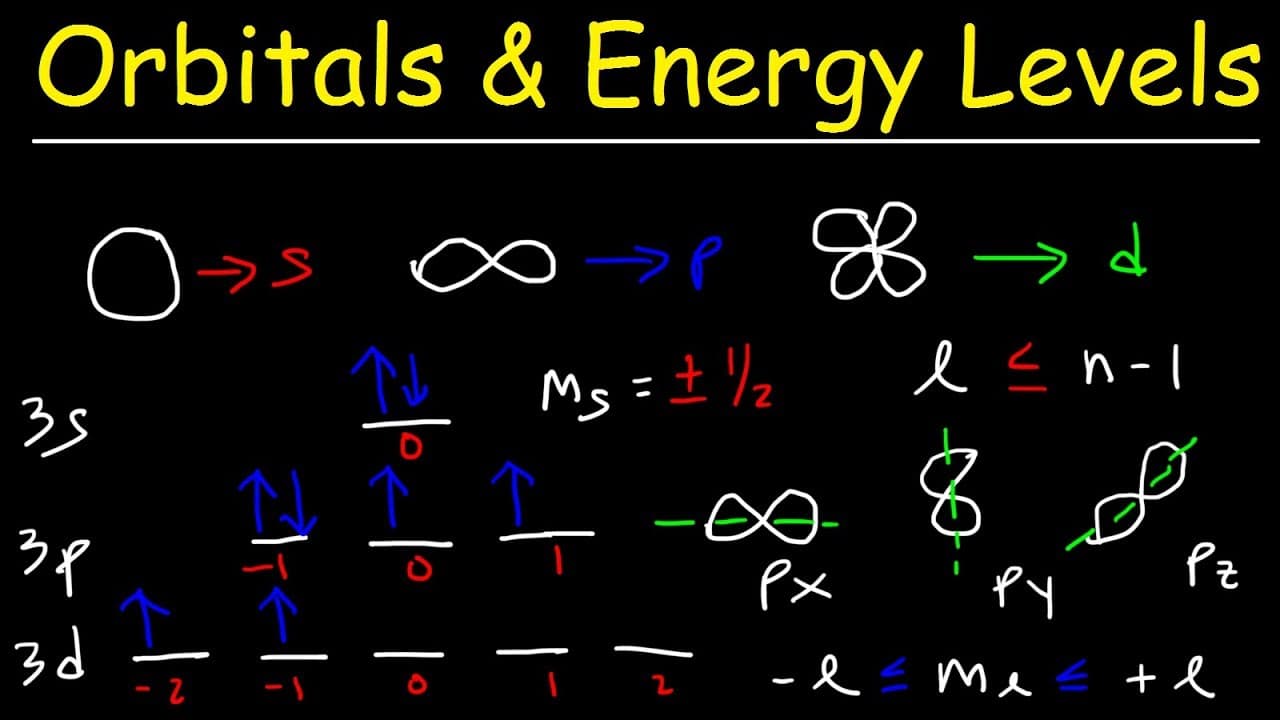
Orbitals are the most probable locations for electrons and are described by four quantum numbers: n for energy level and size, l for shape, mₗ for orientation, and mₛ for spin. The rule l ≤ n − 1 determines which sublevels exist, while mₗ ranges from −l to +l. Read on to see how these rules determine the quantum numbers of specific electrons such as 2p5 and 3d5.
Transcript
in this video we're going to talk about orbitals energy levels sub-levels quantum numbers and things like that now an orbital is simply the most probable location to find an electron so let's say this is nucleus we're going to consider the bohr model of the atom so i'm going to draw circular orbits so this is going to be the first energy level n eq... Read More
Key Insights
- 🫀 An orbital is the most likely location to find an electron in an atom.
- 🎚️ Energy levels determine the size and energy of an orbital, with higher energy levels corresponding to greater distances from the nucleus.
- #️⃣ Quantum numbers describe the shape and orientation of orbitals.
- #️⃣ The magnetic quantum number determines the orientation of an orbital relative to similar orbitals.
- ❓ Electron spin determines the direction of an electron's rotation.
- 🫀 The relationship between energy levels and sublevels determines the number of orbitals in an atom.
- 😫 Each electron in an atom has a unique set of four quantum numbers.
Install to Summarize YouTube Videos and Get Transcripts
Explore YouTube Video Summarizer or Get YouTube Transcript Extractor
Questions & Answers
Q: What are the four quantum numbers, and what does each represent?
The principal quantum number n describes an orbital’s energy level and size, while l describes its shape or sublevel. The magnetic quantum number mₗ describes the orbital’s orientation, and mₛ describes electron spin as either +1/2 or −1/2.
Q: How are orbitals related to atomic energy levels?
An orbital is the most probable location for finding an electron. As the principal quantum number n increases, the orbital’s energy and distance from the nucleus increase, so electrons closer to the nucleus occupy lower energy levels.
Q: Which sublevels are allowed in each energy level?
The angular momentum quantum number follows l ≤ n − 1, with l values 0, 1, 2, and 3 corresponding to s, p, d, and f. Thus, n = 1 has only s; n = 2 has s and p; n = 3 has s, p, and d; and n = 4 has s, p, d, and f.
Q: What shapes do the s, p, d, and f orbitals have?
The s orbital, where l = 0, is spherical, and the p orbital, where l = 1, resembles a dumbbell. The d orbital, where l = 2, is mostly clover-shaped, while the f orbital, where l = 3, has a more unusual shape.
Q: How does the magnetic quantum number mₗ identify orbitals?
The value of mₗ ranges from −l to +l, including zero, and distinguishes orbitals with different orientations within a sublevel. For p, l = 1 gives mₗ values −1, 0, and +1 for its three orbitals; for d, l = 2 gives five values from −2 through +2.
Q: How many orbitals are in the p and d sublevels?
The p sublevel has three orbitals, designated px, py, and pz, which have different orientations along the x, y, and z axes. The d sublevel has five orbitals, corresponding to five mₗ values from −2 to +2.
Q: What are the four quantum numbers for the 2p5 electron?
For 2p5, n = 2 because the electron is in the second energy level, and l = 1 because it is in a p sublevel. In the orbital arrangement shown, the fifth electron has mₗ = 0 and a downward spin, so mₛ = −1/2.
Q: What are the four quantum numbers for the 3d5 electron?
For 3d5, n = 3 and l = 2 because the electron is in the third energy level and the d sublevel. In the arrangement shown, the fifth electron occupies the orbital with mₗ = +2 and has an upward spin, giving mₛ = +1/2.
Summary & Key Takeaways
-
An orbital is the most probable location to find an electron, and it is determined by energy levels.
-
Energy levels (n) describe the size and energy of an orbital, with higher n values indicating greater distance from the nucleus.
-
Quantum numbers (l) describe the shape of an orbital, with different values corresponding to different orbital shapes.
-
Magnetic quantum number (mₗ) describes the orientation of an orbital relative to similar orbitals in an atom.
-
Electron spin determines the direction of an electron's rotation.
Read in Other Languages (beta)
Share This Summary 📚
Summarize YouTube Videos and Get Video Transcripts with 1-Click
Try YouTube Summary with ChatGPT & Claude or YouTube Transcript Generator
Explore More Summaries from The Organic Chemistry Tutor 📚


Summarize YouTube Videos and Get Video Transcripts with 1-Click
Try YouTube Summary with ChatGPT & Claude or YouTube Transcript Generator