How to futureproof your career against AI displacement
TL;DR
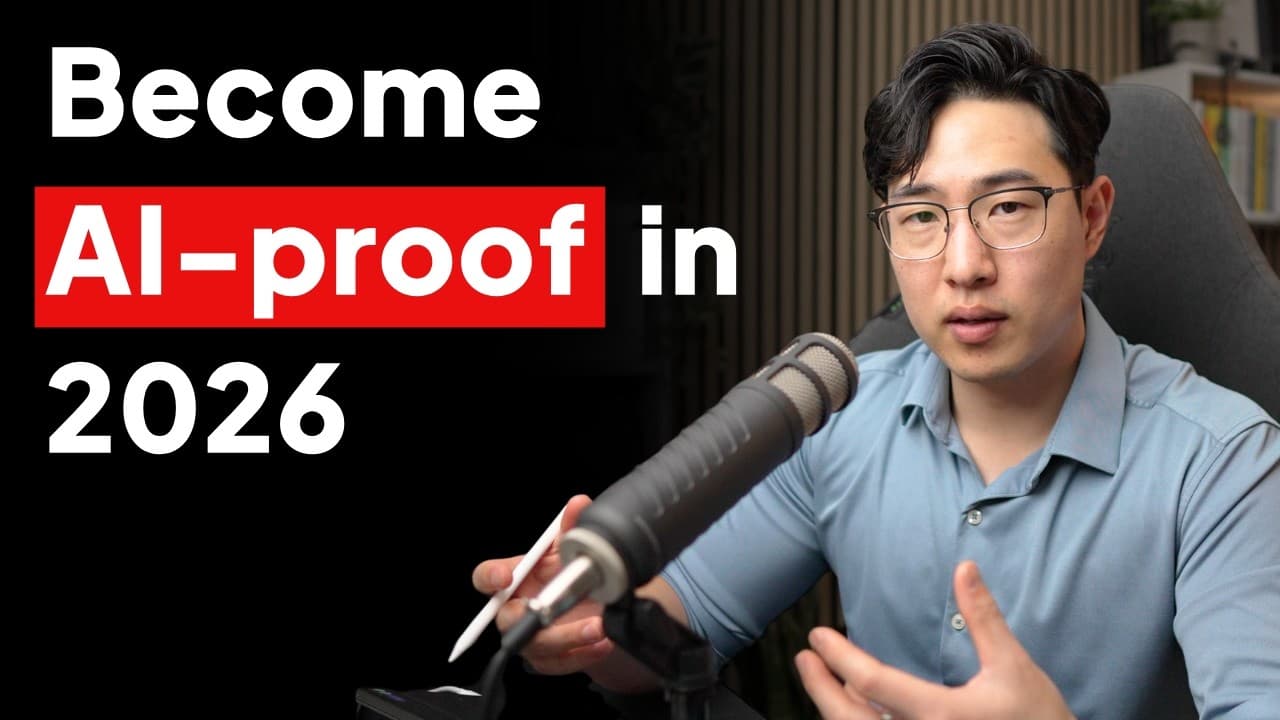
AI will likely replace many routine tasks, so focus on trajectories rather than current capabilities. Understand the difference between technology and capability, and learn how hallucinations and complexity affect AI judgment. Position yourself where the puck is headed by studying industry leaders and managers to futureproof for the coming decade.
Transcript
Is AI going to take your job? The short answer is probably yes. This might be a controversial take, but we live in a pretty capitalistic society and if a business sees that AI can do your job while saving 90% of the cost, there's a pretty good chance that AI is going to take that job. And as humans who need to work and live, that kind of sucks. But... Read More
Key Insights
- AI displacement is likely to happen, but timing depends on market incentives and company decisions.
- The puck analogy emphasizes focusing on future trajectories rather than current capabilities.
- Technology refers to fundamental limits, while capability is about current performance levels.
- Hallucinations in AI are a function of architecture, not a bug that will be instantly fixed.
- Complexity reduces AI reliability in highcontext, nuanced, or emerging domains.
- Temporary limitations can be overcome with learning, while fundamental limits may persist longer.
- Understanding AI mechanics helps identify where automation will struggle and where humans add unique value.
- Positioning yourself where the puck is headed requires studying how managers and industry leaders think about AI.
Install to Summarize YouTube Videos and Get Transcripts
Explore YouTube Video Summarizer or Get YouTube Transcript Extractor
Questions & Answers
Q: How can you start futureproofing your career against AI displacement today?
To start futureproofing, focus on trajectories over hype by studying where the puck is headed in your industry. Learn enough about AI technology to distinguish temporary capabilities from fundamental limits. Develop skills that complement AI, such as complex decisionmaking, high context reasoning, and personalized human interactions that AI cannot easily replicate.
Q: What is the difference between technology and capability in AI?
Technology refers to the underlying architecture and fundamental limits of AI, such as whether a limitation is temporary or fundamental. Capability is the current performance level of a tool. Understanding this difference helps you gauge whether improvements are coming soon or if a limit may persist, guiding career decisions accordingly.
Q: Why are hallucinations not simply a bug in AI systems?
Hallucinations arise because large language models operate on probabilities without a concept of truth or reality. They generate text based on training data and probabilistic matching, so eliminating hallucinations would require a fundamentally different mechanism. This is important for evaluating AI reliability in real world tasks.
Q: How does complexity affect AI reliability in business use cases?
Complexity affects reliability when multiple factors interact and highcontext reasoning is required. In such scenarios, AI may struggle to provide accurate or nuanced outputs due to limited training data and the model’s current architecture. This explains why some business tasks still benefit most from human judgment.
Q: What should you learn about AI to assess its impact on your job?
Learn enough about the AI technology to recognize whether a limitation is temporary or fundamental, understand how training data and probability drive outputs, and identify areas where highcontext reasoning and personalized decisions are essential, since these are more resistant to automation.
Q: What mindset shift helps in aligning with AI driven changes in the workplace?
Adopt a trajectory driven mindset rather than chasing the current capabilities of AI. By thinking like managers and industry leaders, you can anticipate where AI is headed, position yourself to be valuable in those contexts, and reduce the risk of being displaced by automated solutions.
Q: What role does exposure to real industry thinking play in futureproofing?
Exposure to how industry leaders decide which jobs stay or go provides practical insights into what skills are valued long term. Understanding their decision processes helps you map your own upskilling path to align with durable needs rather than transient trends.
Q: What practical steps can a new graduate take to stay relevant against AI displacement?
A new graduate should focus on building skills that require deep human context, advanced problem solving, and collaboration with AI. Seek opportunities to work on complex projects, develop critical thinking, and gain experience using AI as a tool rather than relying on it for all tasks, thereby increasing your adaptability and value.
Summary & Key Takeaways
-
AI displacement is driven by business incentives to cut costs, so proactive planning is essential for longterm career security. The video introduces the idea of tracking trajectories, distinguishing hype from reality, and learning the fundamentals of AI to make informed career moves.
-
A practical approach is to study how industry leaders think about AI, evaluate whether limitations are temporary or fundamental, and differentiate between capability and technology. This helps in choosing actions that keep you ahead rather than chasing shortlived trends.
-
The speaker provides concrete steps, including understanding AI basics, assessing complexity in use cases, and aligning your skills with tasks that are less prone to automation, all aimed at sustaining value in a rapidly evolving job market.
Read in Other Languages (beta)
Share This Summary 📚
Summarize YouTube Videos and Get Video Transcripts with 1-Click
Try YouTube Summary with ChatGPT & Claude or YouTube Transcript Generator
Explore More Summaries from Justin Sung 📚
Summarize YouTube Videos and Get Video Transcripts with 1-Click
Try YouTube Summary with ChatGPT & Claude or YouTube Transcript Generator